
Quick Answer
Most sewing projects require between 1 to 3 yards of fabric, depending on the item size and fabric width. A standard throw pillow needs 1/2 to 3/4 yard, curtain panels require 1.5 to 3 times the finished length, and a twin-size quilt typically needs 6 to 8 yards for the top plus backing. Always add 10-15% extra for shrinkage, pattern matching, and cutting errors.
Key Takeaways
- Standard fabric widths are 45 inches (quilting cotton) and 60 inches (home décor weight), which significantly affects yardage calculations
- Throw pillows need 1/2 to 3/4 yard for an 18-inch square pillow cover
- Curtain panels require fabric equal to 1.5-3 times the finished length, depending on fullness desired
- Twin quilts typically need 6-8 yards for the quilt top, plus 4-5 yards for backing
- Directional prints require 15-25% more fabric because all pattern pieces must face the same direction
- Prewashing causes 3-5% shrinkage in most cotton fabrics, so buy extra to compensate
- Pattern matching (stripes, plaids, large repeats) adds 1/4 to 1/2 yard per project
- Tote bags need 3/4 to 1 yard depending on size and whether you’re adding lining
- Always buy 10-15% extra fabric as insurance against cutting mistakes and future repairs
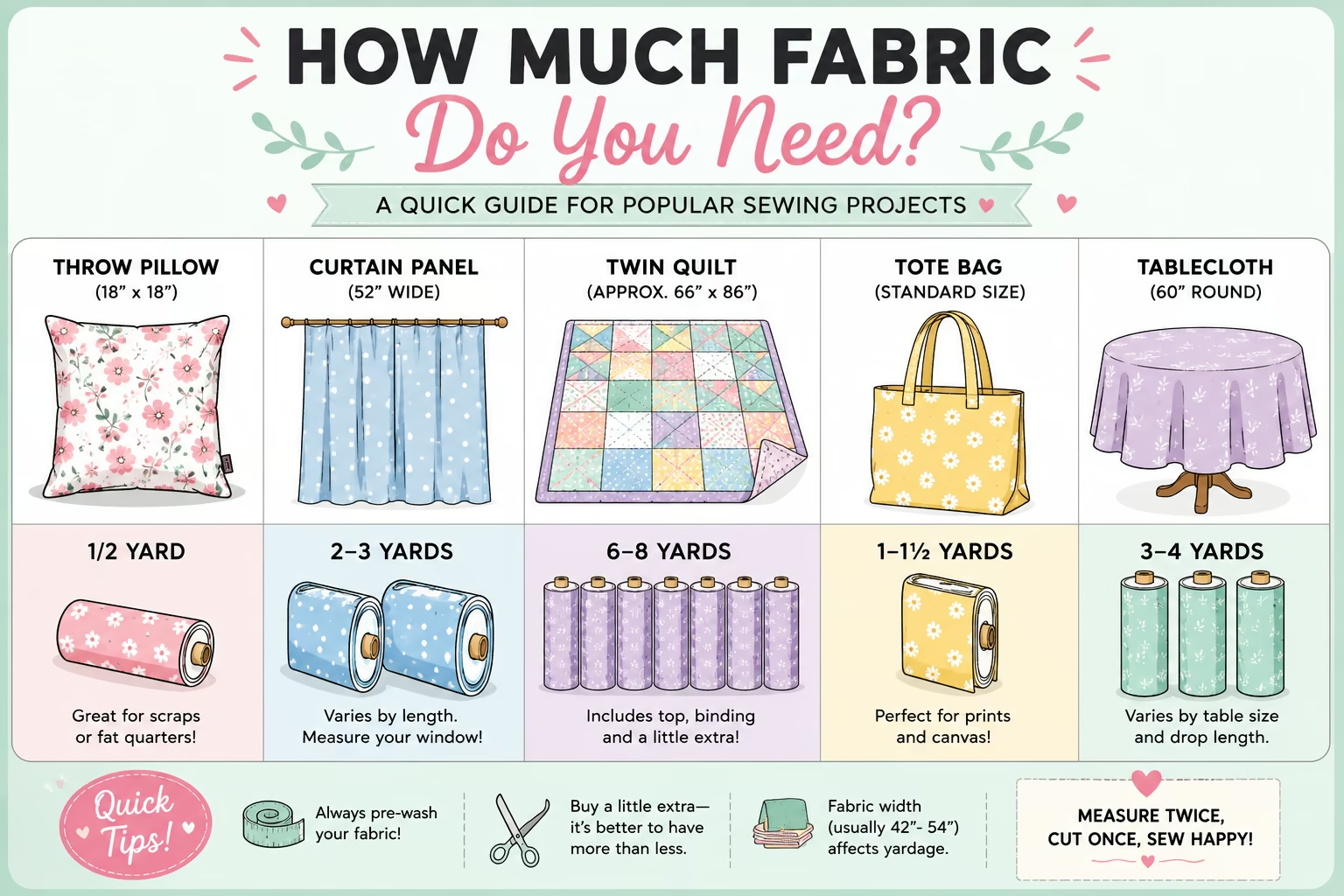
How Much Fabric Do You Need for a Throw Pillow?
A standard 18-inch square throw pillow requires 1/2 to 3/4 yard of fabric, depending on whether you’re making an envelope back or zipper closure. For a simple envelope-back pillow cover, 1/2 yard of 45-inch-wide fabric gives you enough material for the front panel and two overlapping back panels with seam allowances.
Pillow size breakdown:
- 14-inch pillow: 1/2 yard
- 18-inch pillow: 1/2 to 3/4 yard
- 20-inch pillow: 3/4 yard
- 24-inch pillow: 1 yard
If you’re working with directional prints or want to add piping, cording, or ruffles, increase your fabric purchase to 1 yard. This gives you flexibility for pattern placement and decorative elements without running short.
Common mistake: Forgetting to account for seam allowances. An 18-inch finished pillow actually requires cutting 19-inch squares (with 1/2-inch seam allowances on all sides), which changes your layout on the fabric.
Fabric Yardage Chart for Common Sewing Projects
Understanding how much fabric different projects require helps you budget and shop efficiently. The chart below shows typical yardage for popular beginner and intermediate sewing projects, assuming 45-inch-wide quilting cotton.
| Project | Fabric Width | Yardage Needed | Notes |
|---|---|---|---|
| Throw Pillow (18″) | 45″ | 1/2 – 3/4 yd | Add 1/4 yd for piping |
| Standard Pillowcase | 45″ | 3/4 yd | Makes one pillowcase |
| Simple Tote Bag | 45″ | 3/4 – 1 yd | Add 3/4 yd for lining |
| Apron (adult) | 45″ | 1 – 1.5 yd | Depends on style |
| Table Runner (72″) | 45″ | 1.5 yd | Plus 1/2 yd for backing |
| Curtain Panel (84″) | 45″ | 5 – 7 yd | For 1.5-2x fullness |
| Twin Quilt Top | 45″ | 6 – 8 yd | Patchwork style |
| Baby Quilt (36×48″) | 45″ | 2 – 3 yd | Plus 1.5 yd backing |
| Tablecloth (6-ft table) | 60″ | 3 – 4 yd | With 10″ drop |
| Simple A-Line Skirt | 45″ | 1.5 – 2 yd | Adult sizes 6-14 |
Choose 60-inch-wide fabric when available for larger projects like tablecloths and curtains. The extra width reduces the total yardage needed and often eliminates seaming.

Material: 35%Cotton 65%Polyester ; Each Sheet Size: 40” x 45” (100cm x 115cm). All fabric squares are trimmed manually which result in some raw edge and may have 0.5-1cm deviation exist.

PACKAGE CONTENTS: Set of 42 cotton fabric squares measuring 5x5 inches each, pre-cut and organized in 6 color series with 7 pieces per color including red, pink, yellow, green, blue, and purple

Fat Quarter Quilting Fabric Bundles
How to Calculate Fabric Needed for Curtains
Curtain panels require fabric equal to 1.5 to 3 times the finished length, depending on how full you want them to look. For a standard 84-inch-long curtain with medium fullness (2x), you’ll need approximately 5 to 6 yards per panel, assuming 45-inch-wide fabric.
Step-by-step curtain calculation:
- Measure the finished length from rod to floor (or desired endpoint)
- Add hem allowances: 8 inches for bottom hem, 4 inches for top hem/rod pocket
- Multiply by fullness factor: 1.5x for minimal gathering, 2x for standard, 3x for luxurious fullness
- Divide by 36 to convert inches to yards
Example: For an 84-inch window with 2x fullness:
- Finished length: 84 inches
- Plus hems: 84 + 8 + 4 = 96 inches
- Times fullness: 96 × 2 = 192 inches
- Convert to yards: 192 ÷ 36 = 5.3 yards (round up to 5.5 or 6 yards)
If you’re using 60-inch-wide home décor fabric, you can often cut panels horizontally (railroading), which dramatically reduces yardage. For the same 84-inch curtain, you’d only need the finished length plus hems, divided by the number of panels you can fit across the width.
Pro tip: Buy an extra 1/2 yard for pattern matching at seams if your fabric has stripes, plaids, or large repeating motifs.
Difference Between 45-Inch and 60-Inch Fabric Width for Yardage
Fabric width directly impacts how much yardage you need because wider fabric allows you to cut larger pieces or fit more pattern pieces side-by-side. Standard quilting cotton comes in 45-inch widths, while home décor fabrics, upholstery materials, and some apparel fabrics come in 60-inch widths.
How width affects yardage:
- 45-inch fabric: Standard for quilting cotton, requires more length to accommodate pattern pieces
- 60-inch fabric: Common for home décor, drapery, and upholstery, reduces total yardage by 20-30% for large projects
For a tablecloth covering a 6-foot table with a 10-inch drop on all sides, you’d need approximately 4 yards of 45-inch fabric (requiring a center seam), but only 2.5 yards of 60-inch fabric (seamless).
When to choose each width:
- Choose 45-inch for quilting, garments, and projects where seaming isn’t an issue
- Choose 60-inch for curtains, tablecloths, duvet covers, and upholstery where fewer seams look more professional
If your pattern specifies one fabric width and you’re substituting another, recalculate your yardage. Many pattern envelopes include yardage charts for multiple fabric widths.

How Much Extra Fabric Should You Buy for Pattern Matching?
Pattern matching requires an additional 1/4 to 1/2 yard of fabric per project, depending on the size of the repeat and the number of seams. Stripes, plaids, and large-scale prints need careful alignment at seams to look professional, which means you’ll waste more fabric during cutting.
Pattern matching guidelines:
- Small repeats (under 6 inches): Add 1/4 yard
- Medium repeats (6-12 inches): Add 1/3 to 1/2 yard
- Large repeats (over 12 inches): Add 1/2 to 3/4 yard
The repeat size is usually printed on the fabric bolt end or selvage. To calculate extra fabric needed, divide your total number of seams by 2, then multiply by the repeat measurement.
Example: A curtain panel with 3 horizontal seams and an 8-inch repeat needs approximately 12 extra inches (3 ÷ 2 × 8 = 12 inches, or 1/3 yard extra).
Common mistake: Buying exact yardage for striped or plaid fabric without considering that every pattern piece must be cut with stripes running in the same direction and matching at seams. This oversight often leaves you short by 1/2 yard or more.
Fabric Requirements for Making a Twin-Size Quilt
A twin-size quilt (approximately 68 × 90 inches) requires 6 to 8 yards of fabric for the patchwork top, 4 to 5 yards for the backing, and 1/2 yard for binding. The exact amount depends on your quilt design, block size, and whether you’re using a single fabric or multiple coordinating prints.
Twin quilt fabric breakdown:
- Patchwork top: 6-8 yards total (distributed across multiple fabrics)
- Backing: 4-5 yards of 45-inch fabric, or 2.5 yards of 108-inch wide backing
- Binding: 1/2 yard (yields about 360 inches of binding)
- Batting: One twin-size batt (72 × 90 inches)
For a scrappy quilt using 10 different fabrics, buy 1/2 to 3/4 yard of each print. For a simpler design with fewer fabrics, adjust proportions accordingly. Always buy backing fabric that’s 4-6 inches larger than your quilt top on all sides to accommodate quilting shifting.
Choose this approach if: You’re making a traditional patchwork quilt with blocks. If you’re making a whole-cloth quilt or using large fabric panels, you’ll need less total yardage but more of a single fabric.
Wide backing fabric (108 inches) eliminates the need for seaming your backing, which saves time and creates a cleaner finish. It costs more per yard but requires less total yardage.
Where to Buy Fabric by the Yard Online
Several reputable online retailers offer fabric by the yard with competitive pricing, though shipping costs and minimum cuts vary. Fabric.com, Joann.com, and Mood Fabrics are popular choices for beginners, offering both budget-friendly quilting cottons and premium designer fabrics.
Top online fabric sources:
- Fabric.com: Wide selection, frequent sales, free shipping over $49
- Joann.com: Coupons available, in-store pickup option, beginner-friendly
- Mood Fabrics: High-end designer fabrics, NYC-based, Project Runway supplier
- Spoonflower: Custom and indie designer prints, print-on-demand
- Fat Quarter Shop: Quilting-focused, excellent curated collections
Budget tip: Watch for seasonal sales (Black Friday, Memorial Day, end-of-bolt clearances) when quilting cotton drops to $3-5 per yard instead of the usual $10-12. Buy staple colors (white, black, neutrals) in bulk during sales.
Most online retailers sell fabric in 1/4-yard increments with a 1/2-yard minimum. Shipping typically costs $5-8 for standard delivery, so consolidate orders when possible. Some sellers offer free shipping on orders over $35-50.
Common mistake: Ordering fabric without checking reviews for color accuracy and fabric hand. Monitor screens display colors differently, so read customer reviews mentioning whether colors match the photos.

Perfect for all of your sewing and crafting projects

Perfect for all of your sewing and crafting projects

Material: 100% cotton, High quality, 5oz, Eco-friendly printing fabric, soft, strong, comfortable, washable and breathable, colors won’t fade after washing.
What Happens If You Don’t Buy Enough Fabric for Your Project?
Running short on fabric mid-project forces you to either redesign your project, add contrasting panels, or try to find matching fabric from the same dye lot. Most fabric stores don’t guarantee dye lot matches, so even the same fabric purchased weeks apart may have slight color variations.
Your options when you run short:
- Contact the original retailer and ask if they have more from the same dye lot
- Redesign with contrast panels or color-blocking to incorporate a coordinating fabric
- Make the project smaller by reducing dimensions or eliminating design elements
- Use the shortage strategically by placing it in less visible areas (pillow backs, quilt backing, garment lining)
For quilts, running short often means reducing the number of borders or making the quilt slightly smaller. For garments, you might need to use contrast fabric for facings, pockets, or cuffs. For home décor projects like curtains, you may need to add a contrasting band at the bottom.
Prevention strategy: Always buy 10-15% more fabric than your pattern requires. This extra yardage covers shrinkage from prewashing, cutting errors, and future repairs. For a 2-yard project, buy 2.25 to 2.5 yards.
If you’re working with discontinued or limited-edition fabric, buy everything you might need upfront, including extra for potential mistakes. You can always use leftover fabric for coordinating projects like throw pillows or table runners.
Do You Need More Fabric If It Has a Directional Print?
Directional prints require 15-25% more fabric because all pattern pieces must be cut with the design facing the same direction. Fabrics with one-way designs (animals walking, text, flowers growing upward) can’t be rotated during cutting, which reduces how efficiently you can lay out pattern pieces.
Directional print considerations:
- One-way designs: Add 20-25% more fabric
- Two-way designs (symmetrical): No extra needed
- Border prints: Add 1/2 to 1 yard to ensure proper placement
When cutting directional fabric, all pattern pieces must be laid out with their top edges facing the same direction on the fabric. This means you can’t flip pieces to fit into narrow spaces, resulting in more waste.
Example: A simple tote bag that normally requires 3/4 yard might need 1 yard if the fabric features cats all facing right. You can’t rotate the pattern pieces to save fabric without having upside-down cats on part of your bag.
Choose non-directional prints if: You’re a beginner or working with a tight fabric budget. Geometric prints, small florals, and abstract designs offer more cutting flexibility and less waste. If you’re working with knit fabric, directional prints become even more challenging because you must also consider the fabric’s stretch direction.
How Much Fabric for a Simple Tote Bag?
A basic tote bag measuring approximately 14 × 16 inches requires 3/4 to 1 yard of fabric for the exterior, plus an additional 3/4 yard if you’re adding a lining. Larger market-style totes (18 × 18 inches) need 1 to 1.25 yards for the exterior.
Tote bag fabric requirements:
- Small tote (12 × 14 inches): 3/4 yard exterior, 3/4 yard lining
- Medium tote (14 × 16 inches): 1 yard exterior, 3/4 yard lining
- Large market tote (18 × 18 inches): 1.25 yards exterior, 1 yard lining
- Straps: Usually cut from main fabric (included in yardage above)
For a reversible tote, double the exterior fabric amount since both sides will be visible. If you’re adding pockets, interfacing, or decorative elements, add an extra 1/4 yard.
Fabric selection tip: Choose medium-weight cotton, canvas, or home décor fabric for tote exteriors. Quilting-weight cotton works for linings but needs interfacing for structure. Heavy canvas or denim provides structure without interfacing.
Most tote bag patterns include yardage requirements, but if you’re designing your own, measure your desired finished dimensions, add seam allowances (1/2 inch on all sides), and account for the bag bottom, sides, and handles. When working with fabric that doesn’t feed properly, consider using a walking foot for even feeding of multiple layers.
Fabric Calculator for Beginners Who Don’t Understand Yardage
Fabric yardage measures length in yards (36 inches each) while width remains constant at either 45 or 60 inches. To calculate how much fabric you need, determine the total area your project requires, then divide by the fabric width to find the necessary length.
Simple calculation method:
- Measure your project dimensions (length × width in inches)
- Add seam allowances (typically 1/2 inch on each edge, so add 1 inch to both dimensions)
- Divide the project width by fabric width to see how many pieces fit side-by-side
- Multiply project length by number of rows needed
- Divide by 36 to convert inches to yards
- Add 10-15% for insurance
Example: Making a 50 × 60-inch throw blanket from 45-inch-wide fabric:
- Blanket needs to be 51 × 61 inches (with seam allowances)
- 61 inches wide ÷ 45-inch fabric = 2 widths needed
- 51 inches long × 2 = 102 inches total
- 102 ÷ 36 = 2.8 yards (round up to 3 yards)
Visual learners: Sketch your project on graph paper where each square represents 1 inch. Draw rectangles representing your fabric width (45 or 60 squares wide) and see how many lengths you need to stack to cover your project area.
Many online fabric calculators exist, but understanding the basic math helps you make smart decisions in the fabric store. When in doubt, round up to the nearest 1/4 yard.
Common Mistakes When Estimating Fabric Amounts
The most frequent error sewists make is forgetting to account for pattern repeats, directional prints, and fabric shrinkage when calculating yardage. Buying exact amounts without a buffer leaves no room for cutting errors or future repairs.
Top fabric estimation mistakes:
- Ignoring shrinkage: Cotton shrinks 3-5% when prewashed, so 2 yards becomes 1.9 yards
- Forgetting seam allowances: A 40-inch finished width needs 41 inches of fabric with 1/2-inch seams
- Not accounting for pattern matching: Stripes and plaids need extra for alignment
- Assuming all fabric is 45 inches wide: Home décor fabric is often 54-60 inches
- Cutting without a layout plan: Haphazard cutting wastes fabric
- Buying exact pattern amounts: No buffer for mistakes or repairs
- Ignoring fabric nap or direction: One-way designs need more yardage
Prevention strategy: Always add 10-15% to your calculated amount. For a 2-yard project, buy 2.25 to 2.5 yards. This buffer covers shrinkage, cutting errors, and gives you fabric for future repairs or coordinating projects.
Before cutting, lay out all pattern pieces on your fabric to confirm everything fits. This dry run often reveals layout inefficiencies you can correct before making the first cut. If you’re experiencing thread bunching issues during sewing, having extra fabric allows you to practice tension adjustments without sacrificing your main project pieces.
How Much Fabric Do You Need for a Tablecloth for a 6-Foot Table?
A 6-foot rectangular table (72 × 30 inches) requires 3 to 4 yards of 60-inch-wide fabric for a tablecloth with a 10-inch drop on all sides. If you’re using 45-inch-wide fabric, you’ll need approximately 4.5 to 5 yards and will have a center seam.
Tablecloth calculation:
- Table dimensions: 72 × 30 inches
- Add drop on all sides: 10 inches × 2 = 20 inches added to each dimension
- Finished tablecloth: 92 × 50 inches
- Add hem allowances: 2 inches on all sides = 96 × 54 inches
For 60-inch-wide fabric:
- Width needed: 54 inches (fits within 60-inch width)
- Length needed: 96 inches = 2.67 yards (round up to 3 yards for hems and squaring)
For 45-inch-wide fabric:
- Need to seam two widths together
- 96 inches × 2 = 192 inches ÷ 36 = 5.3 yards (round up to 5.5 yards)
Drop length guide:
- Casual dining: 8-10 inch drop
- Formal dining: 12-15 inch drop
- Floor-length: Measure table height minus 1 inch
Choose 60-inch-wide home décor fabric when possible to avoid center seams. If you must seam, use a full width in the center and add partial widths on each side for a more balanced look.
Is Prewashing Fabric Going to Change How Much You Need?
Prewashing cotton fabric causes 3-5% shrinkage, which means 2 yards of fabric becomes approximately 1.9 yards after washing. Always buy extra fabric to compensate for this shrinkage, especially for projects where precise measurements matter like garments and fitted home décor items.
Shrinkage by fabric type:
- Quilting cotton: 3-5% shrinkage
- Cotton flannel: 5-8% shrinkage
- Linen: 4-6% shrinkage
- Cotton/poly blends: 2-3% shrinkage
- Polyester, nylon: Minimal shrinkage (under 1%)
When to prewash:
- Garments that will be laundered regularly
- Quilts and bedding
- Kitchen linens (towels, napkins, aprons)
- Any project where color bleeding would be catastrophic
When to skip prewashing:
- Quilts you want to have a crinkled, vintage look after the first wash
- Projects using fabric stabilizer or starch (prewashing removes these)
- Wool or dry-clean-only fabrics
To prewash, launder fabric the same way you’ll care for the finished project. Use the same water temperature and dryer settings. Press the fabric after drying to remove wrinkles before cutting.
Pro tip: Buy an extra 1/4 yard for every 2 yards of cotton fabric if you plan to prewash. This buffer covers shrinkage and the inevitable fraying at cut edges during washing. When changing your sewing machine needle for different fabric weights, having extra prewashed fabric allows you to test stitch quality before working on your main project.
Conclusion
Calculating how much fabric you need doesn’t have to be intimidating. Start with your project dimensions, add seam allowances and hems, account for fabric width, and always add 10-15% extra as a buffer. The charts and calculations in this guide give you a solid foundation for estimating yardage for common projects, from throw pillows requiring 1/2 yard to twin quilts needing 6-8 yards.
Remember that fabric width (45 inches versus 60 inches) dramatically impacts total yardage requirements, and special considerations like directional prints, pattern matching, and prewashing shrinkage all require additional fabric. When in doubt, round up to the nearest quarter yard. Having extra fabric is always better than running short mid-project.
Your next steps:
- Measure your project dimensions carefully, including all seam allowances
- Determine your fabric width (45 or 60 inches)
- Use the charts in this guide or calculate yardage using the formulas provided
- Add 10-15% extra for insurance
- Consider special factors (directional prints, pattern matching, prewashing)
- Buy your fabric and create something beautiful
Start with simpler projects like throw pillows or tote bags to build your estimation skills, then progress to larger projects like quilts and curtains. With practice, calculating fabric requirements becomes second nature, and you’ll shop with confidence knowing you have exactly what you need.


