
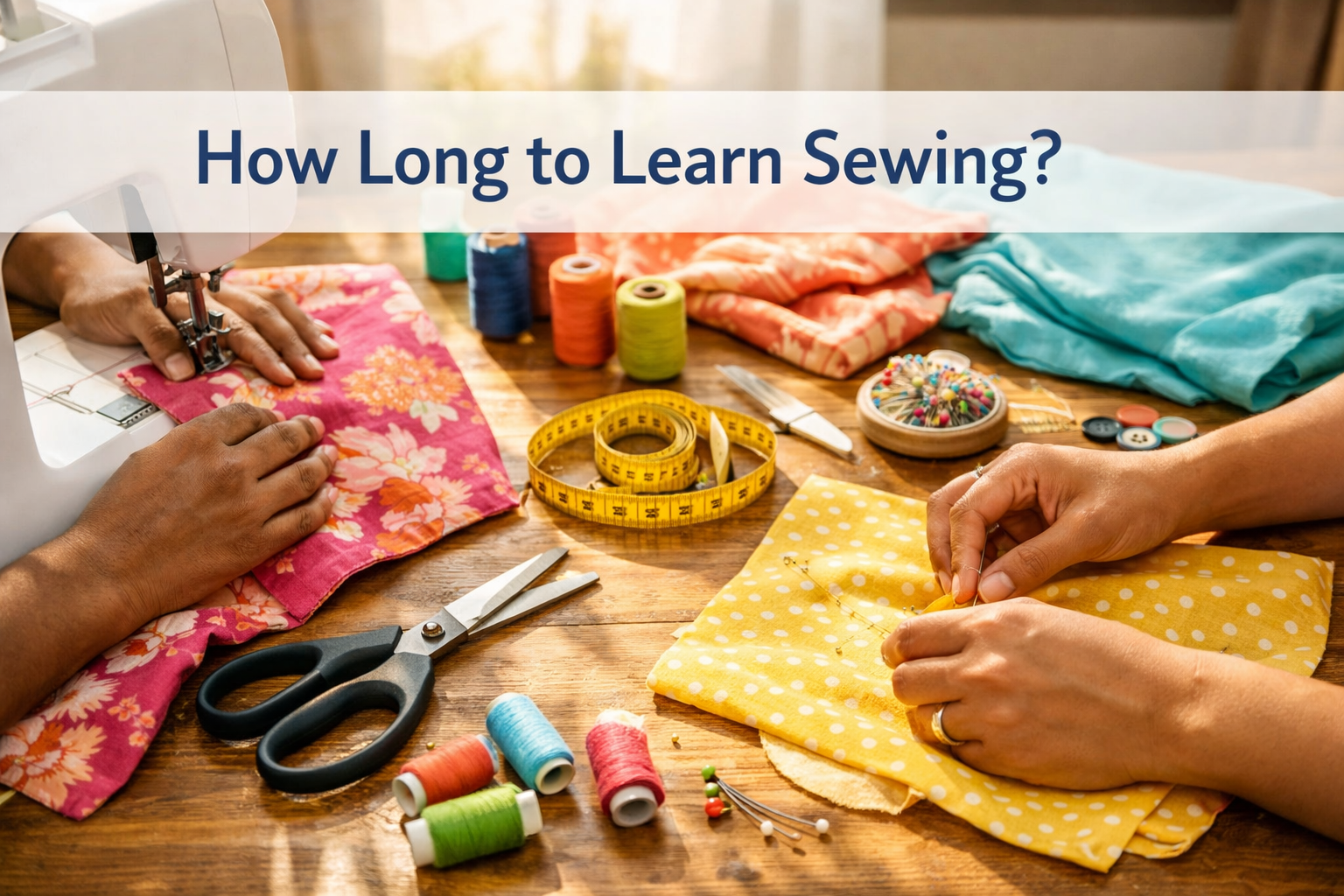
Most beginners can learn basic hand-sewing skills in 2-4 weeks and start using a sewing machine confidently within 1-3 months of regular practice. The timeline to learn sewing depends heavily on how often you practice, whether you’re learning hand-sewing or machine-sewing, and what level of skill you’re aiming for, simple repairs take weeks, while making tailored garments can take 1-2 years of consistent work.
Key Takeaways
- Basic hand-sewing skills (buttons, hems, repairs) typically take 2-4 weeks with regular practice
- Beginner machine sewing requires 1-3 months to feel comfortable with straight seams and simple projects
- Daily practice of 30-60 minutes accelerates learning far more than sporadic weekend sessions
- Making your first wearable garment usually happens within 3-6 months for dedicated beginners
- Intermediate skills (zippers, darts, fitting adjustments) develop around the 6-12 month mark
- Advanced techniques like tailoring and pattern drafting can take 1-3 years to master
- Age is irrelevant,people successfully start sewing in their teens, 40s, 60s, and beyond
- Self-teaching is viable with online resources, though classes can speed up the learning curve
- Common mistakes (skipping practice, starting with complex projects, ignoring machine maintenance) slow progress significantly
- Hand-sewing vs. machine-sewing have different learning curves, but most beginners benefit from learning both
How Long Does It Take to Learn Basic Sewing Skills for Beginners?
Complete beginners can learn fundamental hand-sewing skills in 2-4 weeks with consistent practice of 20-30 minutes daily. These basics include threading a needle, tying knots, sewing on buttons, hemming pants by hand, and making simple repairs like closing small tears.
For machine sewing, expect to spend 1-3 months becoming comfortable with your equipment. During this period, you’ll learn to thread the machine, wind bobbins, adjust tension, sew straight lines, and complete beginner-friendly projects like pillowcases, tote bags, or simple aprons.
What “basic” actually means:
- Hand-sewing: buttons, hems, basting stitches, running stitch, backstitch
- Machine basics: straight seams, turning corners, backstitching, understanding feed dogs
- Reading simple patterns and cutting fabric accurately
- Understanding seam allowances (typically 5/8 inch for garments)
Common mistake: Many beginners try to learn everything at once instead of mastering one skill before moving to the next. Focus on perfecting straight seams before attempting curves or zippers.
Can You Learn to Sew in a Month?
Yes, you can learn foundational sewing skills in one month if you practice daily and focus on specific, achievable goals. In 30 days of dedicated practice (45-60 minutes per day), most people can complete 3-5 beginner projects and feel confident with basic machine operation.
A realistic one-month learning plan includes:
Week 1: Machine setup, threading, tension adjustment, sewing straight lines on scrap fabric
Week 2: First project (pillowcase or simple tote bag), learning to pivot corners
Week 3: Second project with slightly more complexity (zippered pouch or drawstring bag)
Week 4: Simple garment alteration (hemming pants) or third project (apron or pajama pants)
However, “learning to sew” in a month means acquiring basics, not mastery. You won’t be making fitted dresses or tailored jackets, but you will have practical skills for repairs and simple projects.
Choose a month-long intensive if: You have a specific deadline (making gifts, preparing for a trip) or learn best with structured, daily practice. Skip it if you prefer a slower, exploratory pace without pressure.
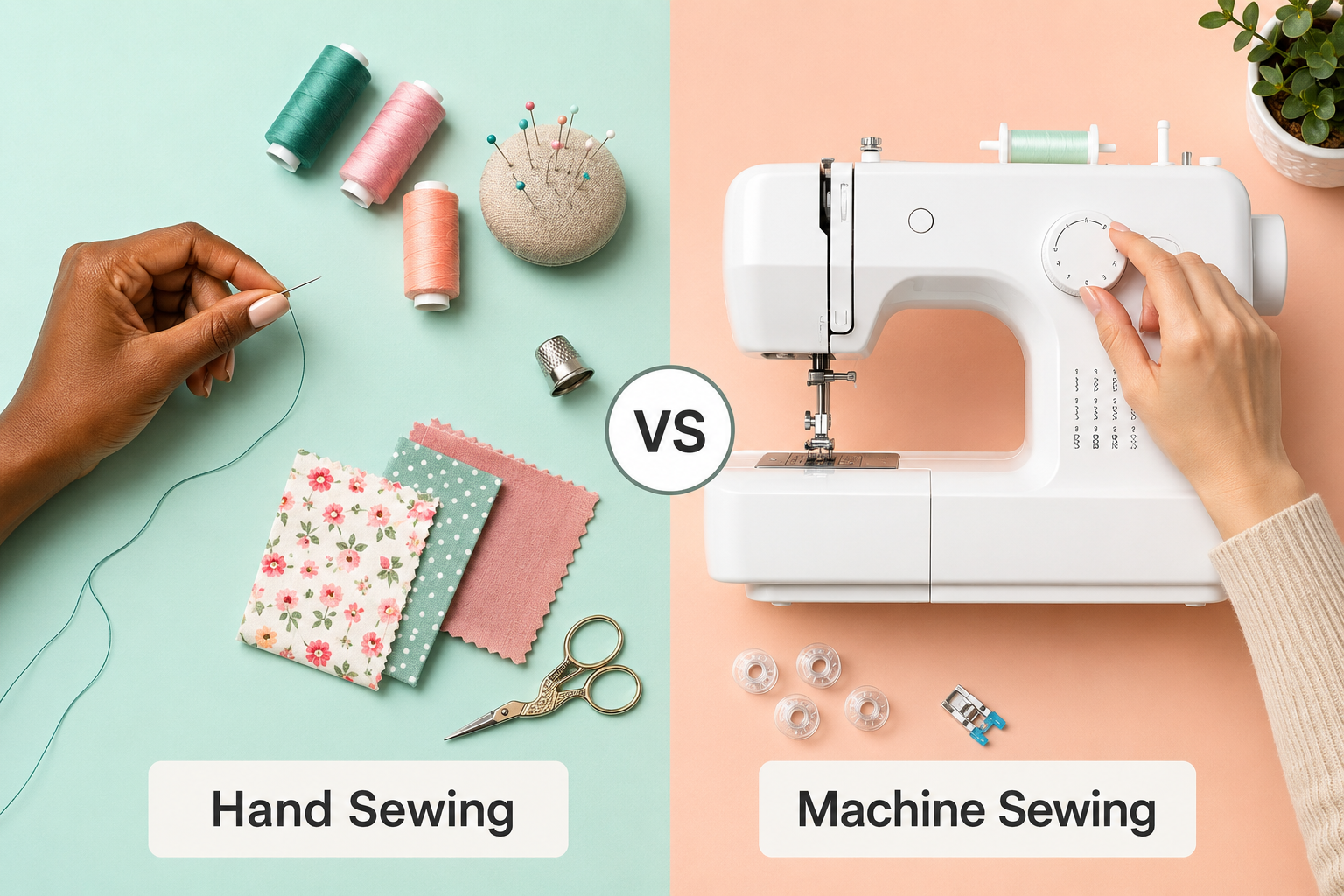
Difference Between Hand Sewing and Machine Sewing Learning Time
Hand-sewing has a gentler learning curve and can be practiced anywhere without equipment, making it accessible within 2-4 weeks for basic competency. Machine sewing requires understanding mechanical components, troubleshooting issues like thread breaking, and developing muscle memory for foot pedal control, typically taking 1-3 months to feel comfortable.
Hand-sewing advantages:
- No equipment investment needed initially
- Portable, practice anywhere
- Fewer variables to troubleshoot
- Immediate tactile feedback
- Essential for finishing work and repairs
Machine-sewing advantages:
- Much faster for long seams and large projects
- More consistent stitch quality once mastered
- Required for most garment construction
- Opens up more project possibilities
Most sewers need both skills. Hand-sewing is perfect for buttons, hems, and basting, while machine-sewing handles construction seams, topstitching, and bulk fabric work. Learning hand-sewing first (2-3 weeks) before moving to a machine gives you foundational understanding of how stitches work and builds confidence.
Edge case: If you only want to do repairs and alterations, hand-sewing alone may suffice. If you want to make clothes or home décor, prioritize machine skills after learning hand-sewing basics.

✅Newly Upgraded Sewing Kit- Including more than 200pcs sewing accessories in this sewing set -43XL sewing thread ( Extra Black & White threads,5 rainbown threads ,and the length has been upgraded from 120 yards to 150 yards),2 Professional scissors,1 seam ripper ,1 pin cushion,1 tape mesure,30 needles,30 buttons etc.
Simple techniques and projects for first-time sewers

【Package List】 A total of 109 sewing supplies: 1 exquisite storage case, 1 handheld sewing machine, 1 fabric scissors, 1 yarn thread cutter, 1 sewing seam ripper, 22 rolls of polyester sewing threads, 12 metal bobbins with sewing threads, 30 assorted hand sewing needles, 26 buttons, 10 safety pins, 2 sewing thimbles, 1 needle threaders, 1 soft tape measure.
How Much Time Per Day Should I Practice Sewing to Get Good?
Practicing 30-60 minutes daily produces faster, more consistent progress than longer weekend sessions. Daily practice builds muscle memory, reinforces techniques, and prevents the frustration of relearning basics each time you sit down to sew.
Recommended practice schedules by goal:
- Casual hobbyist: 20-30 minutes, 3-4 times per week (3-6 months to basic competency)
- Committed beginner: 45-60 minutes daily (1-3 months to basic competency)
- Accelerated learner: 90-120 minutes daily (3-6 weeks to basic competency)
Quality matters more than quantity. Thirty focused minutes practicing one technique (like sewing curves or installing zippers) beats two distracted hours jumping between projects.
Practice structure that works:
- Warm-up (5-10 min): Sew practice lines on scrap fabric, straight, curved, corners
- Skill focus (20-30 min): Work on one specific technique or project step
- Cool-down (5-10 min): Clean your workspace, note what to practice next
Common mistake: Practicing only when starting new projects. Dedicated technique practice on scrap fabric accelerates learning far more than only sewing “real” items where mistakes feel costly.
Best Sewing Projects for Complete Beginners to Start With
Start with projects that use straight seams, forgiving fabrics (quilting cotton or medium-weight linen), and minimal fitting requirements. The best first projects take 1-3 hours to complete and teach fundamental skills without overwhelming complexity.
Top beginner projects ranked by difficulty:
- Fabric coasters (30-45 min): Straight seams, turning corners, topstitching
- Pillowcase (1-2 hours): French seams, hemming, working with larger fabric pieces
- Drawstring bag (1.5-2 hours): Casing, threading cord, reinforcement stitching
- Simple tote bag (2-3 hours): Handles, box corners, reinforced stress points
- Elastic-waist skirt (3-4 hours): Gathering, elastic casing, first wearable garment
- Pajama pants (3-5 hours): Inseam, crotch seam, elastic waistband, pattern reading
Avoid as first projects: Anything with zippers, buttonholes, fitted waistbands, or slippery fabrics like satin. Also skip quilts (too time-intensive for beginners) and stuffed animals (require precision curves).
Project selection rule: Choose something you’ll actually use. A tote bag you carry daily provides more motivation than a decorative item that sits in a drawer. For more guidance on getting started, check out resources for beginner sewing.

Pre-Cut Consistency:Each piece is a 10×10-inch precut fabric square (with a tolerance of 0.2 inches). These blue fabric squares serve as quilt squares, charm pack fabric, and layer cake fabric all at once; they’re ideal for quilt kits with fabric and pattern, and their uniform size supports seamless assembly whether you're using them as blue fabric scraps, quilting fabric, or authentic cotton fabric — including gingham fabric prints and other vintage fabric–inspired motifs.

Work With Fabric: Our fabric glue is suitable for all types of fabrics, including cotton, flannel, denim, leather, polyester, dolls, fabric, nylon, and other materials for repairs. Our fabric glue serves as the perfect alternative to traditional needle and thread, saving you time and effort.

Made of 100% cotton with a sateen weave.200-thread count。Note: If you understand the nature of cotton, you should use microwave testing it.It is safe for microwave 。
Is Sewing Hard to Learn If You Have No Crafting Experience?
Sewing is moderately challenging for complete beginners but doesn’t require prior crafting experience to learn successfully. The main hurdles are understanding three-dimensional construction from two-dimensional fabric, developing hand-eye coordination for machine control, and building patience for precise measuring and cutting.
What makes sewing easier than other crafts:
- Immediate visible results (you can see your seam right away)
- Forgiving materials (most mistakes can be unpicked and redone)
- Abundant free learning resources (YouTube tutorials, blogs, patterns)
- Practical applications (repairs, alterations, gifts)
What makes sewing harder:
- Initial equipment investment (machine, tools, fabric)
- Mechanical troubleshooting when machines malfunction
- Precision required for professional-looking results
- Spatial reasoning for pattern layout and garment construction
People without crafting backgrounds often succeed because they approach sewing without preconceptions. The key is starting with appropriate projects, accepting that early attempts won’t be perfect, and celebrating small wins like a straight seam or completed zipper.
Reality check: Your first projects will have wobbly seams and imperfect corners. This is normal. Most sewers look back at early work and cringe, it’s part of the learning process.
How Long Until I Can Make My Own Clothes After Starting Sewing?
Most beginners can complete their first simple wearable garment within 3-6 months of starting to sew, assuming regular practice of 3-5 hours per week. This timeline applies to basic garments like elastic-waist skirts, pajama pants, simple tops, or loose dresses without fitted elements.
Realistic garment timeline:
- 3-4 months: Elastic-waist skirt, pajama pants, simple apron
- 6-9 months: Loose-fitting dress, basic top, unlined jacket
- 9-12 months: Fitted skirt with zipper, shirt with buttons and collar
- 12-18 months: Fitted dress, pants with fly zipper, tailored blazer
- 18-24 months: Complex garments with lining, interfacing, advanced fitting
The jump from simple projects to garments is significant because clothing requires pattern reading, body measurements, fitting adjustments, and understanding how fabric drapes on the body. Many beginners successfully make their first garment sooner but find it doesn’t fit well, fitting skills take longer to develop than construction skills.
Speed up the timeline by:
- Taking a garment-construction class (in-person or online)
- Starting with loose-fitting styles that don’t require precise fitting
- Making muslins (test garments) before cutting expensive fabric
- Learning to read your body measurements and adjust patterns accordingly
Common mistake: Jumping to garments before mastering basic seam finishes, understanding seam allowances, and learning to press seams properly. These foundational skills make garment construction much easier.

Common Mistakes Beginners Make When Learning to Sew
The biggest mistake beginners make is starting with projects that are too complex, leading to frustration and abandoned half-finished items. Other common errors include skipping fabric prep (pre-washing), neglecting machine maintenance, and not pressing seams as they sew.
Top mistakes that slow learning:
- Skipping practice on scraps: Jumping straight to projects without testing stitches, tension, or techniques on scrap fabric first
- Ignoring the manual: Not reading the machine manual leads to incorrect threading, tension problems, and mechanical issues
- Using dull needles: Continuing with bent or dull needles causes skipped stitches, fabric damage, and frustration, change needles regularly
- Poor fabric choices: Starting with slippery, stretchy, or difficult fabrics instead of stable quilting cotton
- Inadequate lighting: Sewing in dim conditions causes eye strain and imprecise work
- Rushing measurements: Not measuring twice and cutting once leads to wasted fabric
- Skipping pressing: Not pressing seams open or to the side creates bulky, unprofessional results
- Comparing to experts: Expecting early projects to look like professional work instead of celebrating progress
Troubleshooting mindset: When something goes wrong (and it will), approach it as a learning opportunity rather than a failure. Most sewing problems have logical solutions, tangled thread usually means incorrect threading, puckered seams often indicate tension issues, and skipped stitches typically signal a dull or incorrect needle.
For help with common issues, explore sewing machine troubleshooting resources.
Do I Need to Take a Class or Can I Teach Myself Sewing at Home?
Self-teaching sewing at home is completely viable in 2026 thanks to abundant online resources, video tutorials, and supportive online communities. However, taking even one beginner class (in-person or online) can accelerate learning by 2-3 months by correcting bad habits early and providing personalized feedback.
Self-teaching advantages:
- Learn at your own pace without schedule constraints
- Free or low-cost resources (YouTube, blogs, library books)
- Practice whenever convenient
- Freedom to explore topics that interest you most
Self-teaching challenges:
- No immediate feedback on technique
- Harder to troubleshoot machine problems without expert help
- Risk of developing bad habits that must be unlearned later
- Can feel isolated without a sewing community
Class advantages:
- Immediate feedback and error correction
- Hands-on help with machine threading and tension
- Structured curriculum ensures you don’t skip foundational skills
- Built-in community and accountability
- Access to equipment before investing in your own
Hybrid approach (recommended): Take one beginner class or workshop to learn machine basics, proper posture, and fundamental techniques, then continue learning independently with online resources. This combines the benefits of expert guidance with the flexibility of self-paced learning.
Choose self-teaching if: You’re comfortable with independent learning, have strong problem-solving skills, and can access online communities for questions. Choose classes if you learn best with structure, want faster progress, or feel overwhelmed by the abundance of online information.
What Age Is Too Late to Start Learning How to Sew?
No age is too late to start learning to sew, people successfully begin in their teens, 30s, 50s, 70s, and beyond. The learning timeline remains similar across age groups, though older beginners sometimes progress faster due to better focus, patience, and fine motor skills developed over a lifetime.
Age-related considerations:
- Teens and 20s: Often learn quickly but may struggle with patience for precise work
- 30s-40s: Balance learning speed with busy schedules; often highly motivated by practical goals (making kids’ clothes, home décor)
- 50s-60s: Frequently have more time to practice and appreciate the meditative aspects of sewing
- 70s+: May need accommodations for vision (better lighting, magnification) or arthritis (ergonomic tools) but learn just as successfully
Adaptations for older learners:
- Invest in excellent lighting and magnifying lamps
- Choose ergonomic scissors and rotary cutters to reduce hand strain
- Use needle threaders and automatic needle-threading machines
- Take more frequent breaks to prevent fatigue
- Select machines with larger stitch displays and simpler controls
Many older beginners report that sewing provides cognitive benefits, stress relief, and a sense of accomplishment. The tactile, creative nature of sewing appeals across generations, and online communities welcome sewers of all ages.
Reality check: Physical limitations (vision, dexterity, mobility) matter more than age itself. With appropriate tools and accommodations, nearly anyone can learn to sew regardless of when they start.
How Long Does It Take to Learn Advanced Sewing Techniques Like Tailoring?
Advanced techniques like tailoring, pattern drafting, and couture finishing typically require 1-3 years of consistent practice beyond basic sewing skills. Tailoring specifically, including pad-stitching lapels, setting sleeves properly, and creating structured garments, demands understanding of garment construction, fabric behavior, and precise hand-sewing that takes 18-24 months to develop.
Advanced skill timeline:
- 6-12 months: Installing invisible zippers, sewing knit fabrics, basic fitting adjustments, lining garments
- 12-18 months: Drafting simple patterns, advanced darts and pleats, welt pockets, bound buttonholes
- 18-24 months: Tailoring jackets, setting sleeves, pad-stitching, working with interfacing and canvas
- 2-3 years: Couture techniques, draping, complex pattern alterations, working with difficult fabrics (silk, leather)
What separates advanced from intermediate:
Advanced sewers understand why techniques work, not just how to execute them. They can troubleshoot fitting issues, adapt patterns to different fabrics, and make construction decisions based on fabric behavior and desired outcome.
Accelerate advanced learning by:
- Taking specialized workshops in tailoring, pattern-making, or couture techniques
- Studying vintage sewing books (often more detailed than modern resources)
- Deconstructing well-made garments to see professional construction methods
- Practicing the same technique repeatedly until it becomes automatic
Common mistake: Rushing to advanced techniques before mastering intermediate skills. Solid foundation in seam finishes, pressing, and basic fitting makes advanced work much easier.
Why Is My Sewing Progress So Slow Compared to Others?
Sewing progress varies widely based on practice frequency, natural spatial reasoning ability, quality of instruction, and project selection, comparing your timeline to others’ rarely accounts for these variables. If your progress feels slow, the most common causes are inconsistent practice (less than 2-3 times per week), starting with projects above your skill level, or spending time on projects rather than deliberate technique practice.
Factors that speed up learning:
- Daily practice: Even 20 minutes daily beats 3-hour weekend sessions
- Deliberate practice: Focused technique work on scraps, not just project completion
- Quality instruction: Good tutorials or classes that explain why, not just how
- Appropriate projects: Working slightly above but not far beyond current skill level
- Good equipment: A reliable machine that doesn’t constantly malfunction
- Immediate feedback: Having someone correct mistakes before they become habits
Factors that slow learning:
- Sporadic practice: Long gaps between sewing sessions require relearning basics
- Poor-quality materials: Cheap thread, dull scissors, and difficult fabrics create unnecessary frustration
- Perfectionism: Refusing to move forward until each project is flawless
- Skipping fundamentals: Jumping to garments without mastering straight seams and basic techniques
- Machine problems: Spending more time troubleshooting than sewing
Comparison trap: Social media shows finished projects, not the hours of practice, unpicked seams, and failed attempts behind them. Most sewers share successes, not the learning process.
Progress check: If you’ve been sewing 3-4 times per week for three months and still struggle with basic straight seams, consider taking a class or having an experienced sewer watch you work, you may have developed a habit that’s holding you back.
Sewing Machine vs Hand Sewing: Which Should Beginners Learn First?
Beginners benefit most from learning basic hand-sewing first (2-3 weeks), then transitioning to machine sewing. Hand-sewing builds understanding of how stitches work, requires no equipment investment, and teaches essential skills needed for finishing work even after you master machine sewing.
Start with hand-sewing if:
- You don’t yet own a sewing machine
- You want to test your interest before investing in equipment
- You primarily need repair and alteration skills
- You prefer a gentle, low-pressure introduction to sewing
Start with machine-sewing if:
- You already own a machine
- You have specific project goals requiring machine work (curtains, quilts, garments)
- You learn best by diving into the main skill
- You have access to in-person help for machine setup and troubleshooting
Ideal progression:
- Weeks 1-2: Hand-sewing basics (threading, knotting, running stitch, backstitch, sewing on buttons)
- Week 3: Introduction to sewing machine (threading, bobbin winding, straight stitching)
- Weeks 4-8: Machine practice with simple projects while continuing to use hand-sewing for finishing
- Ongoing: Use both skills as appropriate, machine for construction, hand-sewing for hems, buttons, and invisible finishing
Reality check: Professional sewers use both methods. Machine sewing is faster for construction, but hand-sewing produces invisible hems, secure buttons, and delicate repairs that machines can’t match. Learning both makes you a more versatile sewer.
For machine basics, learn about essential components like how to insert a needle properly.

Complete Sewing Kit-The travel sewing kit contains all the necessary tools that are required for performing basic repairs-a scissor, threads (18 colors), 30 sewing needles, shirt buttons, seam ripper, needle threader tools and a foldable tape measure.

𝑩𝒊𝒓𝒕𝒉𝒅𝒂𝒚 𝑮𝒊𝒇𝒕𝒔 𝑰𝒅𝒆𝒂𝒔: This sewing kit is terrific gifts for people who travel frequently, mother, grandmother, backpacker, adults, kids and teen girls! The emergency kit is also suitable for both men and women, beginners and professionals alike, and it is definitely something that everyone needs in their life

🧰 All-in-One Mending Kit with Organized Case Includes 24 thread colors, needles, scissors, tape measure, safety pins, buttons, threaders, seam ripper, thimbles, and more — neatly stored so you can find tools fast
Realistic Timeline to Go From Beginner to Intermediate Sewing Level
Most sewers reach intermediate level after 6-12 months of consistent practice (3-5 hours per week), at which point they can complete garments with zippers and buttonholes, make basic fitting adjustments, work confidently with patterns, and troubleshoot common machine problems independently.
Beginner level (0-3 months):
- Sews straight seams and simple curves
- Completes basic projects (pillowcases, tote bags, simple skirts)
- Understands machine threading and basic tension
- Follows simple patterns with guidance
- Makes frequent mistakes but learns from them
Intermediate level (6-12 months):
- Installs zippers and makes buttonholes
- Sews fitted garments with darts and shaping
- Makes basic pattern adjustments for fit
- Works with various fabric types (knits, lightweight wovens, heavier materials)
- Troubleshoots machine problems independently
- Understands when to use different stitches and techniques
- Produces wearable, presentable garments
Advanced level (18+ months):
- Drafts or significantly alters patterns
- Tailors structured garments (blazers, coats)
- Uses couture techniques and hand-finishing
- Works confidently with challenging fabrics (silk, leather, sheers)
- Teaches others or takes on commission work
- Understands garment construction theory, not just execution
Acceleration factors:
Taking classes or workshops can compress the beginner-to-intermediate timeline to 4-6 months. Conversely, inconsistent practice (less than once per week) can extend it to 18-24 months.
Milestone check: You’ve reached intermediate level when you can look at a garment in a store and understand how it was constructed, then replicate similar techniques in your own projects.
Regular machine maintenance becomes increasingly important as you advance and tackle more complex projects.
Frequently Asked Questions
How many hours does it take to become good at sewing?
Becoming “good” at basic sewing typically requires 60-100 hours of practice spread over 3-6 months. This includes time spent on technique practice, completing projects, and learning from mistakes. Reaching intermediate level usually takes 150-300 hours over 6-12 months.
Can I learn to sew without a sewing machine?
Yes, you can learn hand-sewing without a machine and complete repairs, alterations, hems, and even simple garments using hand-stitching. However, machine sewing is significantly faster for most projects and opens up more possibilities for garment construction and home décor.
What’s the hardest part of learning to sew?
Most beginners find understanding three-dimensional garment construction from flat pattern pieces the hardest concept to grasp. Mechanically, achieving consistent tension and troubleshooting machine problems frustrate many learners initially.
How long does it take to sew a dress as a beginner?
A simple, loose-fitting dress takes most beginners 8-12 hours spread over several sessions, including cutting, construction, and finishing. This assumes you’ve already practiced basic skills for 2-3 months. Fitted dresses with zippers and lining take 15-20 hours.
Is sewing an expensive hobby to learn?
Sewing can be learned affordably with a basic machine ($100-200), essential tools ($50-75), and inexpensive fabric for practice. However, costs increase if you pursue garment-making with quality fabrics, specialty tools, and pattern collections. Budget $300-500 for the first year.
Can you learn to sew from YouTube alone?
Yes, many successful sewers are entirely self-taught using YouTube tutorials, blogs, and online communities. The key is choosing quality instructors, practicing consistently, and joining online groups where you can ask questions and get feedback.
How do I know if I’m ready to move beyond beginner projects?
You’re ready for intermediate projects when you can sew straight seams consistently, understand how to adjust tension, complete beginner projects without constant reference to instructions, and feel confident troubleshooting basic problems independently.
What’s the best age for kids to start learning to sew?
Children as young as 6-7 can learn basic hand-sewing with supervision. Machine sewing is typically appropriate from age 8-10, depending on the child’s maturity, fine motor skills, and ability to follow safety instructions carefully.
How often should I practice sewing to maintain my skills?
Sewing at least once per week maintains current skills. Less frequent practice (every 2-3 weeks) leads to some skill decay, requiring warm-up time to regain proficiency. Daily or near-daily practice continues to build skills.
Why do my seams look worse than tutorial videos?
Tutorial videos often show experienced sewers, use ideal lighting and camera angles, and may edit out mistakes. Your seams will improve with practice, compare your current work to your first projects rather than to experts with years of experience.
Do I need to learn pattern-making to sew clothes?
No, you can sew garments successfully using commercial patterns, free online patterns, or by copying existing clothes. Pattern-making is an advanced skill that’s helpful but not required for most home sewers.
How long before sewing feels natural and not frustrating?
Most sewers report that sewing begins feeling natural rather than frustrating around the 3-4 month mark with regular practice. The initial learning curve is steep, but once basic machine operation becomes automatic, the creative aspects become more enjoyable.
Conclusion
Learning to sew is a journey measured in months and years, not days or weeks. Most beginners achieve basic competency in 1-3 months with regular practice, can make simple garments within 3-6 months, and reach intermediate level after 6-12 months of consistent work. The timeline depends heavily on practice frequency, project selection, and learning approach, daily practice of 30-60 minutes produces faster results than sporadic weekend sessions.
The most important factors for success are starting with appropriate projects, practicing techniques deliberately on scrap fabric, maintaining your equipment properly, and celebrating progress rather than comparing yourself to experts. Whether you’re 15 or 75, have crafting experience or none, you can learn to sew successfully with patience and consistent effort.
Your next steps:
- This week: Learn basic hand-stitches (running stitch, backstitch) and sew on a button
- This month: If you have a machine, complete your first simple project (pillowcase or tote bag); if not, practice hand-sewing repairs and hems
- Next three months: Build a consistent practice schedule (3-5 times per week) and complete 3-5 beginner projects
- Six months: Attempt your first simple garment (elastic-waist skirt or pajama pants)
Remember that every expert sewer started exactly where you are now, with wobbly seams and frustrating mistakes. The difference between beginners and advanced sewers isn’t talent, it’s simply hours of practice and a willingness to learn from each project. Start small, practice often, and enjoy the process of building a valuable lifelong skill.
For more guidance on your sewing journey, explore sewing tips and sewing techniques to continue developing your skills.


