
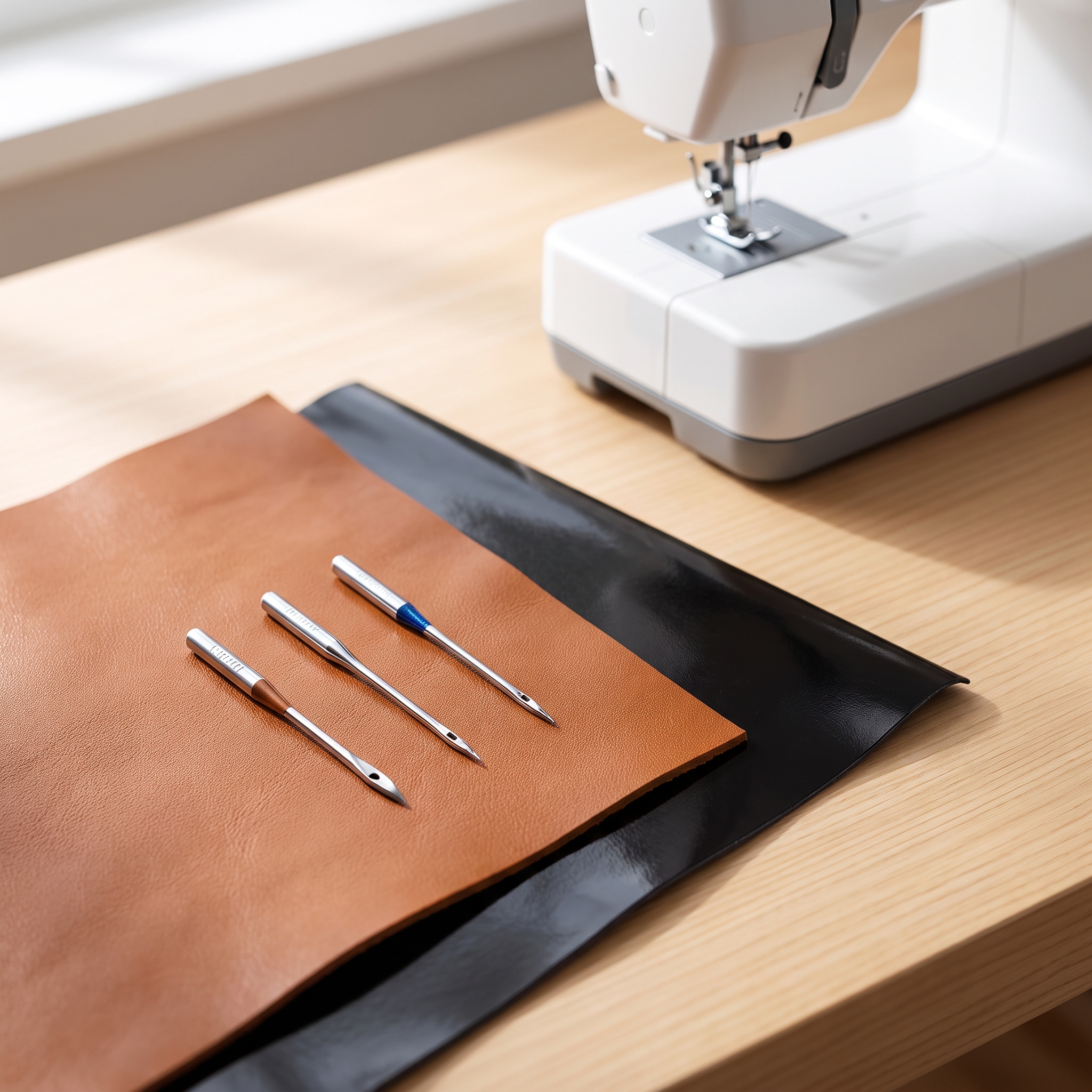
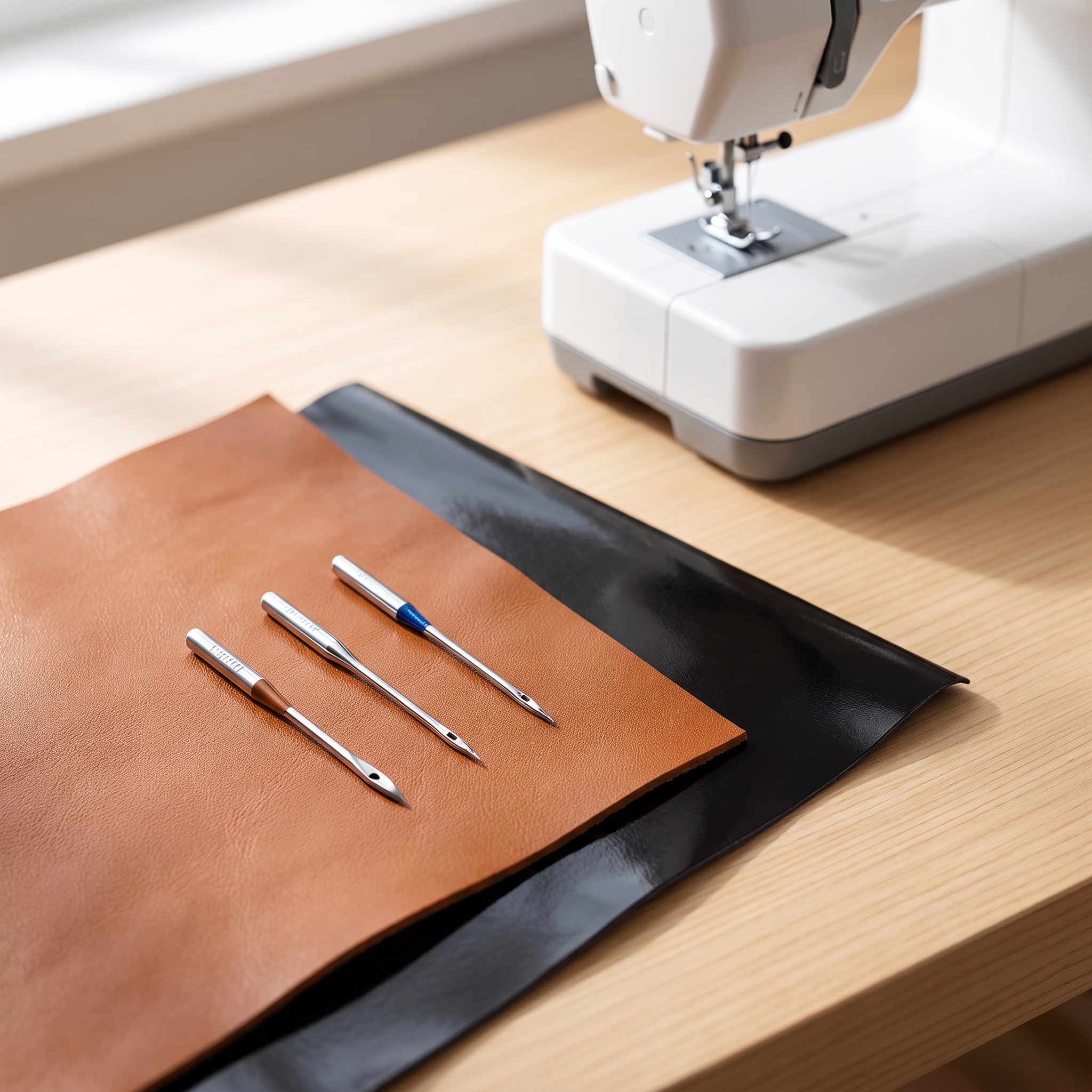
Breaking a needle mid-project isn’t just frustrating, it’s usually a sign you’re using the wrong tool for the job. When sewing leather or vinyl, the needle you choose makes the difference between professional results and a pile of damaged fabric with skipped stitches.
Quick Answer: For leather and vinyl, you need a leather needle (also called a chisel-point or wedge-point needle) in sizes 90/14 to 110/18, depending on material thickness. These needles have a cutting point that slices through dense materials instead of piercing them like regular needles do. Universal or ballpoint needles will skip stitches, break frequently, and damage your fabric because they’re designed for woven or knit textiles, not coated or thick materials.
Key Takeaways
- Leather needles have a wedge-shaped cutting point that slices cleanly through leather and vinyl, while universal needles have round points that snag and tear
- Size 90/14 works for thin leather and vinyl; size 100/16 handles medium-weight upholstery; size 110/18 or 120/19 tackles thick leather on home machines
- Faux leather and vinyl both require leather needles despite being synthetic, the coating and density demand a cutting point
- Needle breakage usually means the needle is too small for the material thickness, the presser foot pressure is wrong, or you’re sewing too fast
- Change your needle every 6-8 hours of sewing time with leather or vinyl, as the cutting edge dulls faster than with fabric
- Denim needles are not interchangeable with leather needles,denim needles have a sharp round point for tight weaves, not a cutting wedge
- Most home sewing machines can handle thin to medium leather (up to 3-4 oz weight) with the right needle and adjustments
- Using the wrong needle on vinyl causes skipped stitches, puckering, and permanent holes that won’t close like fabric does
What Size Needle Do You Need for Sewing Leather?
For sewing leather, you need a size 90/14 needle for thin garment leather (1-2 oz), a 100/16 for medium upholstery leather (3-4 oz), or a 110/18 to 120/19 for thick leather (5-6 oz). The number indicates the needle diameter, higher numbers mean thicker, stronger needles that can penetrate dense material without bending or breaking.
Here’s how to match needle size to your leather project:
Thin leather (1-2 oz / 0.4-0.8 mm):
- Garment leather, lambskin, thin suede
- Use size 90/14 leather needle
- Works with standard thread (size 40-50)
Medium leather (3-4 oz / 1.2-1.6 mm):
- Upholstery leather, bag leather, most vinyl
- Use size 100/16 leather needle
- Pair with heavy-duty thread (size 30-40)
Thick leather (5-6 oz / 2.0-2.4 mm):
- Belt leather, saddle leather, heavy straps
- Use size 110/18 or 120/19 leather needle
- Requires heavy thread (size 20-30) and a walking foot
Common mistake: Many sewers start with a size 80 needle because that’s what came with their machine. This needle is too thin for leather and will bend or break on the first pass. Always size up when working with leather or vinyl.
Edge case: If you’re sewing very thin faux leather or pleather (like fashion leatherette), you might get away with a size 80/12 leather needle, but 90/14 is safer and won’t leave noticeably larger holes.

Set of 5 leather sewing machine needles include three 90/14 sized needles, and two 100/16 sized needles

Effortlessly Tackle Tough Materials: SCHMETZ Leather Needles feature a specialized LL cutting point that cleanly pierces leather, stiff faux leather, and heavy materials, creating precise stitch holes with reduced resistance and improved control

2X STRONGER STEEL — Constructed with reinforced, thick shafts that withstand the resistance of dense, heavy fabrics without bending or breaking, staying sharp longer for consistent, skip-free stitching through any material from start to finish.
What’s the Difference Between a Leather Needle and a Regular Needle?
A leather needle has a wedge-shaped or chisel-point tip that cuts through material like a tiny blade, while a regular (universal) needle has a rounded point that pushes between fabric fibers. This cutting action prevents the needle from dragging or tearing leather and vinyl, which don’t have the woven structure that allows regular needles to slip between threads.
Key differences:
| Feature | Leather Needle | Universal Needle |
|---|---|---|
| Point shape | Wedge/chisel (cutting edges) | Round/tapered |
| How it works | Slices through material | Pushes between fibers |
| Best for | Leather, vinyl, suede, cork | Woven fabrics, quilting cotton |
| Hole type | Clean cut, slightly elongated | Round, closes after stitching |
| Durability | Dulls faster on tough materials | Lasts longer on soft fabrics |
The wedge point creates a small slit rather than a round hole. This matters because leather and vinyl don’t “heal” like fabric does, every needle puncture is permanent. A regular needle creates ragged holes that can tear or enlarge over time, especially under stress.
Visual test: Hold both needles up to the light and look at the very tip. A universal needle comes to a smooth, rounded point. A leather needle has a flattened, blade-like edge that looks almost like a tiny chisel when viewed from the side.
Choose a leather needle if: You’re working with any non-woven material that has a coating, is made from hide, or is thicker than two layers of denim.
Can You Use a Universal Needle on Vinyl?
No, you should not use a universal needle on vinyl. Universal needles will skip stitches, create ragged holes, and often break when sewing vinyl because the rounded point can’t penetrate the dense, coated surface cleanly. Vinyl requires a leather needle with a cutting point to slice through the material’s plastic coating and backing.
Vinyl behaves more like leather than fabric, even though it’s synthetic. The PVC or polyurethane coating creates a tough, non-porous surface that a universal needle can’t pierce efficiently. When you force a universal needle through vinyl, it:
- Pushes the material down into the throat plate instead of cutting through
- Creates friction that heats the needle and can melt the vinyl coating
- Skips stitches because the needle deflects off the surface instead of penetrating
- Leaves rough holes that can tear or enlarge with use
What happens if you try it anyway: You might complete a few stitches, but you’ll quickly notice the machine struggling, uneven stitch length, and a “thunking” sound as the needle hits resistance. The vinyl may also show puckering or permanent indentations around the stitching line.
Exception: Very thin, flexible vinyl (like clear vinyl used for pockets or windows) might tolerate a size 90/14 universal needle for a few inches, but switching to a leather needle will still give cleaner results and prevent frustration.
What’s the Best Needle for Thick Leather on a Home Sewing Machine?
The best needle for thick leather on a home sewing machine is a size 110/18 or 120/19 leather needle, paired with a walking foot and heavy-duty thread. Most home machines can handle leather up to 3-4 oz (about 1.6 mm) thickness per layer, but anything thicker may require a heavy-duty or industrial machine.
Setup for thick leather:
- Install a size 110/18 leather needle (or 120/19 if your machine accepts it)
- Attach a walking foot to feed the leather evenly and prevent shifting
- Use heavy-duty polyester thread (size 30 or 40) in both needle and bobbin
- Increase stitch length to 3.5-4 mm to reduce needle penetrations
- Reduce sewing speed to give the needle time to penetrate fully
- Increase presser foot pressure if your machine allows adjustments
Machine limitations: Most home sewing machines have a motor rated for light to medium fabrics. If you’re sewing two layers of 4 oz leather (total 8 oz or about 3.2 mm), you’re at the upper limit. Signs your machine is struggling include:
- Motor slowing down or straining
- Needle bending or breaking repeatedly
- Stitches skipping even with the correct needle
- Machine making grinding or laboring sounds
Workaround for very thick leather: Reduce the number of layers by skiving (thinning) the leather edges where seams overlap, or use leather glue to hold seams before stitching so you can sew more slowly and carefully.
Choose a 110/18 needle if: You’re sewing belts, bag straps, or upholstery with multiple layers. This is the largest size most home machines can accommodate without risking damage to the needle bar.

Effortlessly Tackle Tough Materials: SCHMETZ Leather Needles feature a specialized LL cutting point that cleanly pierces leather, stiff faux leather, and heavy materials, creating precise stitch holes with reduced resistance and improved control


Why Does My Needle Keep Breaking When Sewing Leather?
Your needle keeps breaking when sewing leather because it’s either too small for the material thickness, you’re sewing too fast, the needle is hitting a pin or zipper, or the presser foot pressure is incorrect. Leather and vinyl are much denser than fabric, so the needle experiences more stress with every penetration.
Top causes and fixes:
1. Needle is too small
- Problem: A size 80 or 90 needle bends under the force needed to penetrate thick leather
- Fix: Size up to 100/16 or 110/18 depending on leather weight
2. Sewing speed is too fast
- Problem: The needle doesn’t have time to fully penetrate before the feed dogs pull the material
- Fix: Slow down to about half your normal speed, especially on seams
3. Hitting hard objects
- Problem: Needle strikes pins, metal zippers, snaps, or rivets
- Fix: Use clips or leather glue instead of pins; hand-crank over thick seams
4. Wrong presser foot pressure
- Problem: Too little pressure lets leather slip; too much pressure bends the needle
- Fix: Increase pressure slightly for leather (opposite of what you’d do for knits)
5. Dull or damaged needle
- Problem: A dull cutting edge can’t slice cleanly and deflects instead
- Fix: Change needles every 6-8 hours of sewing time with leather
6. Needle not fully inserted
- Problem: If the needle isn’t pushed all the way up into the needle clamp, it sits too low and hits the throat plate
- Fix: Remove and reinstall the needle, ensuring it’s seated completely before tightening
Quick test: If needles break consistently in the same spot (usually just above the eye), the needle is too thin for the material. If they break randomly or bend first, check your technique and machine settings.
Leather Needle vs Denim Needle: Which Is Stronger?
A leather needle and a denim needle are equally strong in terms of shaft thickness, but they serve different purposes and are not interchangeable. Denim needles have a sharp, reinforced round point designed to penetrate tight weaves without deflecting, while leather needles have a wedge-shaped cutting point that slices through non-woven materials. For leather and vinyl, only a leather needle will work correctly.
Key differences:
Denim/Jeans Needle:
- Sharp, reinforced round point
- Designed for tightly woven, thick fabrics
- Pushes between densely packed threads
- Works on denim, canvas, upholstery fabric, duck cloth
- Does NOT cut, it pierces
Leather Needle:
- Wedge or chisel cutting point
- Designed for non-woven, coated materials
- Slices through material like a blade
- Works on leather, vinyl, suede, cork, oilcloth
- Creates a slit rather than a round hole
What happens if you use a denim needle on leather: The round point will drag and skip stitches because it can’t penetrate the dense, non-woven surface efficiently. You’ll get uneven stitching and possible needle breakage.
What happens if you use a leather needle on denim: The cutting point will work, but it may create slightly larger holes than necessary and dull faster because denim’s tight weave puts more stress on the cutting edges.
Choose the right tool: If you’re sewing a denim bag with leather trim, use a denim needle for the fabric portions and switch to a leather needle for the leather pieces. Don’t try to use one needle for both, you’ll compromise results on at least one material.
Do You Need a Special Needle for Faux Leather?
Yes, you need a leather needle for faux leather, even though it’s synthetic. Faux leather (also called pleather, leatherette, or vegan leather) has a plastic coating over a fabric backing, and this coating requires a cutting point to penetrate cleanly. A universal needle will skip stitches and create rough holes in the coating.
Why faux leather needs a leather needle:
- Coating density: The polyurethane or PVC layer is non-porous and doesn’t allow a round needle point to slip through
- No “give”: Unlike woven fabric, faux leather can’t shift to accommodate a needle, it must be cut
- Permanent holes: Every needle puncture leaves a visible mark that won’t close, so clean cuts matter
- Friction: The coating creates more friction than fabric, which can bend or break universal needles
Needle size for faux leather:
- Thin fashion faux leather: Size 90/14 leather needle
- Medium upholstery faux leather: Size 100/16 leather needle
- Thick or backed faux leather: Size 110/18 leather needle
Special considerations for faux leather:
- Use a longer stitch length (3.5-4 mm) to minimize perforations that could tear
- Avoid pinning in visible areas, use clips or fabric glue instead
- Test on scraps first because some faux leathers are more delicate than real leather
- Don’t backstitch at seam ends, the repeated needle penetrations can tear the coating
Common mistake: Assuming that because faux leather is “just fabric with coating,” a universal needle will work. The coating is the problem, it’s what makes faux leather behave like real leather, not like fabric.
What Happens If You Use the Wrong Needle on Vinyl?
If you use the wrong needle on vinyl, you’ll get skipped stitches, puckered seams, ragged holes, and possible needle breakage. Vinyl’s plastic coating and dense backing require a cutting point to penetrate cleanly, a universal or ballpoint needle will deflect off the surface, create friction, and may even melt the vinyl coating from heat buildup.
Specific problems from wrong needle choice:
Skipped stitches:
- The needle can’t penetrate fully, so the bobbin hook misses the thread loop
- Results in gaps in your stitching line that weaken the seam
- Most common with universal needles on medium to thick vinyl
Puckering and distortion:
- The needle pushes material down instead of cutting through
- Creates waves and bumps along the seam line
- Permanent because vinyl doesn’t relax like fabric
Rough, torn holes:
- A round point tears through vinyl instead of slicing
- Holes are larger and more irregular than necessary
- Can lead to tearing under stress
Needle breakage:
- The needle bends from resistance and eventually snaps
- Usually happens within the first few inches of sewing
- Wastes needles and risks damaging your machine
Melted coating:
- Friction from a struggling needle heats the vinyl
- Can melt or discolor the surface around stitches
- Irreversible damage that ruins the project
The fix: Switch to a size 90/14 or 100/16 leather needle before you start. If you’ve already sewn a few inches with the wrong needle, remove those stitches carefully (vinyl shows every hole) and start over with the correct needle.
Size 90 or 100 Needle for Upholstery Vinyl?
For upholstery vinyl, use a size 100/16 leather needle as your starting point. Upholstery vinyl is typically medium-weight (similar to 3-4 oz leather) and has a fabric backing that adds density. A size 90/14 may work for very thin upholstery vinyl, but 100/16 provides better penetration and durability for most projects.
Decision guide:
Choose size 90/14 leather needle if:
- Your vinyl is thin and flexible (bends easily in your hand)
- You’re sewing a single layer with no backing
- The project is decorative rather than structural (pillow covers, trim)
Choose size 100/16 leather needle if:
- Your vinyl is medium-weight upholstery grade
- You’re sewing through two layers or vinyl with batting
- The project will see regular use (car seats, furniture, bags)
- You’re using heavy-duty thread (size 40 or thicker)
Choose size 110/18 leather needle if:
- Your vinyl is thick marine or commercial grade
- You’re sewing multiple layers with foam or interfacing
- The seam will bear weight or stress (straps, handles)
Test method: Take a scrap of your vinyl and try to push a pin through it. If the pin goes through easily with light pressure, size 90 will work. If you need firm pressure, go with size 100. If the pin bends or requires significant force, use size 110.
Thread pairing: Match your thread weight to your needle size. A size 100 needle works best with all-purpose polyester thread (size 40-50). If you size up to 110, switch to heavy-duty thread (size 30) to fill the larger hole and prevent thread breakage.
Can Beginners Sew Leather with a Regular Machine?
Yes, beginners can sew leather with a regular home sewing machine, as long as they use the right needle (leather needle, size 90-110), work with thin to medium leather (up to 3-4 oz), and make a few basic adjustments. Most modern home machines can handle garment leather, thin upholstery leather, and vinyl without needing industrial equipment.
Beginner-friendly setup:
1. Start with thin leather
- Garment-weight leather (1-2 oz)
- Thin faux leather or suede
- Single-layer projects like pouches or patches
2. Essential tools and adjustments
- Size 90/14 or 100/16 leather needle
- Heavy-duty polyester thread
- Walking foot or Teflon foot (prevents sticking)
- Longer stitch length (3.5-4 mm)
- Slower sewing speed
3. Beginner-friendly projects
- Leather patches or appliqués
- Simple pouches or coin purses
- Leather trim on fabric projects
- Keychains or luggage tags
- Eyeglass cases
What beginners should avoid:
- Thick leather (5+ oz) or multiple layers
- Leather belts or straps that require heavy stitching
- Projects with tight curves (leather doesn’t ease like fabric)
- Topstitching through thick seams without skiving
Common beginner mistakes:
- Using pins: Pins leave permanent holes in leather, use clips or glue instead
- Backstitching: Repeated needle penetrations can tear leather, tie off threads manually
- Ripping out stitches: Every hole is permanent, so measure twice and sew once
- Sewing too fast: Leather needs time to feed through, slow down to half speed
Machine check: Before buying leather, test your machine with a scrap of denim folded four times. If your machine can sew through that without straining, it can handle thin to medium leather.
Where to Buy Leather Sewing Machine Needles?
You can buy leather sewing machine needles at fabric stores (Joann, Hobby Lobby), online retailers (Amazon, Wawak, Goldstar Tool), and sewing machine dealers. Most stores carry Schmetz leather needles, which fit all home sewing machines with standard needle systems (130/705 H). Expect to pay $3-8 for a pack of five needles.
Best places to buy:
Local fabric stores:
- Pros: Immediate availability, can ask staff for help
- Cons: Limited size selection, higher prices
- Best for: Emergency replacements or first-time buyers
Online sewing suppliers:
- Wawak.com: Professional supply, bulk pricing
- GoldstarTool.com: Wide selection, industrial options
- Amazon: Fast shipping, customer reviews
- Best for: Stocking up or finding specialty sizes
Sewing machine dealers:
- Pros: Expert advice, machine-specific recommendations
- Cons: Higher prices, limited hours
- Best for: Troubleshooting or upgrading to specialty needles
What to look for when buying:
- Brand: Schmetz, Organ, or Klasse are reliable brands
- System: 130/705 H fits most home machines (check your manual)
- Point type: Look for “Leather” or “LL” designation
- Size range: Buy a variety pack (90/14, 100/16, 110/18) to test
Typical pricing:
- Single pack (5 needles, one size): $3-5
- Variety pack (5 needles, mixed sizes): $5-7
- Bulk pack (10+ needles): $8-12
Money-saving tip: Buy a variety pack first to test which size works best for your projects, then buy that size in bulk. Leather needles dull faster than regular needles, so having extras on hand prevents project delays.

Leather (130/705 HLL / 15X2NTW) Sewing Machine Needles

Universal (130/705 H) Sewing Machine Needles

CONTENTS: 10 Sewing Machine Needles | Universal | 130/705 H | With Flat Heel | Size 70/10-100/16 | Supplied in a Storage Box for Sewing Machine Needles
How Often Should You Change Your Needle When Sewing Leather?
Change your needle every 6-8 hours of sewing time when working with leather or vinyl, or immediately if you notice skipped stitches, popping sounds, or uneven holes. Leather and vinyl dull the cutting edge of a leather needle much faster than fabric dulls a universal needle because the dense material wears down the wedge point with every penetration.
Signs it’s time to change your needle:
- Skipped stitches that weren’t happening before
- Popping or thunking sound as the needle penetrates
- Ragged holes instead of clean slits
- Thread shredding or breaking frequently
- Needle feels rough when you run your finger along the point (carefully)
- Visible damage to the needle tip under magnification
Needle lifespan by material:
| Material | Approximate Lifespan |
|---|---|
| Thin garment leather | 8-10 hours |
| Medium upholstery leather | 6-8 hours |
| Thick leather or vinyl | 4-6 hours |
| Faux leather (coated) | 5-7 hours |
| Suede | 10-12 hours |
Why leather dulls needles faster: The cutting point on a leather needle is a precision edge, similar to a knife blade. Every time it slices through leather, the edge experiences microscopic wear. Vinyl is even harder on needles because the plastic coating is abrasive.
Best practice: Start every major project with a fresh needle, and keep a used needle container nearby to track when you’ve changed needles. Mark your needle pack with the date you started using it, or keep a simple log if you’re working on multiple projects.
Cost consideration: At $0.60-1.00 per needle, changing needles regularly is cheap insurance against ruined projects. A dull needle can create weak seams that fail or leave visible damage that can’t be repaired.
Wedge Point Needle vs Round Point for Leather
A wedge point needle (leather needle) has a blade-like cutting edge that slices through leather and vinyl, while a round point needle (universal or sharp needle) has a tapered point that pushes between fabric fibers. For leather, vinyl, suede, and other non-woven materials, only a wedge point needle will produce clean, professional results without skipped stitches or material damage.
Wedge point (leather needle):
- Shape: Flattened, chisel-like cutting edge
- Action: Slices through material like a tiny blade
- Hole type: Elongated slit
- Best for: Leather, vinyl, suede, cork, oilcloth, Ultrasuede
- Result: Clean penetration, no skipped stitches, minimal material distortion
Round point (universal/sharp needle):
- Shape: Tapered, rounded tip
- Action: Pushes between woven threads
- Hole type: Round, closes after stitching (in fabric)
- Best for: Woven fabrics, quilting cotton, linen, denim
- Result on leather: Skipped stitches, ragged holes, possible tearing
Visual comparison: If you look at a wedge point needle under magnification, you’ll see that the very tip is flattened into a blade shape, with the cutting edge perpendicular to the direction of sewing. A round point needle comes to a smooth, conical point with no flat edges.
Why the difference matters: Leather and vinyl don’t have the woven structure that allows a round point to slip between threads. When you try to use a round point on leather, the needle either deflects off the surface (causing skipped stitches) or tears through (creating ragged holes). The wedge point makes a controlled cut that’s clean and precise.
Specialty wedge points:
- Standard wedge (NW): Cuts a slit parallel to the seam line, best for most leather sewing
- Reverse wedge (RW): Cuts a slit perpendicular to the seam line, used for decorative effects
- Diamond point (DW): Four-sided cutting point for hand-sewing look
For home sewing: Stick with standard wedge point (NW) leather needles unless you’re doing specialized leatherwork. The standard wedge handles 95% of leather and vinyl projects on home machines.
FAQ
Can I use a leather needle on regular fabric? Yes, but it’s not ideal. A leather needle will cut through regular fabric instead of slipping between threads, which can weaken the fabric and create larger holes than necessary. Save leather needles for leather, vinyl, and similar materials, and use universal needles for woven fabrics.
What’s the difference between a leather needle and a jeans needle? A leather needle has a wedge-shaped cutting point that slices through non-woven materials, while a jeans needle has a sharp, reinforced round point that penetrates tightly woven fabrics. They’re not interchangeable, use leather needles for leather and vinyl, jeans needles for denim and canvas.
Will a leather needle work on suede? Yes, a leather needle works perfectly on suede. Suede is leather with a napped surface, so it requires the same wedge-point cutting action. Use a size 90/14 or 100/16 leather needle depending on the suede’s thickness.
Can I sew vinyl without a walking foot? You can sew thin vinyl without a walking foot, but results will be better with one. A walking foot feeds the top and bottom layers evenly, preventing the vinyl from sticking or shifting. For thick vinyl or multiple layers, a walking foot is essential.
Why does my leather pucker when I sew it? Leather puckering usually means your stitch length is too short, your presser foot pressure is too high, or you’re pulling the leather as you sew. Increase stitch length to 3.5-4 mm, reduce pressure slightly, and let the feed dogs move the leather without pulling.
Do I need special thread for leather? Yes, use heavy-duty polyester thread for leather and vinyl. Regular all-purpose thread may break under the stress of penetrating dense material. Polyester is stronger than cotton and won’t rot if the leather gets wet.
Can I use a ballpoint needle on faux leather? No, ballpoint needles are designed for knits and will skip stitches on faux leather. The rounded tip can’t penetrate the plastic coating. Always use a leather needle with a cutting point for faux leather.
How do I know if my needle is dull? A dull needle creates skipped stitches, makes a popping sound when penetrating, leaves ragged holes, or causes thread to shred. If you notice any of these signs, change the needle immediately.
What size needle for car upholstery vinyl? Car upholstery vinyl typically requires a size 100/16 or 110/18 leather needle, depending on thickness. Automotive vinyl is usually medium to heavy weight, so start with 100/16 and size up if you experience difficulty.
Can I sharpen a leather needle? No, you cannot effectively sharpen a leather needle. The wedge point is precision-ground during manufacturing, and attempting to sharpen it will alter the geometry and ruin the needle. Leather needles are inexpensive, replace them rather than trying to sharpen them.
Will a leather needle work on cork fabric? Yes, a leather needle is perfect for cork fabric. Cork has a dense, non-woven structure similar to leather, so the cutting point slices through cleanly. Use a size 90/14 leather needle for most cork fabric projects.
Do I need to change my bobbin thread when sewing leather? Use the same heavy-duty polyester thread in both the needle and bobbin when sewing leather. Mismatched thread weights can cause tension problems and weak seams. Wind a bobbin with your leather thread before starting your project.
Conclusion
Choosing the right needle for leather and vinyl isn’t complicated once you understand the basics: leather needles have a wedge-shaped cutting point that slices through dense, non-woven materials, while universal needles have round points designed for fabric. For most leather and vinyl projects, a size 100/16 leather needle paired with heavy-duty thread and a walking foot will give you professional results on a home sewing machine.
Your next steps:
- Buy a variety pack of leather needles (sizes 90/14, 100/16, 110/18) to test on your specific materials
- Test on scraps before starting your project, leather shows every mistake
- Adjust your machine settings: longer stitch length (3.5-4 mm), slower speed, increased presser foot pressure
- Change needles regularly,every 6-8 hours of sewing time with leather or vinyl
- Use clips instead of pins to avoid permanent holes in visible areas
Remember that leather and vinyl are unforgiving materials. Every needle hole is permanent, so take time to set up your machine correctly, use the right needle size for your material thickness, and practice on scraps until you’re confident. With the right needle and technique, your home sewing machine can handle a wide range of leather and vinyl projects, from garment details to upholstery and bags.


