
Quick Answer: For most knit fabrics, you need a ballpoint or stretch needle rather than a regular sharp needle. Ballpoint needles (sizes 70/10 to 90/14) work for stable knits like jersey and interlock, while stretch needles handle high-elasticity fabrics like spandex blends and ribbing. The rounded tip slides between fibers instead of piercing them, preventing runs, skipped stitches, and fabric damage.
Key Takeaways
- Ballpoint needles are the standard choice for most knit fabrics including jersey, interlock, and cotton knits
- Stretch needles feature a special scarf design for highly elastic fabrics like swimwear, activewear, and ribbed knits
- Needle size matters: lightweight knits need 70/10 or 75/11, medium knits use 80/12 or 90/14, heavy knits require 90/14 or 100/16
- Regular sharp needles will damage knit fabric by creating holes, runs, and laddering in the fabric structure
- Skipped stitches and broken needles usually indicate the wrong needle type or a dull needle that needs replacing
- Universal needles can work for stable, tightly-knit fabrics but aren’t ideal for stretchy or delicate knits
- Always match your needle size to both fabric weight and thread thickness for best results
What Type of Sewing Machine Needle Is Best for Knit Fabric?
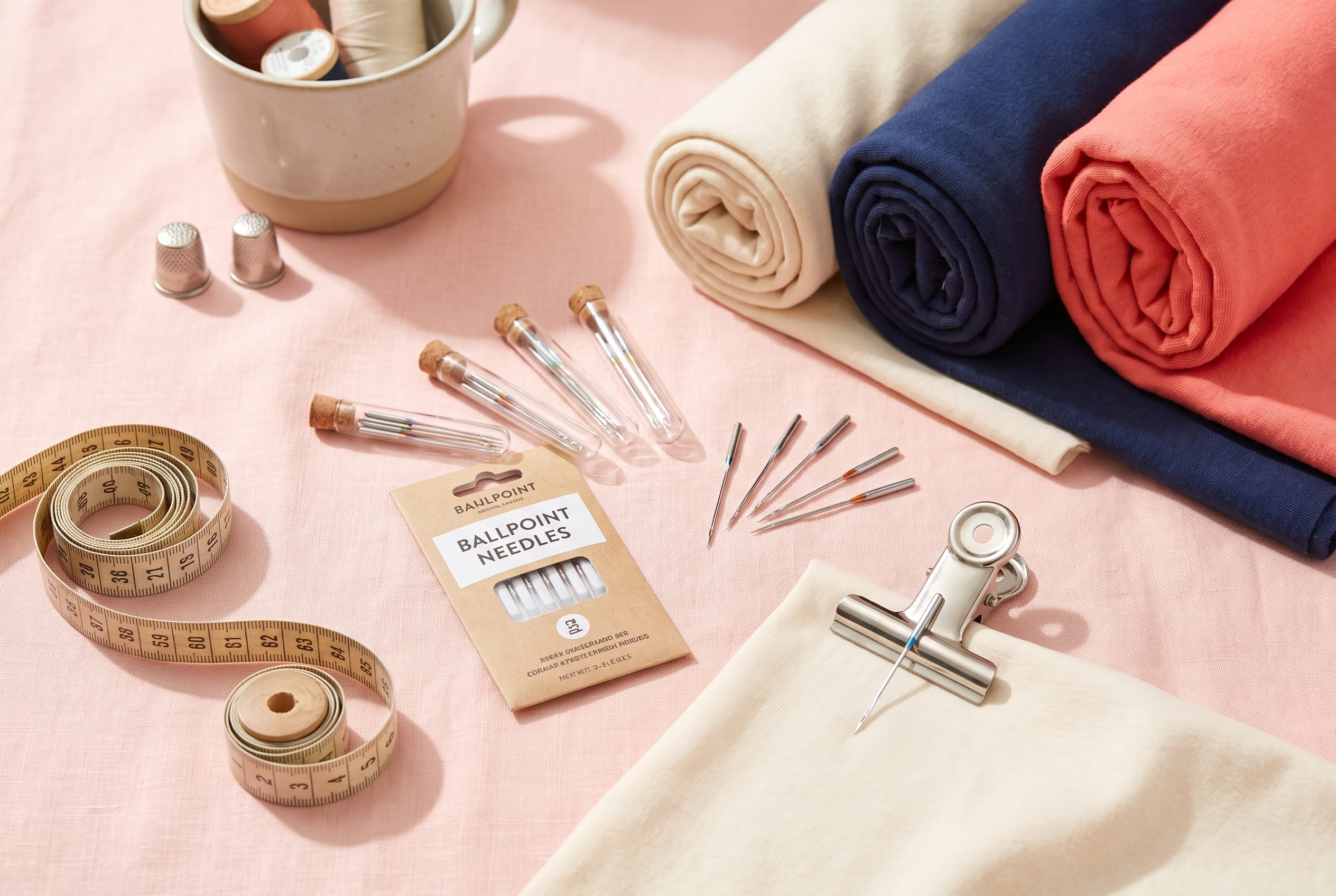
The best needle for knit fabric is a ballpoint needle for general knits or a stretch needle for high-elasticity fabrics. These specialized needles have rounded tips that push between the fabric’s loops rather than cutting through them, which prevents damage to the knit structure.
Regular sharp or universal needles have pointed tips designed to pierce woven fabrics. When you use them on knits, they can snag and break the looped fibers, creating permanent holes or runs. Ballpoint and stretch needles solve this problem with their blunt, rounded tips.
Choose a ballpoint needle when sewing:
- Jersey knit (t-shirt fabric)
- Interlock knit
- Cotton knits
- Ponte knit
- French terry
- Most stable knit fabrics
Choose a stretch needle when sewing:
- Spandex blends
- Activewear fabrics
- Swimwear
- Ribbed knits
- Highly elastic fabrics
- Two-way or four-way stretch materials
The key difference lies in how much the fabric stretches. If your knit has moderate stretch and good recovery, a ballpoint works great. If it’s super stretchy and elastic, go with a stretch needle.


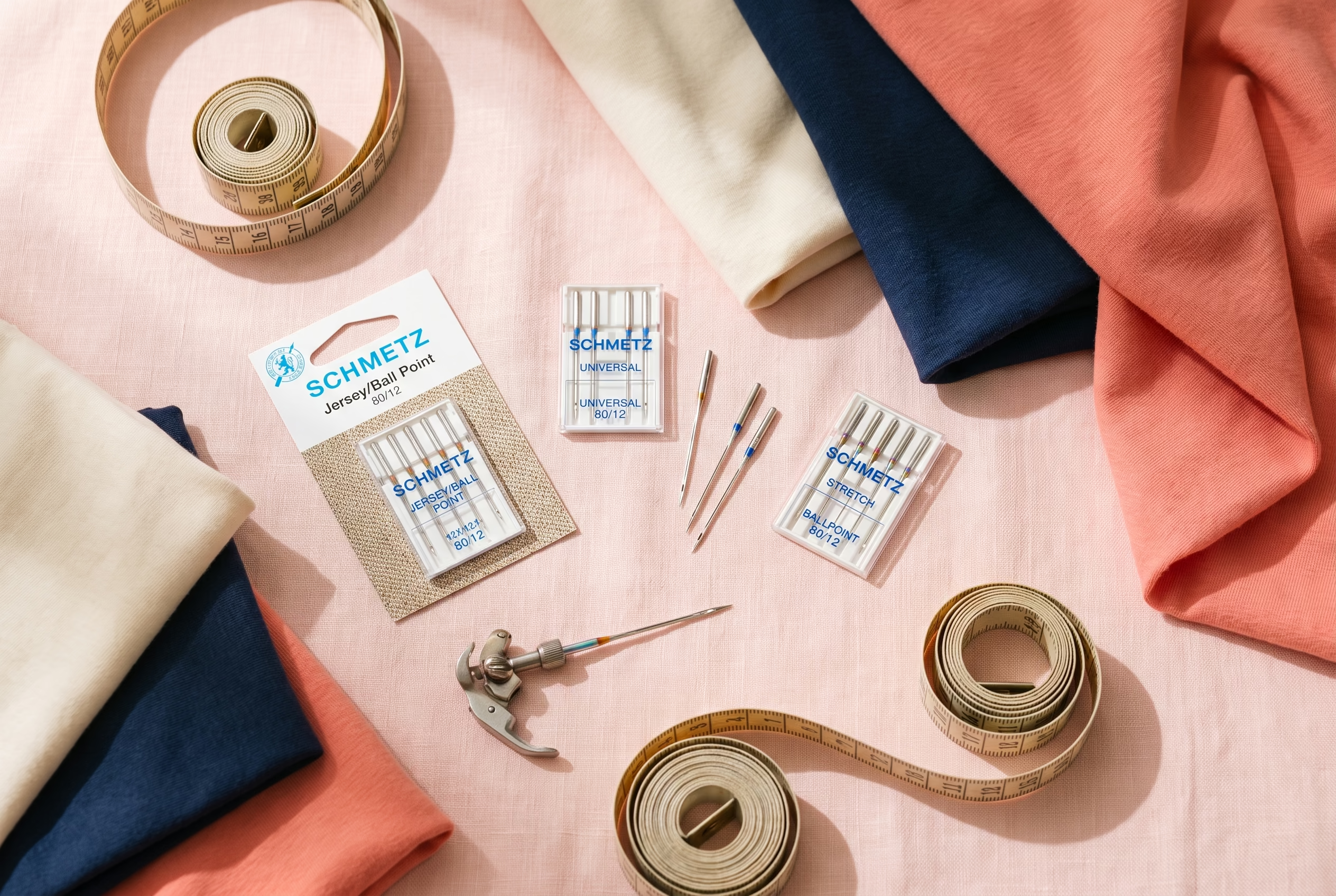
Superior Control & Consistency: The SCHMETZ Jersey Ball Point needle features a rounded medium ball point design that glides between fabric fibers instead of piercing them, helping prevent snags, runs, and holes on delicate knits and stretch fabrics

Superior Control & Consistency: The SCHMETZ Jersey Ball Point needle features a rounded medium ball point design that glides between fabric fibers instead of piercing them, helping prevent snags, runs, and holes on delicate knits and stretch fabrics
Difference Between Ballpoint and Stretch Needles for Knits
Ballpoint needles and stretch needles both have rounded tips, but stretch needles include a special scarf (the indentation above the eye) and a deeper groove that prevents skipped stitches on highly elastic fabrics. Ballpoint needles work for most stable knits, while stretch needles are engineered specifically for fabrics with significant elasticity.
The scarf design on stretch needles allows the bobbin hook to get closer to the needle, which helps form stitches more reliably when the fabric is stretching during sewing. This prevents the frustrating problem of skipped stitches that happens when sewing elastic materials.
Ballpoint needle features:
- Rounded tip to slide between fibers
- Standard scarf design
- Works for jersey, interlock, and stable knits
- Available in sizes 70/10 through 100/16
- Sometimes labeled as “Jersey” needles
Stretch needle features:
- Rounded tip plus special scarf
- Deeper front groove for thread protection
- Prevents skipped stitches on elastic fabrics
- Best for spandex, Lycra, and two-way stretch
- Usually available in sizes 75/11 and 90/14
Common mistake: Many sewers assume all knits need stretch needles, but using them on stable knits can actually cause problems. The specialized design isn’t necessary for fabrics that don’t have significant elasticity, and ballpoint needles will give you better results on those materials.


Schmetz Stretch 130/705 H-S 75/11 Needles.

NonStick resists glue & sticky fusibles.
What Size Needle Should I Use for Jersey Knit?
For standard jersey knit fabric, use a size 80/12 or 90/14 ballpoint needle. Lightweight jersey works best with 70/10 or 75/11, while heavier jersey requires 90/14. The needle size must match both the fabric weight and your thread thickness to prevent skipped stitches and fabric damage.
Jersey is one of the most common knit fabrics for home sewing, used for t-shirts, dresses, and casual wear. The right needle size ensures smooth stitching without puckering or stretching the fabric.
Jersey knit needle size guide:
| Jersey Type | Fabric Weight | Needle Size | Thread |
|---|---|---|---|
| Lightweight jersey | Thin, drapey | 70/10 or 75/11 | Fine polyester |
| Standard jersey | Medium weight | 80/12 or 90/14 | All-purpose polyester |
| Heavy jersey | Thick, stable | 90/14 or 100/16 | Heavy-duty polyester |
The first number (70, 80, 90) is the European size, and the second number (10, 12, 14) is the American size. They refer to the same needle, just different measurement systems.
How to test: If you’re unsure about your jersey weight, sew a test seam on scrap fabric. If the needle creates visible holes or the fabric puckers, go down a size. If you get skipped stitches or the needle breaks, go up a size.

Superior Control & Consistency: The SCHMETZ Jersey Ball Point needle features a rounded medium ball point design that glides between fabric fibers instead of piercing them, helping prevent snags, runs, and holes on delicate knits and stretch fabrics

Superior Control & Consistency: The SCHMETZ Jersey Ball Point needle features a rounded medium ball point design that glides between fabric fibers instead of piercing them, helping prevent snags, runs, and holes on delicate knits and stretch fabrics

4X LONGER LIFE WITH TITANIUM COATING — Titanium-coated needles are super strong and last up to 4 times longer than regular sewing machine needles, delivering exceptional durability and value for high-volume sewing projects
Why Does My Needle Keep Breaking When Sewing Knits?
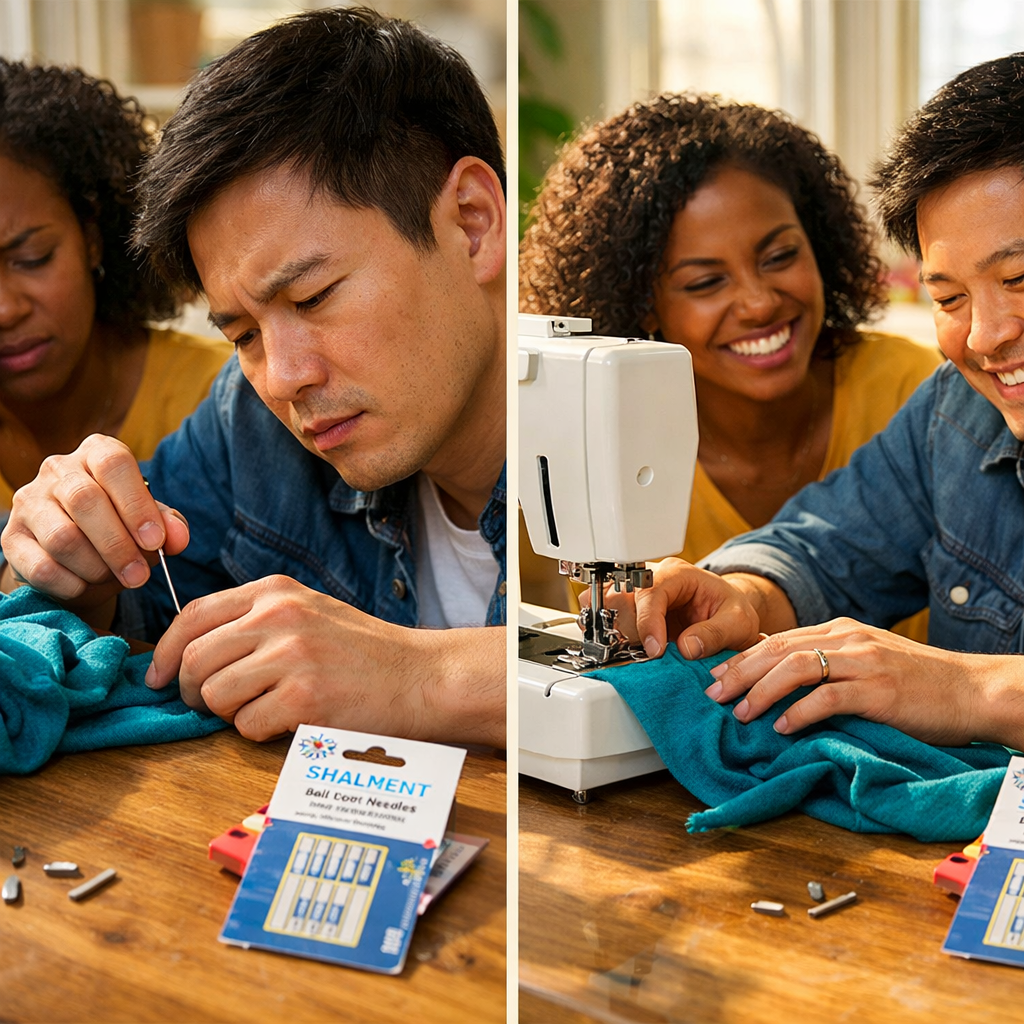
Needles break when sewing knits because of using the wrong needle type, sewing too fast, pulling the fabric, or hitting pins. The most common cause is using a regular sharp needle instead of a ballpoint or stretch needle, which creates resistance as the needle tries to pierce the knit structure instead of sliding between fibers.
When a sharp needle hits the looped fibers of knit fabric, it can catch and bend slightly with each stitch. This repeated stress causes metal fatigue, and eventually the needle snaps. The problem gets worse with stretchy or thick knits.
Top reasons needles break on knits:
- Wrong needle type – Sharp or universal needles catch on knit loops
- Needle too small – Can’t handle the fabric thickness
- Pulling or pushing fabric – Let the feed dogs do the work
- Sewing too fast – Especially on thick seams or hems
- Hitting pins – Always remove pins before the needle reaches them
- Dull or damaged needle – Replace needles every 8-10 hours of sewing
- Needle inserted incorrectly – Must be fully seated and facing the right direction
Quick fix: Switch to a ballpoint or stretch needle one size larger than you think you need. Slow down your sewing speed, especially when crossing seams. Never pull the fabric through the machine; guide it gently and let the feed dogs move it.
If needles continue breaking after switching to the correct type and size, check your machine’s timing or take it in for service. Timing issues can cause the needle to hit the bobbin case or hook.
Can I Use a Regular Needle on Knit Fabric?
You should not use a regular sharp needle on knit fabric because it will damage the fabric structure, create holes, cause runs, and lead to skipped stitches. Regular needles are designed for woven fabrics and have sharp points that pierce fibers rather than sliding between them, which breaks the loops in knit construction.
Some sewers try regular needles on knits and think it works fine initially, but the damage often appears later. The fabric may develop small holes that grow into runs after washing, or the seams may pucker and lose their stretch.
What happens when you use a sharp needle on knits:
- Visible holes along the seam line
- Runs or laddering in the fabric
- Skipped stitches
- Fabric puckering
- Loss of stretch in seams
- Seam failure after washing
The only exception: Very tightly knit, stable fabrics with minimal stretch (like some ponte or double knits) might tolerate a universal needle, but a ballpoint is still the better choice. Universal needles have a slightly rounded point that’s less sharp than a regular needle, making them more versatile but not ideal for stretchy knits.
The cost difference between regular and ballpoint needles is minimal (usually just a few dollars for a pack), so there’s no good reason to risk damaging your fabric project by using the wrong needle type.
Ballpoint vs Stretch vs Universal Needle for T-Shirt Fabric
For standard t-shirt fabric (jersey knit), use a ballpoint needle in size 80/12 or 90/14. Stretch needles work if your t-shirt fabric has added spandex or significant elasticity. Universal needles can work on very stable jersey but aren’t the best choice for typical stretchy t-shirt material.
T-shirt fabric is almost always jersey knit, which has moderate stretch in the width and minimal stretch in the length. This makes it perfect for ballpoint needles, which handle the knit structure without the specialized features needed for highly elastic fabrics.
Decision guide for t-shirt fabric:
Choose ballpoint if:
- 100% cotton jersey
- Cotton/poly blend jersey
- Fabric has moderate stretch
- Making basic t-shirts or casual tops
Choose stretch if:
- Jersey with spandex or Lycra
- Fabric stretches significantly in all directions
- Making fitted athletic or performance wear
- Experiencing skipped stitches with ballpoint
Choose universal if:
- Very stable, tightly knit jersey
- You’re in a pinch and it’s all you have
- Fabric barely stretches
Real-world example: When making a basic cotton t-shirt, start with a 80/12 ballpoint needle. If you notice skipped stitches, switch to a stretch needle or go up to 90/14 ballpoint. If the fabric is puckering, try a 75/11 ballpoint instead.
Most t-shirt sewing problems come from using universal or sharp needles when a ballpoint would solve the issue immediately. Keep a variety pack of ballpoint needles in different sizes, and you’ll be prepared for any t-shirt project.
What Needle Do I Need for Thick Sweatshirt Material?
For thick sweatshirt material (fleece or French terry), use a size 90/14 or 100/16 ballpoint needle. Heavy sweatshirt fleece requires the larger needle to penetrate the thick fabric layers without breaking, while the ballpoint tip protects the knit structure from damage.
Sweatshirt fabric is typically French terry (with loops on one side) or fleece (brushed on one or both sides). Both are knit fabrics, so they need ballpoint needles, but the thickness requires going up in size compared to lighter knits.
Sweatshirt fabric needle guide:
- Lightweight French terry: 80/12 or 90/14 ballpoint
- Standard sweatshirt fleece: 90/14 ballpoint
- Heavy fleece or multiple layers: 100/16 ballpoint
- Stretch fleece with spandex: 90/14 stretch needle
Thread matters too: Use heavy-duty or all-purpose polyester thread with thick sweatshirt material. Cheap or thin thread will break under the tension needed to sew through multiple layers.
Common mistake: Trying to sew thick sweatshirt fabric with a 70/10 or 75/11 needle because that’s what’s in the machine. The needle is too thin for the fabric and will bend or break. Always match needle size to fabric weight.
Pro tip: When sewing through particularly thick areas (like crossing seams in a hood or pocket), slow down your machine speed and use the hand wheel to manually advance the needle through the thickest spots. This prevents needle breakage and skipped stitches.

How to Stop Skipped Stitches When Sewing Knit Fabric
To stop skipped stitches on knits, switch to a stretch needle, increase needle size, check thread tension, and ensure you’re using polyester thread. Skipped stitches happen when the bobbin hook can’t catch the needle thread loop, which is common with elastic fabrics that stretch as you sew.
Skipped stitches are one of the most frustrating problems when sewing knits. The machine seems to be working fine, but random stitches don’t form, leaving gaps in your seam. This usually indicates a mismatch between your needle type and the fabric’s elasticity.
Step-by-step fix for skipped stitches:
- Replace the needle – Even slightly dull needles cause skipped stitches
- Switch to stretch needle – The special scarf design prevents skipping on elastic fabrics
- Go up one needle size – Try 90/14 instead of 80/12
- Check thread quality – Use polyester thread, not cotton
- Adjust tension – Slightly loosen upper tension
- Slow down – Sewing too fast can cause skipping on stretchy fabrics
- Use a walking foot – Helps feed stretchy fabric evenly
- Stabilize the fabric – Use a strip of tissue paper under the seam
Why it works: Stretch needles have a deeper scarf that allows the bobbin hook to get closer to the needle, making it easier to catch the thread loop even when the fabric is stretching. The larger needle size also creates a bigger thread loop for the hook to catch.
Test before fixing the whole project: Sew a test seam on scrap fabric after each adjustment. Once the skipped stitches stop, you’ve found the right combination of needle type, size, and settings.
If skipped stitches continue after trying all these fixes, your machine may need professional service. Timing issues or a damaged bobbin hook can also cause skipping.
Best Needle for Lightweight Cotton Knit
For lightweight cotton knit, use a size 70/10 or 75/11 ballpoint needle. These smaller needles create minimal holes in delicate knit fabric while the ballpoint tip protects the knit structure. Lightweight cotton knits include tissue-weight jersey, fine rib knits, and thin interlock.
Lightweight knits are more delicate than standard jersey and require a gentler approach. A needle that’s too large will leave visible holes, while a needle that’s too small or the wrong type will cause skipped stitches or fabric damage.
Lightweight cotton knit characteristics:
- Thin, drapey fabric
- Often semi-sheer
- Used for baby clothes, lingerie, lightweight tops
- Stretches easily and can distort
Needle and thread pairing:
- Needle: 70/10 or 75/11 ballpoint
- Thread: Fine polyester or polyester/cotton blend
- Stitch length: 2.5-3mm for seams
- Presser foot pressure: Reduce if possible to prevent stretching
Sewing tips for lightweight knits:
- Use a new needle for each project
- Sew slowly to maintain control
- Don’t pull or stretch the fabric as you sew
- Consider using a walking foot or even-feed foot
- Test on scraps first to dial in settings
Common mistake: Using a 80/12 or 90/14 needle because that’s what you use for regular jersey. The larger needle creates visible holes in lightweight fabric that won’t close up. Always go smaller for delicate knits.
If you’re getting skipped stitches with a 70/10 ballpoint, try a 75/11 stretch needle instead. The slightly larger size and special scarf design often solve the problem without creating visible holes.
Do I Need a Special Needle for Ribbed Knit Fabric?
For ribbed knit fabric, use a stretch needle in size 75/11 or 90/14 depending on the rib weight. Ribbed knits have high elasticity in the crosswise direction due to their alternating knit and purl structure, which requires the special scarf design of stretch needles to prevent skipped stitches.
Ribbing is the stretchy fabric used for cuffs, neckbands, and waistbands on knit garments. It’s more elastic than regular jersey, so it needs a needle designed for high-stretch fabrics.
Types of ribbed knit:
- 1×1 rib (one knit, one purl) – Most common, moderate stretch
- 2×2 rib (two knit, two purl) – Slightly less stretch
- Rib knit fabric – Sold by the yard for making entire garments
- Ribbed cuffs/bands – Pre-made tubular ribbing
Needle selection for ribbing:
- Lightweight rib (cuffs, neckbands): 75/11 stretch needle
- Medium rib (waistbands): 90/14 stretch needle
- Heavy rib knit fabric: 90/14 or 100/16 stretch needle
Why stretch needles work better: The alternating knit-purl structure creates more elasticity than plain jersey. When you sew ribbing, it stretches under the presser foot, which can cause the needle thread loop to be pulled away from the bobbin hook. The stretch needle’s special scarf compensates for this movement.
Sewing ribbing successfully:
- Use a stretch needle
- Stretch the ribbing slightly as you sew (for cuffs and neckbands)
- Use a narrow zigzag or stretch stitch
- Polyester thread only (cotton thread breaks)
- Reduce presser foot pressure if possible
If you’re attaching ribbing to a garment and getting skipped stitches, switch to a stretch needle and the problem usually disappears immediately.
What Happens If You Use the Wrong Needle on Knits?
Using the wrong needle on knits causes visible holes, runs in the fabric, skipped stitches, puckered seams, and broken needles. Sharp needles pierce and break the looped fibers instead of sliding between them, creating permanent damage that often worsens after washing. The seams may also lose their stretch and fail under stress.
The damage from wrong needles isn’t always immediately obvious. You might finish a project and think it looks fine, only to discover holes and runs after the first wash. This happens because the damaged fibers continue to unravel with wear and washing.
Visible problems from wrong needles:
Immediate damage:
- Small holes along seam lines
- Skipped stitches (gaps in the seam)
- Puckered or wavy seams
- Fabric stretching out of shape
- Needle breaking or bending
Delayed damage (appears after washing):
- Holes growing into runs
- Laddering in the fabric
- Seam failure
- Fabric distortion around seams
- Loss of fabric stretch
Why it happens: Knit fabric is made of interlocking loops of yarn. When a sharp needle pierces through a loop instead of sliding between loops, it breaks the yarn. That broken loop can then unravel, creating a run similar to what happens with pantyhose.
Real-world example: A sewer makes a t-shirt using a universal needle instead of a ballpoint. The shirt looks fine when finished. After two washes, small holes appear along the shoulder seams and side seams. The holes grow larger with each wash until the seams fail completely. The entire project is ruined because of a $2 needle mistake.
The fix is simple: Always use ballpoint or stretch needles for knits. Keep a variety pack on hand so you have the right size for any project. Replace needles regularly (every 8-10 hours of sewing or with each new project).
Needle Size Chart for Different Types of Knit Fabrics
Here’s a comprehensive needle size chart for different knit fabrics, showing the recommended needle type and size for each common knit material. Match your fabric to the chart, then test on scraps before sewing your project.
| Fabric Type | Needle Type | Needle Size | Notes |
|---|---|---|---|
| Lightweight jersey | Ballpoint | 70/10 or 75/11 | Thin t-shirt fabric, baby clothes |
| Standard jersey | Ballpoint | 80/12 or 90/14 | Most common t-shirt fabric |
| Heavy jersey | Ballpoint | 90/14 or 100/16 | Thick, stable jersey |
| Interlock knit | Ballpoint | 80/12 or 90/14 | Stable, doesn’t curl at edges |
| Ponte knit | Ballpoint | 90/14 | Double knit, very stable |
| French terry | Ballpoint | 80/12 or 90/14 | Loops on one side |
| Sweatshirt fleece | Ballpoint | 90/14 or 100/16 | Thick, brushed surface |
| Ribbed knit | Stretch | 75/11 or 90/14 | High elasticity, cuffs/waistbands |
| Spandex/Lycra blend | Stretch | 75/11 or 90/14 | Activewear, leggings |
| Swimwear/performance | Stretch | 75/11 or 90/14 | Very elastic, four-way stretch |
| Cotton knit (stable) | Ballpoint | 80/12 | Minimal stretch |
| Sweater knit | Ballpoint | 90/14 or 100/16 | Thick, loose knit |
How to use this chart:
- Identify your fabric type (check the bolt label or feel the fabric)
- Find the matching row in the chart
- Start with the smaller needle size listed
- Test on scraps – if you get skipped stitches, go up one size
- If you see visible holes, go down one size
Remember: These are starting points. Your specific fabric, thread, and machine may require adjustments. Always test on scraps before sewing your actual project.
Can You Sew Knits with a Microtex Needle?
You should not use a Microtex (sharp) needle on knit fabrics because the ultra-sharp point will pierce and damage the knit structure, creating holes and runs. Microtex needles are designed for tightly woven fabrics like silk, microfiber, and synthetic wovens where a sharp point is necessary to penetrate between densely packed threads.
Microtex needles are the opposite of what knits need. They have an extremely sharp, thin point that’s perfect for woven fabrics but terrible for knits. Using a Microtex needle on knits is like using a knife when you need a spoon – it’s the wrong tool for the job.
Microtex needles are designed for:
- Silk and satin (woven)
- Microfiber fabrics
- Tightly woven synthetics
- Quilting cotton
- Any densely woven fabric
Why they damage knits:
- Ultra-sharp point pierces knit loops
- Breaks yarn fibers instead of sliding between them
- Creates permanent holes and runs
- Causes skipped stitches on stretchy fabrics
- Seams lose their stretch
What to use instead: Always use ballpoint or stretch needles for knits. If you’re sewing a project that combines woven and knit fabrics (like a woven bodice with knit sleeves), change needles when switching between fabric types, or use a ballpoint needle for the entire project since it can handle both reasonably well.
The only exception: There is no exception. Never use Microtex needles on knits. The damage is permanent and will ruin your project.
Frequently Asked Questions
How often should I change my needle when sewing knits? Change your needle every 8-10 hours of sewing time or with each new project, whichever comes first. Knit fabrics dull needles faster than wovens because the needle must push through dense, looped fibers. A dull needle causes skipped stitches, puckering, and fabric damage.
Can I use a twin needle on knit fabric? Yes, use a twin ballpoint or twin stretch needle for knits. Twin needles create professional-looking parallel rows of stitching, perfect for hems on t-shirts and knit garments. Choose size 2.5/80 or 4.0/80 for most knits, and always test on scraps first.
What’s the difference between jersey and ballpoint needles? Jersey needles and ballpoint needles are the same thing. Different needle manufacturers use different names, but both refer to needles with rounded tips designed for knit fabrics. Some brands label them “Jersey,” others “Ballpoint,” and some use “Jersey/Ballpoint.”
Why does my knit fabric pucker when I sew it? Knit fabric puckers when the needle is too large, thread tension is too tight, stitch length is too short, or you’re pulling the fabric as you sew. Use the correct needle size for your fabric weight, loosen upper tension slightly, increase stitch length to 3mm, and let the feed dogs move the fabric without pulling.
Do I need special thread for sewing knits? Use polyester or polyester-blend thread for knits because it has slight stretch and won’t break when the fabric stretches. Avoid 100% cotton thread, which has no give and will snap when the seam is stressed. All-purpose polyester thread works for most knit projects.
Can I use a walking foot with knit fabric? Yes, a walking foot helps feed stretchy knit fabric evenly through the machine, preventing stretching and puckering. It’s especially helpful for sewing multiple layers of knit, attaching ribbing, or working with very stretchy fabrics. Combine it with the correct needle type for best results.
What stitch should I use for sewing knits? Use a narrow zigzag stitch (width 1-1.5mm, length 2.5-3mm) or a stretch stitch if your machine has one. Straight stitches can break when the fabric stretches. The zigzag allows the seam to stretch with the fabric while maintaining strength.
How do I know if my needle is dull? A dull needle makes a popping or punching sound as it enters the fabric, creates skipped stitches, causes puckering, or leaves visible holes. If you notice any of these signs, replace the needle immediately. Dull needles damage fabric and create poor-quality seams.
Can I sew knits without a serger? Yes, you can sew knits successfully on a regular sewing machine using ballpoint or stretch needles, polyester thread, and a zigzag or stretch stitch. A serger makes finishing easier and faster, but it’s not required. Many sewers create beautiful knit garments using only a standard machine.
What’s the best needle brand for sewing knits? Schmetz and Organ are widely considered the best needle brands for quality and consistency. Both offer excellent ballpoint and stretch needles in all sizes. Schmetz needles are color-coded for easy identification, while Organ needles are known for staying sharp longer.
Why do I get holes in my knit fabric after sewing? Holes appear when you use the wrong needle type (sharp instead of ballpoint), the needle is too large for the fabric, the needle is dull or damaged, or you’re pulling the fabric as you sew. Switch to a ballpoint or stretch needle in the correct size and let the feed dogs move the fabric.
Should I use a stabilizer when sewing knits? Use stabilizer only on specific areas like buttonholes, shoulder seams, or necklines where you want to prevent stretching. For most knit seams, don’t use stabilizer because it prevents the natural stretch of the fabric. Water-soluble or tear-away stabilizers work best when needed.
Conclusion
Choosing the right needle for knits makes the difference between a professional-looking project and a frustrating failure. Ballpoint needles handle most stable knits like jersey and interlock, while stretch needles are essential for highly elastic fabrics like spandex blends and ribbing. Match your needle size to your fabric weight – 70/10 or 75/11 for lightweight knits, 80/12 or 90/14 for medium-weight fabrics, and 90/14 or 100/16 for heavy sweatshirt material.
Never use regular sharp or Microtex needles on knits. The pointed tips will damage the fabric structure, creating holes and runs that often worsen after washing. The small investment in proper needles (usually just a few dollars for a variety pack) protects your fabric investment and saves hours of frustration.
Your next steps:
- Check your current needle stash and organize by type and size
- Buy a variety pack of ballpoint needles (sizes 70/10 through 100/16)
- Add a pack of stretch needles (75/11 and 90/14) for elastic fabrics
- Test on fabric scraps before starting any knit project
- Replace needles every 8-10 hours of sewing or with each new project
- Keep notes on which needle worked best for each fabric type
Start your next knit project with confidence, knowing you have the right needle for the job. The difference in stitch quality, fabric appearance, and sewing ease will be immediately obvious. Happy sewing!


