
Quick Answer: Ballpoint needles have rounded tips that slide between knit fibers without breaking them, sharp needles have pointed tips that pierce tightly woven fabrics cleanly, and universal needles feature a slightly rounded point that works adequately on both fabric types but excels at neither. Choose ballpoint for jersey and stretch knits, sharp for woven cotton and silk, and universal only when switching between fabric types frequently on simple projects.
Key Takeaways
- Ballpoint needles push between knit fabric fibers rather than piercing them, preventing runs and snags on jersey, interlock, and stretch materials
- Sharp needles (also called microtex) pierce woven fabrics cleanly, creating precise stitches on cotton, linen, silk, and tightly woven synthetics
- Universal needles compromise between the two with a slightly tapered point, working acceptably on both fabric types but not optimally on either
- Using the wrong needle type causes skipped stitches, fabric damage, thread breaks, and puckered seams
- Most sewing machines come with universal needles installed, which beginners often use for everything until they encounter problems
- Ballpoint and stretch needles differ: ballpoint works for standard knits while stretch needles have an even more rounded tip and special scarf for high-elasticity fabrics like spandex
- Needle choice matters more than needle size for preventing fabric damage and stitch quality issues
- Keeping separate labeled storage for each needle type prevents mix-ups and project failures
What Is the Difference Between Ballpoint, Universal, and Sharp Sewing Machine Needles?
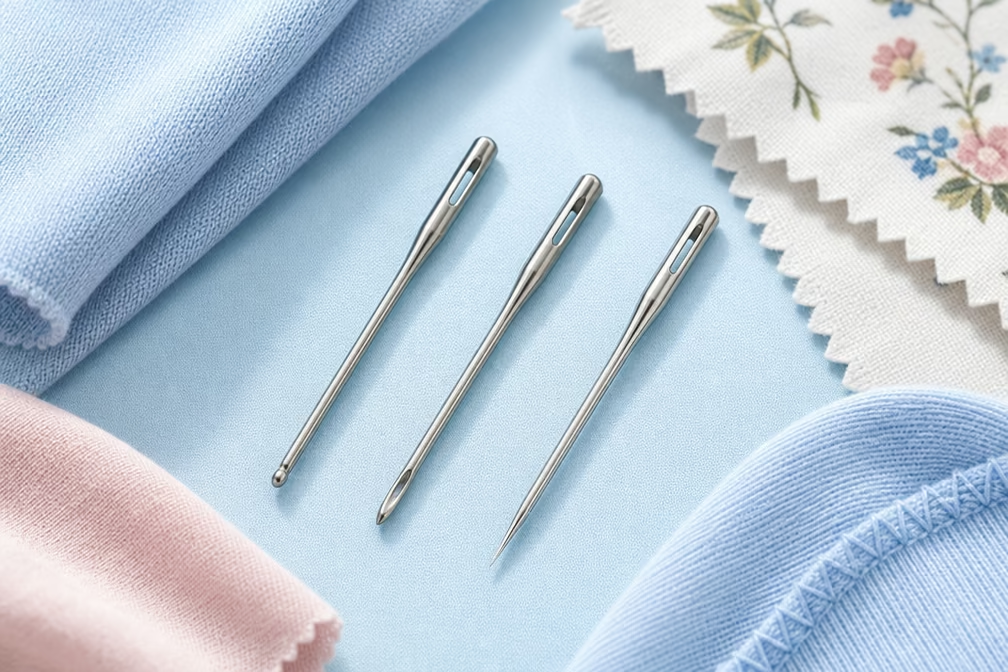
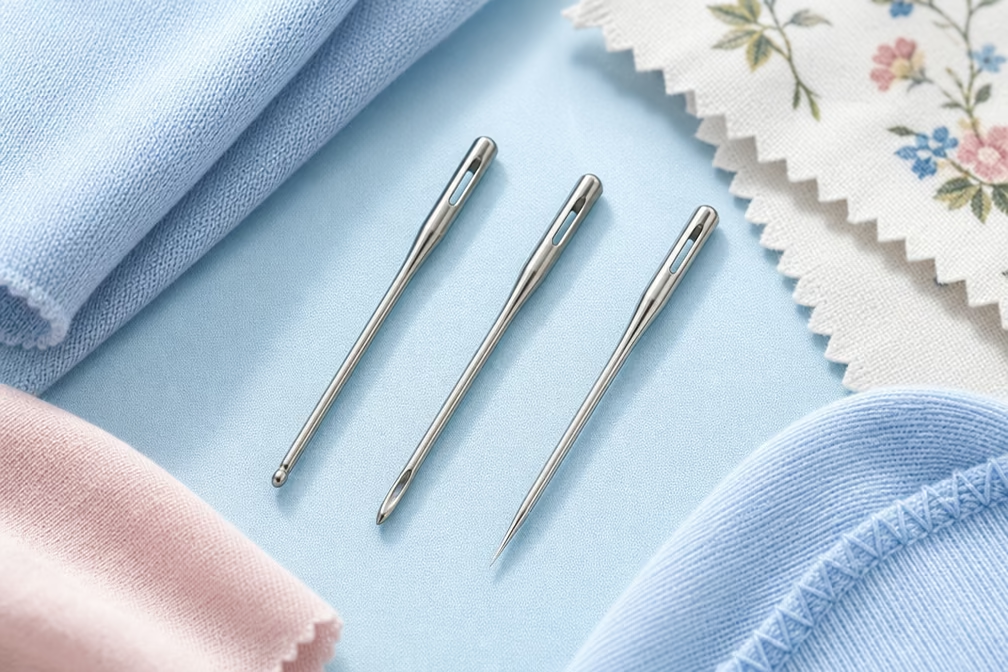
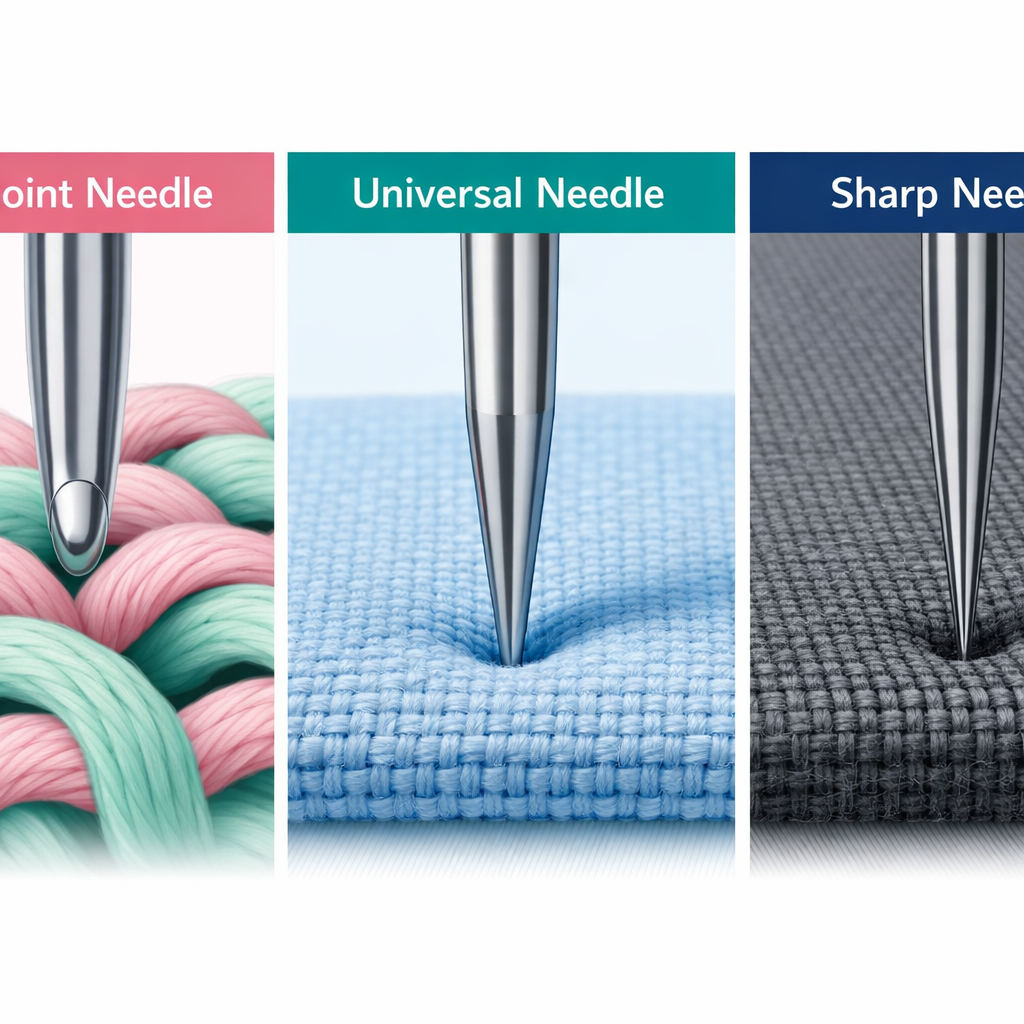
The primary difference between ballpoint, universal, and sharp sewing machine needles lies in the shape of the needle point and how it interacts with fabric fibers. Ballpoint needles feature a rounded tip that pushes knit fabric loops aside rather than piercing them, sharp needles have a pointed tip that cuts through tightly woven fibers cleanly, and universal needles split the difference with a slightly rounded point designed to work on multiple fabric types.
Ballpoint Needle Characteristics
Ballpoint needles (sometimes labeled “ball point” or with a “SUK” designation) have these defining features:
- Rounded tip that slides between knit fabric loops without breaking fibers
- Prevents runs, ladders, and snags in jersey, interlock, rib knits, and sweater knits
- Available in sizes 70/10 through 100/16, with 80/12 and 90/14 most common
- Works specifically on knit fabrics where fibers are looped rather than woven
The rounded point is the key feature. When you examine a ballpoint needle under magnification, the tip appears dome-shaped rather than pointed. This shape lets the needle find spaces between the knit loops and gently push them aside as it passes through.
Sharp Needle Characteristics
Sharp needles (also called microtex or labeled with an “H-M” designation) feature:
- Acute pointed tip that pierces fabric fibers rather than pushing them aside
- Creates clean, precise holes in tightly woven fabrics
- Ideal for cotton, linen, silk, microfiber, and densely woven synthetics
- Reduces puckering and skipped stitches on woven materials
- Available in sizes 60/8 through 110/18
The sharp point cuts through individual woven threads cleanly. This matters most on tightly woven fabrics where there’s no space between fibers for a rounded needle to slide through. Using a sharp needle on woven fabric produces straighter stitches and cleaner seam lines.
Universal Needle Characteristics
Universal needles (often labeled “H” or “standard”) represent a compromise:
- Slightly tapered point that’s less rounded than ballpoint but not as acute as sharp
- Designed to work acceptably on both knit and woven fabrics
- Most common needle type included with new sewing machines
- Best for beginners working on simple projects with medium-weight fabrics
- Available in sizes 60/8 through 120/19
Universal needles work adequately when you’re switching frequently between fabric types and don’t want to change needles constantly. However, they don’t perform as well as specialized needles on either extreme of the fabric spectrum.
When Should I Use a Ballpoint Needle vs a Sharp Needle?
Use a ballpoint needle whenever sewing knit fabrics including jersey, interlock, rib knits, sweater knits, or any fabric with visible stretch and loop construction. Use a sharp needle for tightly woven fabrics like quilting cotton, shirting, linen, silk, microfiber, or any fabric where individual threads are woven together without stretch.
The decision comes down to fabric construction, not fabric content. A cotton jersey t-shirt needs a ballpoint needle even though it’s cotton, while a cotton broadcloth shirt needs a sharp needle even though it’s also cotton. The difference is how the fabric is constructed, not what fiber it’s made from.


Superior Control & Consistency: The SCHMETZ Jersey Ball Point needle features a rounded medium ball point design that glides between fabric fibers instead of piercing them, helping prevent snags, runs, and holes on delicate knits and stretch fabrics

Superior Control & Consistency: The SCHMETZ Jersey Ball Point needle features a rounded medium ball point design that glides between fabric fibers instead of piercing them, helping prevent snags, runs, and holes on delicate knits and stretch fabrics
Choose Ballpoint Needles When:
- Sewing t-shirts, activewear, or casual knit garments
- Working with jersey, interlock, or rib knit fabrics
- Fabric stretches significantly when pulled
- You can see loops or a “grain” that runs in columns rather than a woven grid
- Previous attempts with other needles caused runs or snags
- Making swimwear, underwear, or athletic wear (though you may need stretch needles for high-spandex content)
Choose Sharp Needles When:
- Quilting with cotton fabrics
- Sewing button-down shirts, blouses, or formal wear
- Working with silk, linen, or tightly woven synthetics
- Fabric has no stretch or minimal stretch
- You can see a clear woven grid pattern when examining the fabric closely
- Topstitching or edge-stitching where precision matters
- Sewing lightweight fabrics that tend to pucker
The Fabric Pull Test
When unsure, grab the fabric with both hands and pull. If it stretches significantly and you can see the fabric structure open up into loops, use a ballpoint needle. If it barely stretches and maintains a tight woven structure, use a sharp needle.
Can I Use a Universal Needle on Knit Fabric?
You can use a universal needle on stable, medium-weight knit fabrics for basic projects, but it’s not ideal and may cause skipped stitches, small snags, or runs on delicate knits. Universal needles work best on interlock or thicker jersey knits where the fabric structure is more forgiving, but they often fail on lightweight jersey, ribbing, or any knit with a loose construction.
The slightly rounded point of a universal needle can push aside some knit loops, but not as effectively as a true ballpoint. This means you might get away with it on a casual t-shirt made from stable cotton jersey, but you’ll likely encounter problems on:
- Lightweight jersey (under 180 gsm)
- Rayon or modal knits with a drapey hand
- Ribbing or rib knit fabrics
- Sweater knits with visible texture
- Any knit that feels delicate or shows runs easily
Common outcome: Many sewers report that universal needles work fine for the first few inches of a seam on knit fabric, then start skipping stitches or creating small snags as the needle dulls. Switching to a ballpoint needle immediately solves the problem.
Which Needle Type Is Best for Cotton Fabric?
The best needle type for cotton fabric depends on whether the cotton is woven or knit. Woven cotton fabrics like quilting cotton, poplin, broadcloth, and lawn require sharp needles for clean penetration and precise stitches, while cotton jersey, cotton interlock, and cotton rib knits require ballpoint needles to prevent fiber damage.

Durable and Rustproof: The embroidery needles are made of durable stainless steel, so it will last for a long time without rusting.they can easily get through the fabric
You will Receive: The crochet needle for yarn kit contains 10 curved tapestry needles in 5 different colors and a needle bottle. Each tapestry needle is 2.8 inches long to meet various handcraft needs

STRONG & SHARP PRECISION NEEDLE: The SCHMETZ Microtex sewing machine needle features an ultra-thin, sharp point for flawless stitching and perfectly straight stitches, delivering powerful precision in fashion sewing and quilting
Cotton Woven Fabrics (Use Sharp Needles)
- Quilting cotton: Sharp 80/12 or 90/14
- Cotton lawn or voile: Sharp 70/10 or 80/12
- Cotton poplin or broadcloth: Sharp 80/12
- Denim: Sharp or denim needle 90/14 to 110/18
- Canvas or duck cloth: Sharp 100/16 or 110/18
Cotton Knit Fabrics (Use Ballpoint Needles)
- Cotton jersey: Ballpoint 80/12 or 90/14
- Cotton interlock: Ballpoint 80/12
- Cotton rib knit: Ballpoint 80/12
- Cotton French terry: Ballpoint 90/14
The fiber content (cotton) doesn’t determine needle choice. The fabric construction (woven vs. knit) determines whether you need a sharp or ballpoint needle. This same principle applies to polyester, rayon, linen, and other fibers.
What Happens If I Use a Sharp Needle on Jersey?
Using a sharp needle on jersey knit fabric typically causes skipped stitches, visible holes or runs in the fabric, and potential laddering where the needle has pierced and broken the knit loops rather than sliding between them. The sharp point cuts through the looped fibers instead of pushing them aside, damaging the fabric structure and creating weak points that can develop into runs or holes after washing and wearing.

Immediate Problems
When you first sew jersey with a sharp needle, you might notice:
- Skipped stitches where the machine fails to catch the bobbin thread
- Popping sounds as the needle breaks through fibers
- Visible holes along the seam line that don’t close up
- Thread breaks because the damaged fabric creates friction
- Puckered seams where the fabric has been stressed
Long-Term Damage
Even if the seam looks acceptable initially, using a sharp needle on jersey creates lasting problems:
- Small holes along seam lines that enlarge with wear
- Runs that develop from the puncture points
- Weakened seams that split under stress
- Fabric laddering near seam allowances
- Premature garment failure
Real-world example: Sewing a t-shirt hem with a sharp needle might look fine when you finish. After the first wash, small holes appear along the hemline where the needle broke fibers. By the third wash, those holes have become visible runs. The garment is ruined even though the stitching itself is intact.
Do I Really Need Different Needle Types or Is Universal Enough?
Universal needles are sufficient only for beginners working on simple projects with medium-weight, stable fabrics like cotton quilting fabric or basic cotton jersey. For quality results on a range of fabrics, you need both ballpoint and sharp needles because universal needles compromise performance on both fabric extremes and often cause problems with delicate knits, lightweight wovens, and specialty materials.
When Universal Needles Work Adequately
Universal needles handle these situations reasonably well:
- Learning basic straight seams on medium-weight cotton
- Simple projects with forgiving fabrics (tote bags, basic pillows)
- Occasional sewing where you’re not concerned about professional results
- Testing a pattern or making a muslin
- Sewing on stable interlock knit or medium-weight woven cotton
When You Need Specialized Needles
Invest in ballpoint and sharp needles when:
- Sewing garments you plan to wear regularly
- Working with fabrics that cost more than $10 per yard
- Creating items for sale or as gifts
- Encountering skipped stitches, puckering, or fabric damage
- Sewing lightweight fabrics (under 4 oz per square yard)
- Working with delicate knits like rayon jersey or modal
- Quilting or doing precision piecing
- Sewing formal wear, activewear, or specialty garments
Cost consideration: A pack of five specialized needles costs $4-8, while a yard of quality fabric costs $10-30. Spending $15 on a basic needle assortment (ballpoint, sharp, and stretch) protects your fabric investment and prevents project failures that waste both materials and time.
Ballpoint Needle vs Stretch Needle: What’s the Difference?
Ballpoint needles work for standard knit fabrics with moderate stretch, while stretch needles feature an even more rounded tip and a special scarf (the indentation above the eye) designed specifically for high-elasticity fabrics containing spandex, lycra, or elastane. Stretch needles prevent skipped stitches on fabrics that stretch 50% or more, such as swimwear, activewear, and performance fabrics.
Ballpoint Needle Specifications
- Rounded tip for standard knits
- Standard scarf design
- Works on jersey, interlock, rib knits, sweater knits
- Handles fabrics with 25-50% stretch
- Labeled “SUK” or “ball point”
Stretch Needle Specifications
- Extra-rounded tip (more rounded than ballpoint)
- Deep scarf that prevents skipped stitches on elastic fabrics
- Designed for swimwear, activewear, power mesh, and fabrics with over 50% stretch
- Essential for fabrics containing spandex/lycra/elastane
- Labeled “H-S” or “stretch”
When to upgrade from ballpoint to stretch: If you’re sewing standard cotton jersey t-shirts, ballpoint needles work fine. If you’re making leggings, swimsuits, sports bras, or anything with significant spandex content, stretch needles prevent the frustrating skipped stitches that ballpoint needles can’t solve.
The deep scarf on stretch needles allows the bobbin hook to catch the needle thread more reliably when the fabric is being stretched during sewing. This matters most on fabrics that stretch as the feed dogs move them, which can pull the needle thread away from the bobbin hook and cause skipped stitches.
Why Does My Needle Keep Breaking on Knit Fabric?
Needles break on knit fabric primarily because of using the wrong needle type (sharp instead of ballpoint), using a needle that’s too small for the fabric weight, sewing too fast on thick knits, or the needle hitting pins or the presser foot due to fabric shifting. Switching to a ballpoint or stretch needle in the appropriate size solves most needle breakage issues on knits.
Primary Causes of Needle Breakage on Knits
Wrong needle type: Sharp needles catch on knit loops and bend or break under the stress. The pointed tip gets caught in the fabric structure instead of sliding through smoothly.
Needle too small: Using a 70/10 needle on heavyweight sweatshirt fleece or French terry creates excessive stress. The thin needle shaft can’t handle the force required to penetrate thick fabric.
Fabric shifting: Knit fabrics stretch and shift more than wovens. If the fabric moves while the needle is down, the needle bends and breaks. This happens most often when:
- Sewing without pins or clips
- Using the wrong presser foot (standard foot instead of walking foot)
- Sewing too close to the edge where fabric is unsupported
- Machine tension is too tight
Hitting obstacles: Needles break instantly when they hit pins, the presser foot edge, or the needle plate. On stretchy knits, fabric can shift unexpectedly and cause these collisions.
Solutions for Needle Breakage
- Switch to ballpoint or stretch needles appropriate for knit fabric
- Size up: Use 80/12 or 90/14 for medium-weight knits, 90/14 or 100/16 for heavyweight
- Slow down: Reduce sewing speed on thick or unstable knits
- Use a walking foot to feed top and bottom layers evenly
- Remove pins before they reach the needle or place pins perpendicular to the seam in the seam allowance only
- Check needle insertion: Ensure the needle is fully inserted and the flat side faces the back
- Replace dull needles: Dull needles require more force to penetrate fabric and break more easily
Can Universal Needles Work for Both Woven and Knit Fabrics?
Universal needles can work for both woven and knit fabrics when sewing simple projects with medium-weight, stable materials, but they deliver mediocre results on both fabric types compared to specialized needles. They’re acceptable for basic cotton quilting fabric and stable cotton interlock, but they struggle with lightweight wovens, delicate knits, tightly woven fabrics, and high-stretch materials.
Where Universal Needles Succeed
Universal needles handle these combinations adequately:
- Medium-weight quilting cotton (woven)
- Stable cotton interlock (knit)
- Basic cotton jersey over 200 gsm (knit)
- Cotton poplin or broadcloth (woven)
- Simple home décor projects
- Beginner projects where precision isn’t critical
Where Universal Needles Fail
Universal needles cause problems with:
- Lightweight jersey under 180 gsm (causes snags and runs)
- Silk, rayon, or modal knits (damages delicate fibers)
- Tightly woven cotton lawn or voile (causes puckering)
- Silk or microfiber wovens (skips stitches)
- Any fabric with spandex content (skips stitches)
- Ribbing or textured knits (causes runs)
- Denim or heavyweight wovens (dulls quickly)
Practical approach: Keep universal needles installed for quick mending or simple projects, but switch to specialized needles for any project where you care about the outcome. The two minutes it takes to change a needle saves hours of seam ripping and frustration.
What Needle Should a Beginner Use for Most Projects?
Beginners should start with universal 80/12 needles for learning basic techniques on medium-weight fabrics, then quickly expand to a basic needle assortment including ballpoint 80/12 for knits and sharp 80/12 for wovens once they move beyond practice projects. This three-needle starter set covers approximately 80% of common home sewing projects and prevents most fabric damage issues.
Beginner Needle Starter Kit
Build a basic needle collection with these essentials:
- Universal 80/12 (pack of 5): For practice, testing, and medium-weight stable fabrics
- Ballpoint 80/12 (pack of 5): For t-shirts, jersey knit projects, and casual knit garments
- Sharp 80/12 (pack of 5): For quilting cotton, shirts, and woven fabric projects
Total investment: $12-20 for all three packs, which provides 15 needles covering most beginner projects.
When to Add Specialized Needles
Expand your collection as you tackle new project types:
- Stretch 75/11 or 80/12: When sewing activewear, swimwear, or high-spandex fabrics
- Denim/Jeans 90/14 or 100/16: For hemming jeans or sewing with denim
- Leather 90/14 or 100/16: For leather, vinyl, or faux leather projects
- Topstitch 90/14: For decorative topstitching with heavier thread
- Twin needles: For hemming knits with a professional double-needle finish
Needle Organization for Beginners
Prevent mix-ups by:
- Keeping needles in original packaging with labels
- Using a needle storage case with labeled compartments
- Writing the needle type on masking tape stuck to your machine when you change needles
- Disposing of used needles in a sharps container (a small jar with a lid works)
- Changing needles every 8-10 hours of sewing or with each new project
Common beginner mistake: Using the same universal needle for months or even years. Needles dull quickly, and a dull needle causes more problems than the wrong needle type. Change needles frequently.
Sharp Needle Skipping Stitches on Polyester Knit: What’s Wrong?
A sharp needle skipping stitches on polyester knit indicates you’re using the wrong needle type for the fabric. Polyester knit requires a ballpoint or stretch needle regardless of fiber content because the knit construction needs a rounded tip to slide between loops rather than pierce them. Switch to a ballpoint 80/12 or stretch 75/11 needle to eliminate skipped stitches on polyester knit fabrics.
Why Sharp Needles Skip on Knits
Sharp needles skip stitches on knit fabrics because:
- The pointed tip catches on knit loops instead of sliding through smoothly
- The fabric deflects downward as the sharp point tries to pierce it
- The needle thread doesn’t form a proper loop for the bobbin hook to catch
- The timing appears off even though the machine timing is correct
The problem isn’t your machine. The sharp needle point creates resistance against the knit structure, causing the fabric to push down and away from the needle. This prevents the needle thread from forming the loop that the bobbin hook needs to catch, resulting in skipped stitches.
Complete Solution
Fix skipped stitches on polyester knit by:
- Replace the sharp needle with ballpoint 80/12 (or stretch 75/11 for high-spandex content)
- Check that the needle is fully inserted with the flat side facing back
- Ensure you’re using the correct thread (polyester or poly-cotton thread, not cotton-only)
- Reduce upper tension slightly if stitches still skip
- Clean the bobbin area to remove lint that can interfere with hook timing
- Slow down your sewing speed on stretchy fabrics
Expected result: Switching from sharp to ballpoint needle typically eliminates 95% of skipped stitch problems on knit fabrics immediately. If skipping continues with the correct needle, check thread quality, needle insertion, and bobbin tension.
Where to Buy Ballpoint Needles for Sewing Machine
Ballpoint sewing machine needles are available at fabric stores (Joann, Hobby Lobby), big-box retailers (Walmart, Target), online marketplaces (Amazon, Etsy), sewing specialty retailers (Wawak, Nancy’s Notions), and directly from needle manufacturers (Schmetz, Organ, Klasse). Online retailers typically offer the widest selection and best prices, while local fabric stores provide immediate availability for urgent projects.

4X LONGER LIFE WITH TITANIUM COATING — Titanium-coated needles are super strong and last up to 4 times longer than regular sewing machine needles, delivering exceptional durability and value for high-volume sewing projects


Superior Control & Consistency: The SCHMETZ Jersey Ball Point needle features a rounded medium ball point design that glides between fabric fibers instead of piercing them, helping prevent snags, runs, and holes on delicate knits and stretch fabrics
Best Places to Buy Needles
Online retailers (best selection and prices):
- Amazon: Wide selection, fast shipping, customer reviews
- Wawak: Professional sewing supplier, bulk pricing available
- Nancy’s Notions: Curated selection, educational resources
- Joann.com: Frequent coupons, store pickup option
Local stores (immediate availability):
- Joann Fabric: Carries Schmetz needles in common sizes
- Hobby Lobby: Limited selection, frequent 40% off coupons
- Walmart: Basic universal and ballpoint in common sizes
- Local independent fabric stores: Often carry professional-grade needles
Manufacturer direct:
- Schmetz: German-made needles, industry standard
- Organ: Japanese-made needles, excellent quality
- Klasse: Budget-friendly option with good performance
What to Look For
When buying ballpoint needles, check:
- Correct labeling: Look for “ball point,” “SUK,” or a ball point symbol
- Size range: 80/12 and 90/14 are most versatile
- Quantity: Packs of 5 are standard, bulk packs of 10-25 save money
- Brand reputation: Schmetz and Organ are reliable; avoid unlabeled generic needles
- Compatibility: Ensure needles fit your machine (most home machines use standard 130/705 H system needles)
Price expectations: Quality ballpoint needles cost $4-8 for a pack of five. Bulk packs of 25 needles cost $15-25. Avoid extremely cheap needles (under $2 per pack) as they’re often poorly manufactured and break easily.
How Do I Know Which Needle Came with My Sewing Machine?
Most sewing machines come with a universal 80/12 or 90/14 needle pre-installed, though some brands include a small assortment of needles (typically universal, ballpoint, and sometimes stretch or denim) in a plastic case with the accessories. Check your machine’s manual or accessory box to identify included needles, but assume the installed needle is universal unless labeled otherwise.
Identifying Pre-Installed Needles
The needle that came installed in your machine is almost certainly:
- Universal 80/12 or 90/14: Standard for most home sewing machines
- Unlabeled: Manufacturers rarely label pre-installed needles
- Medium quality: Adequate for testing the machine but not premium quality
Important: The pre-installed needle is meant for testing the machine and sewing your first practice seams. Replace it with an appropriate needle type for your actual project fabric.
Checking the Accessory Box
Many machines include a needle assortment in the accessory box:
- Small plastic case with 3-5 needles in individual slots
- Usually includes: 1-2 universal, 1 ballpoint, sometimes 1 stretch or jeans needle
- May be labeled with needle type and size on the case
- Check the manual for a list of included accessories
When You Can’t Identify the Needle
If you’re unsure what needle is installed:
- Assume it’s universal and replace it with the appropriate needle for your fabric
- Check the flat side: All standard home machine needles have a flat side that faces back
- Measure the shaft: Thicker shafts indicate larger sizes (90/14, 100/16)
- Start fresh: Install a new needle in the correct type and size for your project
Best practice: Never start a project with an unknown needle. The few minutes spent installing a fresh, correctly-typed needle prevents hours of troubleshooting skipped stitches and fabric damage.
Common Mistakes When Choosing Sewing Machine Needles
The most common mistakes when choosing sewing machine needles include using universal needles for all projects, never changing needles between projects, choosing needle size based on thread thickness rather than fabric weight, mixing up ballpoint and sharp needles due to poor storage, and assuming all needles fit all machines without checking the needle system compatibility.
Top Needle Selection Mistakes
1. Using universal needles exclusively
Many sewers buy one pack of universal needles and use them for everything from silk to denim to jersey. Universal needles compromise performance on all fabric types and cause most beginner frustration with skipped stitches and fabric damage.
Fix: Build a basic collection of universal, ballpoint, and sharp needles in size 80/12.
2. Never changing needles
Needles dull quickly, typically after 8-10 hours of sewing or one large project. Dull needles cause skipped stitches, thread breaks, and fabric damage even when you’re using the correct needle type.
Fix: Change needles at the start of each new project or after 8-10 hours of sewing.
3. Choosing size by thread instead of fabric
Needle size should match fabric weight, not thread thickness. A common mistake is using a size 70/10 needle with fine thread on medium-weight fabric, which causes the thin needle to break or bend.
Fix: Choose needle size based on fabric weight first, then ensure the needle eye accommodates your thread.
4. Poor needle organization
Storing different needle types together without labels leads to grabbing the wrong needle. Sharp and ballpoint needles look identical, but using the wrong one ruins projects.
Fix: Keep needles in original packaging or use a labeled storage case. Mark your machine with tape noting the installed needle type.
5. Ignoring needle system compatibility
Not all needles fit all machines. Most home machines use 130/705 H system needles, but some industrial machines, vintage machines, and specialty machines require different systems.
Fix: Check your manual for the correct needle system before buying needles.
6. Buying the cheapest needles
Generic, unbranded needles from discount sources often have poor quality control. They break easily, have rough finishes that damage thread, and may not be sized accurately.
Fix: Stick with reputable brands like Schmetz, Organ, or Klasse. The price difference is minimal compared to the cost of ruined fabric.
7. Using the wrong needle for specialty fabrics
Leather, vinyl, and knits with metallic threads require specialty needles. Using standard needles on these materials causes immediate problems.
Fix: Research needle requirements before starting projects with specialty materials.
Frequently Asked Questions
Can I use a sharp needle on stretch fabric?
No, sharp needles will damage stretch fabric by piercing and breaking the knit loops rather than sliding between them. Use ballpoint needles for moderate stretch fabrics or stretch needles for high-elasticity fabrics containing spandex. Sharp needles cause runs, holes, and skipped stitches on any knit or stretch material.
How often should I change my sewing machine needle?
Change your sewing machine needle every 8-10 hours of sewing, at the start of each new project, or immediately if you hear popping sounds, notice skipped stitches, or see thread fraying. Needles dull quickly and a dull needle causes more problems than using the wrong needle type.
What size needle should I use for cotton jersey?
Use a ballpoint 80/12 needle for lightweight to medium-weight cotton jersey, or a ballpoint 90/14 for heavyweight cotton jersey or French terry. The ballpoint tip prevents damage to the knit structure while the size accommodates the fabric weight. Never use a sharp or universal needle on jersey.
Do needle brands matter?
Yes, needle brands matter significantly. Schmetz and Organ needles have consistent quality control, accurate sizing, and smooth finishes that protect thread and fabric. Generic unbranded needles often have rough finishes, inconsistent sizing, and break easily. The small price difference is worth the reliability.
Can I use a ballpoint needle on woven fabric?
You can use a ballpoint needle on loosely woven fabric without problems, but it will produce slightly less precise stitches than a sharp needle on tightly woven fabrics. The rounded tip may push woven threads aside rather than piercing cleanly, causing minor puckering on dense weaves. For best results on woven fabrics, use sharp needles.
What’s the difference between jersey and stretch needles?
Jersey needles (ballpoint) have a rounded tip for standard knits with moderate stretch, while stretch needles have an even more rounded tip and a deeper scarf designed for high-elasticity fabrics containing spandex or lycra. Use jersey/ballpoint needles for cotton jersey and standard knits; use stretch needles for activewear, swimwear, and fabrics with over 50% stretch.
Why do my needles keep breaking?
Needles break due to using the wrong needle type for your fabric (sharp on knits), using a needle that’s too small for the fabric weight, sewing too fast on thick materials, hitting pins or the presser foot, or the needle not being fully inserted. Check that you’re using the correct needle type and size, remove pins before they reach the needle, and ensure the needle is properly installed.
Can I sharpen a dull sewing machine needle?
No, you cannot effectively sharpen a dull sewing machine needle. The needle point is precisely manufactured and any attempt to sharpen it will damage the geometry and cause more problems. Needles are inexpensive consumables designed to be replaced regularly. Dispose of dull needles safely and install a fresh needle.
What does the H mean on needle packages?
The “H” on needle packages stands for “Hohlkehle,” the German word for scarf (the indentation on the needle shaft). It indicates the needle is designed for home sewing machines using the 130/705 H system. Additional letters indicate needle type: H-SUK (ballpoint), H-M (sharp/microtex), H-S (stretch), H-J (jeans/denim).
Do I need different needles for different thread types?
Generally no, the needle type should match your fabric, not your thread. However, very thick threads (topstitching thread, buttonhole twist) require needles with larger eyes (topstitch needles), and metallic threads work best with needles that have special coatings or larger eyes to prevent shredding. For standard thread, choose needle type based on fabric construction.
What needle do I use for fleece?
Use a ballpoint 90/14 needle for fleece fabric. Fleece is a knit fabric despite its thick, fuzzy texture, so it requires a ballpoint needle to avoid damaging the knit structure. The larger 90/14 size accommodates the fabric weight. For very heavyweight fleece, use a ballpoint 100/16.
Can universal needles cause skipped stitches?
Yes, universal needles frequently cause skipped stitches on lightweight knits, delicate jerseys, and high-stretch fabrics because their slightly rounded point isn’t rounded enough to reliably slide between knit loops. Switching to a true ballpoint or stretch needle eliminates most skipped stitch problems on knit fabrics.
Conclusion
Understanding the differences between ballpoint, universal, and sharp needles transforms your sewing results from frustrating to professional. The needle point shape determines how it interacts with fabric: ballpoint needles slide between knit loops without damage, sharp needles pierce woven fibers cleanly, and universal needles compromise on both. While universal needles work adequately for beginners on stable, medium-weight fabrics, investing in specialized needles prevents fabric damage, skipped stitches, and project failures.
Take action now:
- Audit your current needle supply and identify what types you own
- Build a starter collection with ballpoint 80/12, sharp 80/12, and universal 80/12 needles
- Label your needle storage to prevent mixing up needle types
- Change your needle before starting your next project, choosing the type based on fabric construction (knit vs. woven) rather than fiber content
- Replace needles regularly every 8-10 hours of sewing or with each new project
The small investment in proper needles (typically $12-20 for a basic assortment) protects your fabric investment and saves countless hours of troubleshooting. Match your needle type to your fabric construction, change needles frequently, and watch your stitch quality improve immediately.


