
Quick Answer
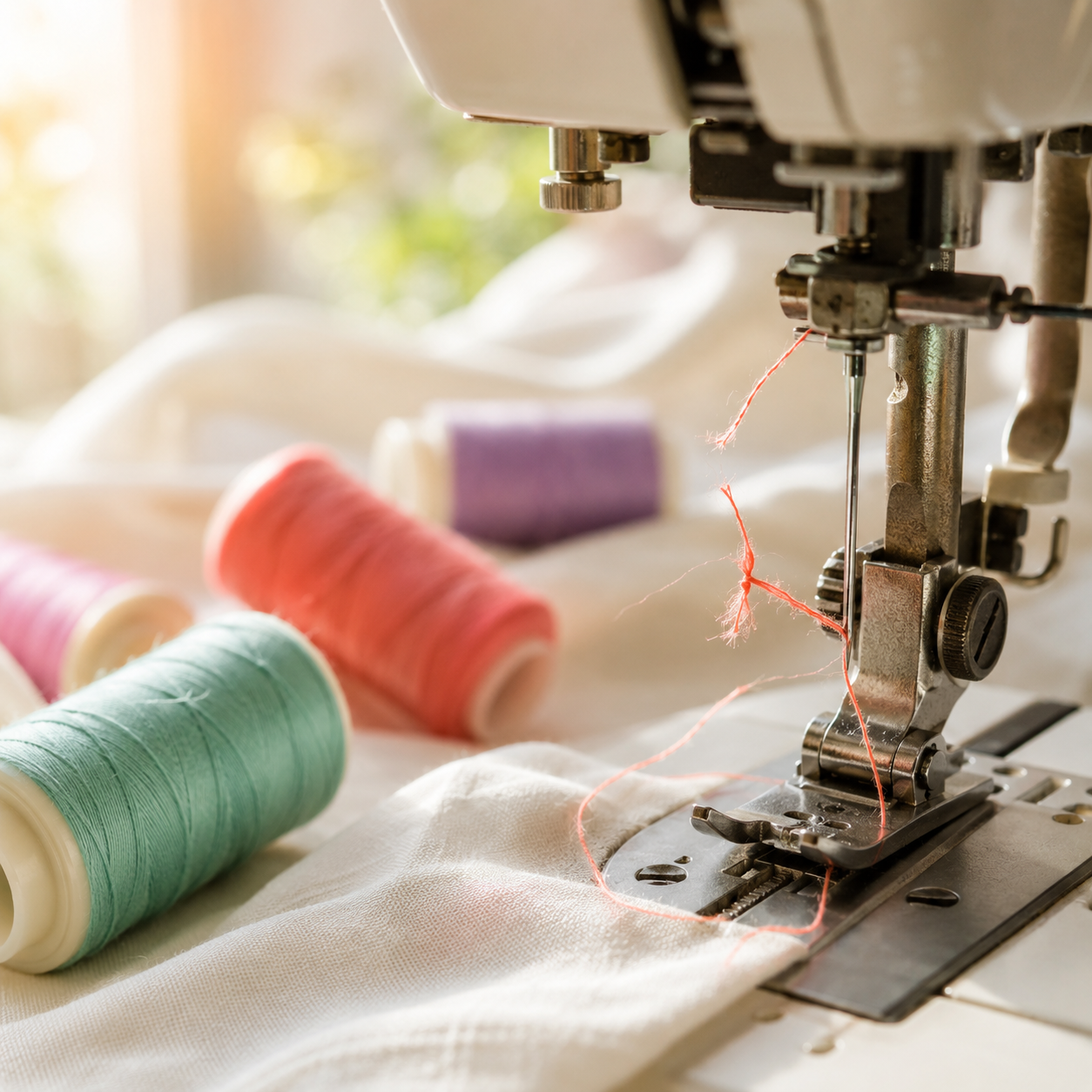
Thread breaks during sewing primarily because of incorrect needle size, improper tension settings, poor thread quality, or a dull or damaged needle. Most breaking issues stem from a mismatch between your needle, thread weight, and fabric type, or from threading errors that create friction points. Fixing the problem usually requires checking your needle size, adjusting upper tension, and ensuring your thread path is smooth and correctly threaded.
Key Takeaways
- Needle size matters most: A needle too small for your thread weight creates friction and heat that snaps thread repeatedly
- Tension imbalance is the second most common culprit: Upper tension set too tight pulls thread until it breaks, especially at the needle eye
- Thread quality directly affects breakage: Old, dried-out, or bargain-bin thread lacks the strength and flexibility of fresh, quality thread
- Dull needles cause 30-40% of breaking problems: A needle used for more than 8 hours of sewing or one that’s hit pins will damage thread fibers
- Threading path errors create hidden friction: Missing a single thread guide or threading the machine with the presser foot down causes breaks
- Fabric thickness requires needle and tension adjustments: Thick fabrics need larger needles and sometimes looser tension to prevent thread stress
- Polyester thread generally breaks less than cotton: Its higher tensile strength and flexibility make it more forgiving for beginners
- The same-spot break pattern indicates a burr or rough spot: Thread breaking at an identical point every few stitches means a damaged needle or rough machine part
What Causes Sewing Thread to Break Constantly?
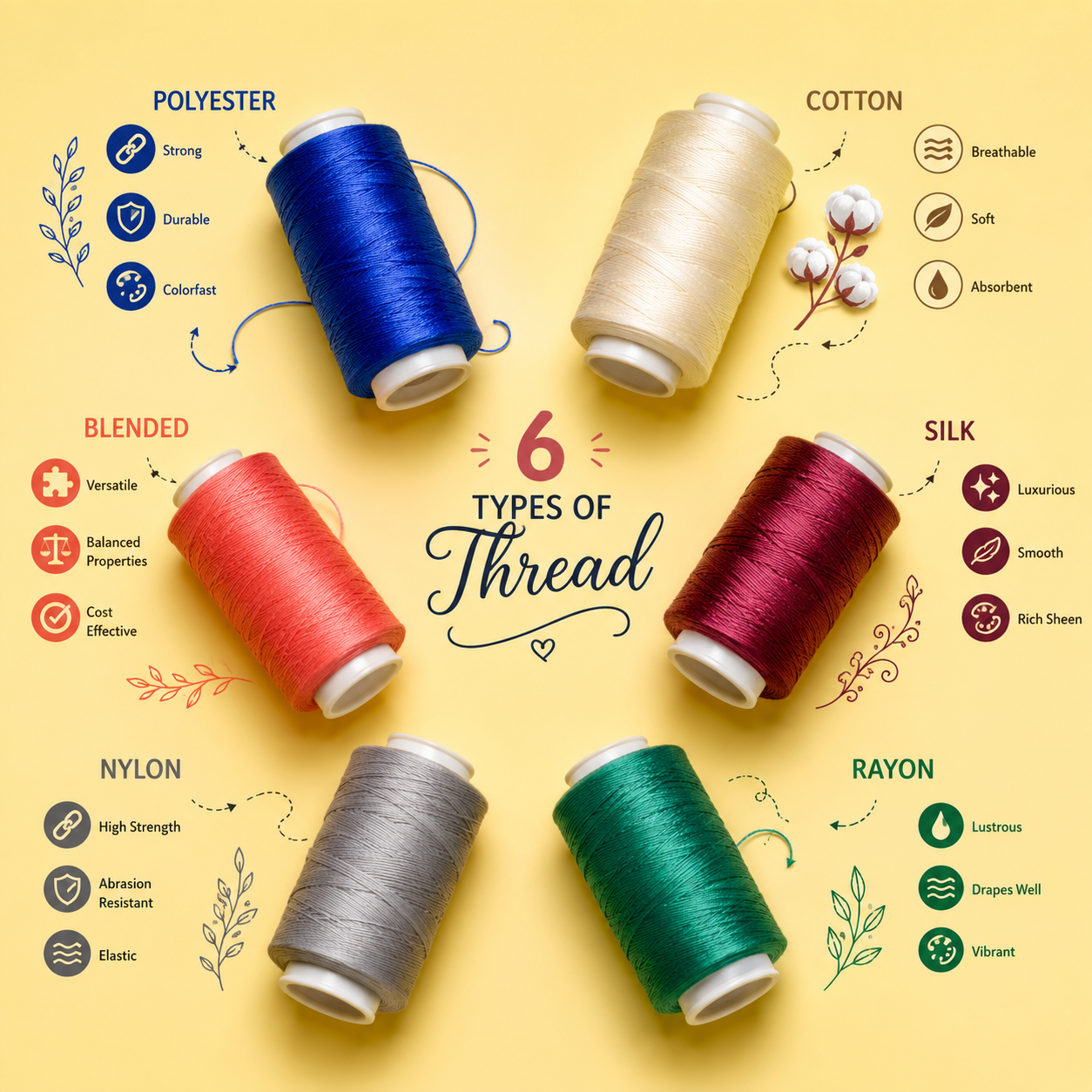
Thread breaks constantly when one or more elements in your sewing system are mismatched or damaged. The most common causes are using a needle that’s too small for your thread weight, setting upper tension too tight, using old or low-quality thread, sewing with a dull or damaged needle, or threading your machine incorrectly.
Think of thread as a rope under constant stress. Every stitch pulls it through multiple friction points: the spool pin, tension discs, take-up lever, thread guides, and needle eye. If any of these points creates excessive friction or if the thread itself is weak, it will snap.
The five primary culprits behind constant thread breaking:
- Needle-thread mismatch: A size 70/10 needle with heavy topstitching thread creates a tight squeeze that generates heat and friction
- Excessive upper tension: Tension set above 5-6 on most machines pulls thread so tightly it can’t flex during stitch formation
- Compromised thread quality: Thread that’s been sitting in a hot garage for three years loses moisture and becomes brittle
- Worn or damaged needle: A dull point or burr on the needle eye acts like a tiny knife cutting your thread with each pass
- Threading errors: Skipping the take-up lever or a thread guide creates uneven tension and sudden jerks that snap thread
Common mistake: Many sewers assume their machine is broken when thread keeps breaking, but 80-90% of the time it’s a simple setup issue that takes less than five minutes to fix.
How to Fix Thread Breaking on Your Sewing Machine
Start by rethreading your entire machine with the presser foot UP, which opens the tension discs properly. Then replace your needle with a fresh one that matches your thread weight, and reduce upper tension by one full number. This three-step sequence solves most breaking problems immediately.
Step-by-step troubleshooting process:
- Turn off the machine and remove the thread completely
- Raise the presser foot (this is critical, threading with it down traps thread incorrectly)
- Install a brand-new needle in the correct size for your thread and fabric
- Rethread from spool to needle, checking that thread passes through every guide and the take-up lever
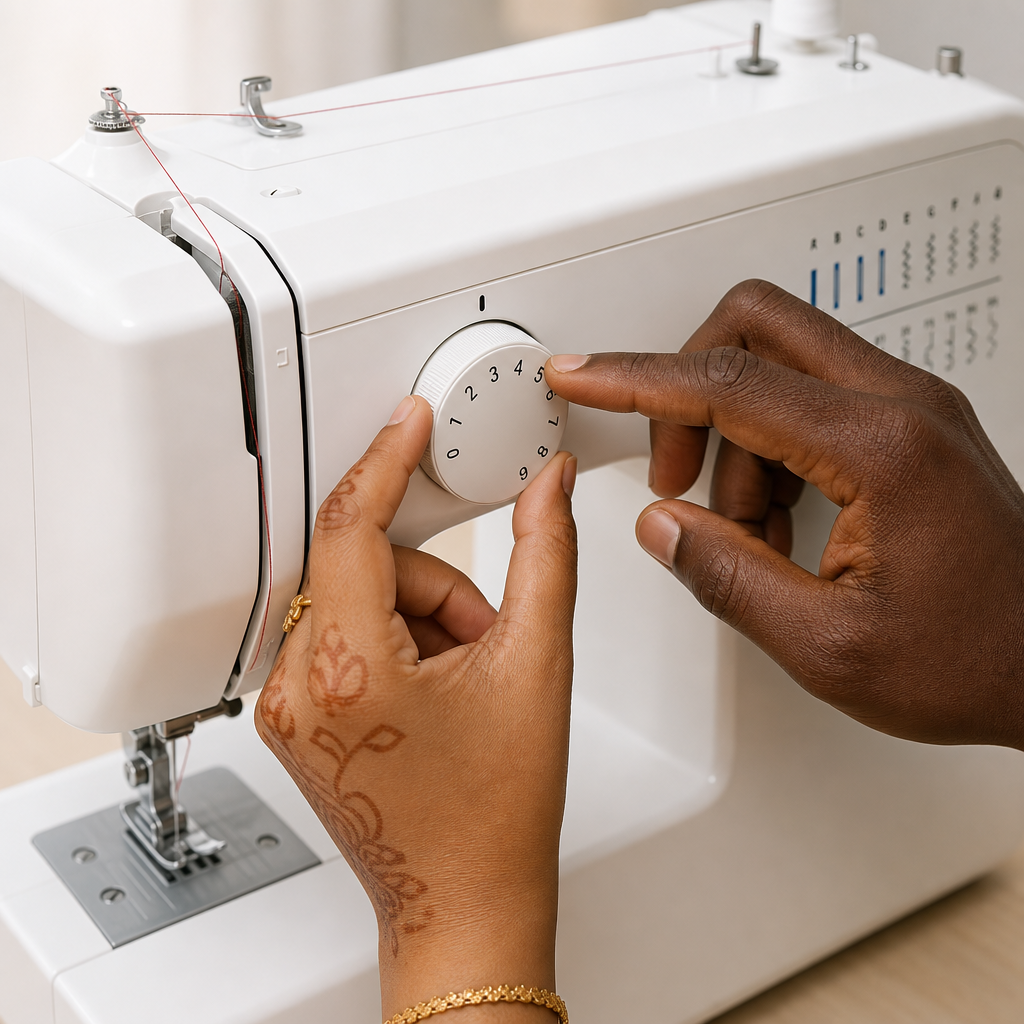
- Lower tension by 1-2 numbers from your current setting
- Test on scrap fabric that matches your project material
- If breaking continues, check bobbin tension by holding the bobbin case, it should drop slowly when you hold the thread
Choose this approach if: You’ve been sewing for a while without changing your needle, you’re not sure when you last cleaned your machine, or you recently switched to a different thread brand or weight.
Edge case: If thread breaks only when sewing in reverse, your take-up lever timing may be slightly off, or you’re reversing too quickly. Slow down your reverse stitching speed and see if the problem disappears.

PREMIUM QUALITY MATERIAL: Made of top quality high-strength steel, sharp smooth, sturdy and durable, not easy to bend, and long service life.

Regular Point & Durable Design:Features a sharp regular point that penetrates fabrics smoothly,ensuring even stitches and avoiding skipped stitches or fabric damage.The needles are made of high-quality material with a sturdy shaft,wear-resistant and durable,not easy to bend or break even when sewing heavy-duty materials.The bright color coating not only enhances visibility but also adds a layer of protection against wear.

Pack of 10 Genuine Singer Sewing Machine Needles
Is My Needle Too Small for the Thread Weight?
Your needle is too small for your thread if the thread barely fits through the needle eye or if you see fraying at the needle after just a few inches of sewing. Thread needs room to move freely through the needle eye without excessive friction, a tight fit generates heat that weakens and breaks thread.
Needle-to-thread matching guide:
| Thread Weight | Needle Size | Thread Type Examples |
|---|---|---|
| Extra fine (100wt) | 60/8 or 65/9 | Silk thread, fine embroidery |
| Fine (60-80wt) | 70/10 or 75/11 | Standard cotton, fine polyester |
| Medium (40-50wt) | 80/12 or 90/14 | All-purpose thread, most projects |
| Heavy (30wt) | 90/14 or 100/16 | Topstitching thread, buttonhole twist |
| Extra heavy (12-20wt) | 100/16 or 110/18 | Upholstery thread, heavy topstitching |
The needle eye should be roughly 40% larger than your thread diameter. If you hold the needle up to light and can barely see light around the thread when it’s in the eye, go up one or two needle sizes.
Decision rule: Choose a larger needle if you’re working with decorative or specialty threads, sewing multiple layers, or using fabrics that are thick or densely woven. Choose a smaller needle only for delicate fabrics where a large needle would leave visible holes.
Thread Breaking vs Bobbin Tension Problems: How to Tell the Difference
Thread breaking happens when the upper thread snaps completely, while bobbin tension problems show up as loose loops on the fabric underside, uneven stitches, or thread nests without actual breakage. If your thread is snapping, the problem is almost always with the upper thread system, not the bobbin.
Upper thread breaking symptoms:
- Thread snaps audibly during sewing
- Broken thread end is visible at the needle or hanging from the take-up lever
- Machine may stop or continue sewing without thread
- Often happens at the same point in the stitch cycle
Bobbin tension problem symptoms:
- Loops of bobbin thread visible on the fabric top
- Stitches look uneven but thread doesn’t break
- Thread nests or “bird nests” form under the fabric
- Fabric puckers or gathers unexpectedly
Test to identify the issue: Thread your machine with a contrasting color on top and in the bobbin. Sew a test line. If the top thread breaks, it’s an upper thread problem. If you see loops of the bottom color on top of the fabric, it’s a bobbin tension issue.
Common mistake: Adjusting bobbin tension when the real problem is upper thread tension or needle size. Bobbin tension is factory-set on most machines and rarely needs adjustment, only change it if you’ve ruled out all upper thread causes.
Best Thread Brands That Don’t Break Easily
Quality thread brands like Gutermann, Mettler, Aurifil, and Coats & Clark produce consistently strong thread with even twist and minimal lint that resists breaking under normal sewing conditions. These brands use longer staple fibers and better manufacturing processes that create thread with higher tensile strength.
Top-rated thread brands for break resistance:
- Gutermann Sew-All: Polyester thread with excellent strength, available in 250+ colors, works well for general sewing
- Mettler Metrosene: Long-staple polyester with low lint, popular among quilters and garment sewers
- Aurifil 50wt: Cotton thread with a tight twist that resists breakage, favorite for quilting and appliqué
- Coats & Clark Dual Duty XP: Poly-wrapped cotton core, good all-purpose choice for beginners
- Superior Threads So Fine: Ultra-fine polyester that’s surprisingly strong despite its delicate appearance
What makes quality thread break-resistant:
- Longer staple fibers create fewer weak points
- Consistent twist throughout the spool prevents thin spots
- Proper finish reduces friction through the needle eye
- Fresh thread retains moisture and flexibility
- Even dye application doesn’t weaken fibers
Avoid these red flags: Thread that sheds lint heavily when you run it through your fingers, thread with visible thick and thin spots, spools without brand labels or fiber content information, and thread that feels dry or brittle when you pull it.

12WT Bonded Polyester Outdoor Thread. Improved resistance to strength loss from UV exposure over standard polyester filament thread. No lint. No joint. Outdoor Living Thread

Bonded Nylon Sewing Thread #138: Compared to bonded polyester thread, the heavy-duty nylon thread is stronger & has higher heat tolerance, making great leather thread, outdoor thread, marine thread, carpet thread, canvas thread, & jeans thread.
![Selric [1500Yards / 36 Colors Available] UV Resistant High Strength Polyester Thread #69 T70 Size 210D/3 for Upholstery, Outdoor Market, Drapery, Beading, Purses, Leather (White)](https://m.media-amazon.com/images/I/31I7SOSHnVL._SL500_.jpg)
Selric High Quality Polyester Threads. Size: 1500Yards 210D/3 #69 T70. Thread Net Weight: Threads 110g.If you are interested in buying two spools of the same colors (US warehouse available), please kindly search for " Selric Pack of 2 Polyester Thread" to save $1.99 Dollar on two spools.
How Much Does Quality Thread Cost Compared to Cheap Thread?
Quality thread costs $4-8 per 250-yard spool compared to $1-2 for bargain thread, but the price difference is negligible per project since most garments use less than 100 yards of thread. A $6 spool of Gutermann will sew approximately 8-10 garments, making the per-project cost about 60-75 cents versus 15-20 cents for cheap thread.
Cost comparison breakdown:
- Bargain thread: $1-2 per spool, often breaks multiple times per project, may require resewing seams
- Mid-range thread: $3-5 per spool, reliable for most projects, occasional breaks on difficult fabrics
- Premium thread: $6-10 per spool, rarely breaks, smoother finish, better color selection
- Specialty thread: $10-20 per spool, designed for specific applications like metallic embroidery or outdoor fabrics
The hidden cost of cheap thread includes time spent rethreading your machine, frustration, potential damage to your machine’s tension system from lint buildup, and the risk of ruining a nearly-finished project when thread breaks during final topstitching.
Decision rule: Use premium thread for heirloom projects, garments you plan to wear for years, and any project where you’re investing significant time. Mid-range thread works fine for practice projects, home décor items, and everyday sewing. Skip bargain thread entirely unless you’re doing temporary basting that you’ll remove later.

Premium Dual Duty XP Construction: Made from durable 100% polyester, this all purpose thread for sewing machine projects delivers exceptional strength, smooth feeding, and consistent tension across a wide range of fabric types and weights.
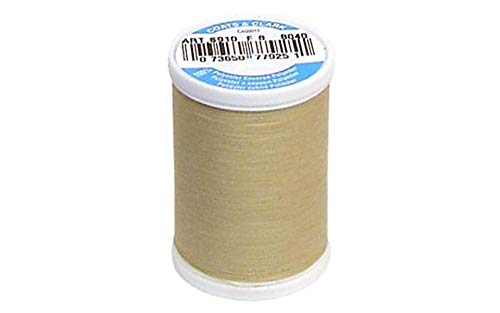
Premium Dual Duty XP Construction: Made from durable 100% polyester, this all purpose thread for sewing machine projects delivers exceptional strength, smooth feeding, and consistent tension across a wide range of fabric types and weights.

Versatile Thread: Coats Thread & Zippers S910-6160 is a high-quality, dual-duty thread suitable for a wide range of sewing projects, ensuring reliability and durability.
Why Does Thread Break Only on Thick Fabric?
Thread breaks on thick fabric but not thin fabric because thick layers require more needle penetration force, create more friction as the needle passes through, and put additional stress on the thread during stitch formation. The combination of increased resistance and heat buildup weakens thread to its breaking point.
When sewing through multiple layers or dense fabrics like denim, canvas, or upholstery material, your needle must push through more resistance. This creates three problems: the needle heats up from friction, the thread gets pulled more forcefully through the fabric, and the needle may deflect slightly, causing the thread to rub against the needle eye at an angle.
Solutions for thick fabric thread breaking:
- Increase needle size by 2-4 sizes: Move from a 80/12 to a 90/14 or 100/16 for heavy fabrics
- Switch to a wedge-point or denim needle: These specialized needles penetrate thick fabric more easily
- Reduce sewing speed by half: Slower stitching generates less heat and gives thread time to move through the fabric
- Use polyester or poly-wrapped thread: These have higher heat resistance than 100% cotton
- Loosen upper tension by 1-2 numbers: Thick fabric needs more thread to form each stitch
- Consider a walking foot: This presser foot helps feed thick layers evenly, reducing stress on thread
Edge case: If thread breaks only when topstitching thick fabric, you may need to switch to topstitching thread (30wt) with a topstitching needle (100/16) that has an extra-large eye designed for heavy thread.
Thread Keeps Breaking Even After Rethreading Machine
If thread continues breaking after rethreading, the problem is likely a damaged needle, incorrect tension setting, a rough spot in your thread path, or thread that’s too old or low-quality to work reliably. Rethreading fixes path errors but doesn’t address mechanical or material issues.
Advanced troubleshooting checklist:
- Replace the needle with a new one from a different package (occasionally an entire package has defective needles)
- Check the needle is inserted correctly: Flat side should face the back on most machines
- Inspect the needle eye with a magnifying glass: Look for burrs, rough spots, or damage
- Run your fingernail along the thread path: Feel for rough spots on thread guides, tension discs, or the needle plate
- Clean the tension discs: Thread lint can build up between discs, creating uneven tension
- Test with a different thread brand: Your current thread may be defective or incompatible with your machine
- Reduce tension to 2-3: If breaking stops, gradually increase until you find the sweet spot
- Check the spool pin: Thread should unwind smoothly without catching or jerking
When to suspect machine damage: If you’ve tried all the above and thread still breaks, your machine may have a timing issue, a damaged tension assembly, or a burr on an internal part. This requires professional servicing.
Common mistake: Assuming the problem is solved after rethreading once. If breaking continues, you need to work through the entire troubleshooting sequence systematically rather than just rethreading repeatedly.
Is Polyester or Cotton Thread Less Likely to Break?
Polyester thread breaks less frequently than cotton thread because it has higher tensile strength, more flexibility, and better resistance to heat and friction. For beginners and general sewing, polyester is the more forgiving choice that handles tension variations and machine quirks better than cotton.
Polyester thread advantages:
- 30-40% stronger than cotton of the same weight
- Stretches slightly under tension, absorbing stress that would break cotton
- Resists heat buildup from high-speed sewing
- Doesn’t rot or mildew in humid conditions
- More colorfast and UV-resistant for outdoor projects
Cotton thread advantages:
- Presses flatter for crisp seams in quilting
- Preferred for natural fiber fabrics in heirloom sewing
- Slightly less sheen for a more traditional look
- Easier to break intentionally for basting
- Biodegradable for eco-conscious sewers
Poly-wrapped cotton core thread offers a middle ground: cotton’s pressing qualities with polyester’s strength. This blend works well for garment sewing where you want durability but prefer cotton’s handling characteristics.
Decision rule: Choose polyester for knits, synthetics, high-stress seams, outdoor items, and any project where you’re having breaking problems. Choose cotton for quilting, heirloom sewing, natural fiber garments, and projects where you want a completely natural fiber content. Choose poly-wrapped cotton for general garment construction.
Do Beginners Have More Thread Breaking Issues?
Beginners experience thread breaking 2-3 times more frequently than experienced sewers because they’re still learning proper threading technique, often use whatever needle came with the machine, and may not recognize the signs of incorrect tension or poor thread quality. Most beginner breaking problems disappear once they master the threading path and develop a needle-changing routine.
Why beginners struggle with thread breaking:
- Threading with presser foot down: This is the single most common beginner error, trapping thread incorrectly in tension discs
- Never changing the needle: Many beginners don’t realize needles dull quickly and should be replaced every 8 hours of sewing
- Inconsistent tension awareness: Beginners often don’t notice when tension needs adjustment for different fabrics
- Using old inherited thread: Grandma’s thread stash may be 20+ years old and too brittle to use
- Skipping the manual: Threading paths vary by machine model, and guessing leads to errors
How beginners can reduce breaking:
- Watch a threading video specific to your machine model
- Mark your tension dial’s “home” position (usually 4) with nail polish
- Change your needle at the start of every project
- Buy one spool of quality all-purpose polyester thread and use it for all practice projects
- Keep a threading checklist taped to your machine until the path becomes automatic
Encouraging note: Thread breaking frustrates everyone at first, but it’s a skill issue, not a talent issue. Once you internalize the troubleshooting sequence, you’ll fix most breaks in under 60 seconds.
Common Mistakes That Cause Thread to Snap
The most common mistakes that cause thread snapping are threading the machine with the presser foot down, using a needle that’s too small or too dull, setting tension too high, and pulling fabric through the machine instead of letting the feed dogs do the work. Each of these creates excessive stress or friction that breaks thread.
Top 10 thread-breaking mistakes:
- Threading with presser foot down: Prevents thread from seating properly in tension discs
- Using the same needle for multiple projects: Needles dull after 6-8 hours of sewing
- Tension set above 6: Most fabrics work best at 3-5; higher settings stress thread unnecessarily
- Cheap or old thread: Bargain thread and thread older than 3-5 years lacks strength
- Wrong needle type for fabric: Using a universal needle on knits or leather instead of specialty needles
- Pulling fabric through the machine: Creates uneven tension and jerks that snap thread
- Sewing too fast on thick fabric: Generates heat that weakens thread
- Skipping thread guides: Missing even one guide creates uneven tension
- Cross-wound thread on vertical spool pin: Should use a spool cap to prevent thread from catching
- Not cleaning the machine: Lint buildup in tension discs and bobbin area creates friction
Quick prevention routine: Before starting any project, install a fresh needle, thread with presser foot up, set tension to 4, and test on scrap fabric. This 3-minute routine prevents 90% of breaking problems.
Can Old Dried Out Thread Cause Constant Breaking?
Old thread causes constant breaking because it loses moisture over time, becoming brittle and weak. Thread older than 5-10 years, especially cotton thread or thread stored in hot, dry conditions, may have lost 30-50% of its tensile strength and will snap under normal sewing stress.
Thread is made from fibers that need a small amount of moisture to remain flexible. When thread sits in a hot attic, garage, or sunny sewing room for years, that moisture evaporates. The fibers become stiff and brittle, like old rubber bands that snap when you stretch them.
Signs your thread is too old to use:
- Feels dry, rough, or brittle when you run it through your fingers
- Sheds excessive lint or fuzz
- Has visible thick and thin spots
- Breaks when you pull it firmly between your hands
- Leaves a dusty residue on your fingers
- Has been stored for more than 10 years (cotton) or 15 years (polyester)
How to test thread age: Pull about 18 inches of thread from the spool and give it a firm tug (not a yank). Quality fresh thread should stretch slightly and hold. Old thread will snap easily or feel like it has no give at all.
Storage tips to extend thread life:
- Keep thread in a cool, dry place away from direct sunlight
- Store in closed containers or drawers, not open shelves
- Avoid garages, attics, or other areas with temperature extremes
- Use thread within 5 years of purchase for best results
- Consider donating old thread for craft projects rather than sewing garments
Edge case: Some vintage thread from the 1950s-1960s was manufactured with higher quality standards than modern bargain thread and may still be usable if stored properly. Test it carefully before using on important projects.
When to Replace Sewing Machine Needle to Stop Breaks
Replace your sewing machine needle every 6-8 hours of sewing time, at the start of each new project, or immediately if you hit a pin or hear a popping sound while sewing. A dull or damaged needle is responsible for 30-40% of all thread breaking problems and is the easiest fix to implement.
Needles dull gradually from friction with fabric, and the dulling accelerates when sewing through thick fabrics, synthetics, or multiple layers. A dull needle doesn’t pierce fabric cleanly, it pushes through, creating heat and friction that weakens thread. A damaged needle with a burr or bent tip will cut thread fibers with each pass.
Replace your needle immediately if:
- You hear a popping or punching sound when the needle enters fabric
- You hit a pin (even if the needle looks fine, it may have a microscopic burr)
- Thread breaks repeatedly in the same spot
- You see skipped stitches or uneven stitch length
- The needle has been in the machine for more than 8 hours of sewing
- You’re starting a new project, especially with different fabric weight
Needle lifespan by fabric type:
- Delicate fabrics (silk, chiffon): 6-8 hours
- Medium-weight fabrics (cotton, linen): 8 hours
- Heavy fabrics (denim, canvas): 4-6 hours
- Synthetics (polyester, fleece): 6 hours (synthetics dull needles faster)
Money-saving tip: Buy needles in multi-packs of 10-25 rather than individually. This brings the per-needle cost down to 30-50 cents, making it easy to change needles frequently without worrying about the expense.
Why Does Thread Break at the Same Spot Every Time?
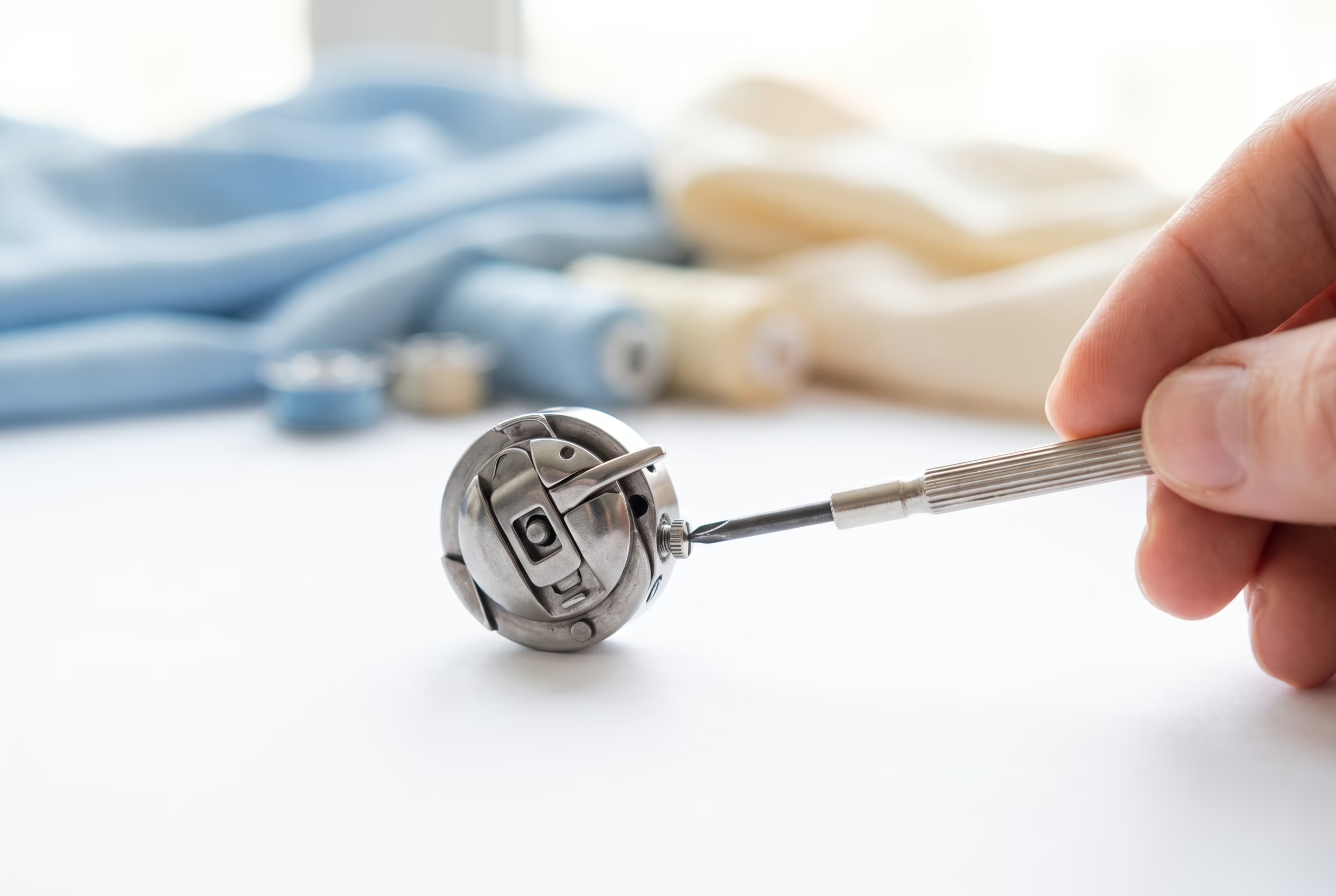
Thread breaking at the exact same spot in the stitch cycle indicates a burr, rough spot, or damaged part in your thread path, usually on the needle eye, a thread guide, or the needle plate. The thread catches on this rough spot repeatedly until it weakens and snaps at that precise point.
This pattern is distinctly different from random breaking, which suggests tension or thread quality issues. Same-spot breaking is mechanical: something sharp or rough is physically damaging your thread as it passes through.
How to locate the problem spot:
- Replace the needle first: 70% of same-spot breaks come from a damaged needle eye
- Run dental floss through the entire thread path: Floss will catch and fray on rough spots
- Inspect the needle plate: Look for burrs around the needle hole, especially if you’ve hit the plate with a needle
- Check each thread guide: Run your fingernail along the inside of each guide feeling for roughness
- Examine the bobbin case: Look for scratches or rough spots where thread passes
- Test the tension discs: Thread should slide smoothly between them when presser foot is up
If the break happens at a specific stitch count (for example, every 8th stitch), the problem may be timing-related, which requires professional service. If it happens at a specific physical location (always when thread is at the take-up lever, for example), focus your inspection on that area.
Temporary fix: If you find a rough spot on a thread guide or needle plate and can’t get immediate service, you can sometimes smooth it with very fine emery cloth or a nail file. This is a temporary solution, the part should be replaced when possible.
Frequently Asked Questions
Why does my thread break only when sewing fast?
Fast sewing generates more heat from friction between thread and needle, which weakens thread fibers and causes breaking. Slow down to half speed, especially on thick fabrics, and make sure you’re using a needle size large enough to let thread move freely through the eye without excessive friction.
Can a dirty sewing machine cause thread to break?
Yes, lint buildup in the tension discs, bobbin area, and thread path creates friction points that can break thread. Clean your machine after every 4-8 hours of sewing, removing lint from the bobbin case, feed dogs, and tension assembly with a small brush.
Should I adjust bobbin tension if my thread keeps breaking?
No, bobbin tension rarely causes upper thread breaking. If your upper thread snaps, adjust upper tension, check your needle size, and verify threading path. Only adjust bobbin tension if you see loops of bobbin thread on the fabric surface, which indicates a different problem.
Why does thread break when I backstitch?
Thread breaks during backstitching because the reverse motion puts extra stress on thread and may indicate your take-up lever timing is slightly off or you’re reversing too quickly. Slow down your reverse stitching speed and make sure your needle is fresh and properly sized.
Can humidity affect thread breaking?
Yes, very low humidity (below 30%) can dry out thread, making it brittle and prone to breaking, while very high humidity (above 70%) can cause thread to swell slightly and create more friction in the needle eye. Store thread in moderate humidity conditions when possible.
Does thread color affect how easily it breaks?
Thread color itself doesn’t affect strength, but darker colors (especially black) are sometimes dyed more heavily, which can slightly weaken fibers if the dye process isn’t done properly. Quality thread brands maintain consistent strength across all colors.
Why does metallic thread break more than regular thread?
Metallic thread breaks more easily because it’s made with metal-wrapped fibers that are less flexible than cotton or polyester and create more friction in the needle eye. Use a metallic or topstitching needle (size 90/14 or larger), reduce tension by 1-2 numbers, and slow your sewing speed by half.
Can I use the same needle for different thread weights?
You should change needle size when switching between thread weights that differ by more than one category. For example, moving from 50wt all-purpose thread to 30wt topstitching thread requires going up 1-2 needle sizes to accommodate the thicker thread.
Why does thread break on my serger but not my sewing machine?
Sergers run at higher speeds and use 3-4 threads simultaneously, creating more heat and tension stress. Make sure you’re using quality serger thread (not all-purpose sewing thread), check that all four thread paths are correctly threaded, and verify tension settings are balanced across all loopers.
How can I tell if my tension is too tight?
Tension is too tight if thread breaks frequently, fabric puckers along seam lines, or you can see the bobbin thread pulled up to the fabric surface. Reduce upper tension by one number at a time until stitches look balanced and thread stops breaking.
Does thread brand matter for preventing breaks?
Yes, thread brand significantly affects breaking. Quality brands like Gutermann, Mettler, and Aurifil use longer staple fibers and better manufacturing processes that create stronger, more consistent thread. Bargain thread often has weak spots, excessive lint, and breaks 3-4 times more frequently.
Why does thread break only on certain fabrics?
Thread breaks on certain fabrics because different materials create different levels of friction and require different needle sizes. Thick fabrics, tightly woven fabrics, and synthetics all stress thread more than lightweight cotton. Match your needle size and type to your fabric weight and adjust tension accordingly.
Conclusion
Thread breaking frustrates every sewer at some point, but the solution is almost always straightforward once you understand the underlying cause. The vast majority of breaking problems come down to four fixable issues: using the wrong needle size, setting tension too tight, working with poor-quality or old thread, or threading the machine incorrectly.
Start your troubleshooting with the simplest fixes first: install a fresh needle in the correct size for your thread and fabric, rethread your machine with the presser foot raised, and reduce tension by one number. This three-step sequence solves 80-90% of breaking problems in under five minutes.
Your action plan to stop thread breaking:
- Change your needle right now if it’s been in your machine for more than 8 hours of sewing
- Invest in 2-3 spools of quality all-purpose polyester thread in neutral colors
- Learn your machine’s correct threading path by watching a video specific to your model
- Create a pre-project checklist: fresh needle, proper threading, tension at 4, test on scrap
- Keep a needle size chart and thread weight guide near your machine for quick reference
Remember that thread breaking is a normal part of learning to sew, not a sign that you’re bad at it or that your machine is defective. Every experienced sewer has dealt with breaking thread hundreds of times. The difference is that with practice, you’ll diagnose and fix the problem in seconds rather than minutes, and you’ll prevent most breaks before they happen by maintaining good habits around needle changes, thread quality, and machine maintenance.
The next time your thread breaks, take a breath, work through the troubleshooting checklist systematically, and you’ll be back to sewing in no time. Your future projects will thank you for the smooth, uninterrupted stitching that comes from understanding why thread breaks and how to prevent it.


