
Quick Answer
For serious hobbyists choosing between Juki and Janome, Juki machines excel at high-speed straight stitching and quilting with industrial durability, while Janome offers more versatility with built-in decorative stitches and user-friendly features for garment sewing. Quilters typically prefer Juki’s TL series for speed and precision, whereas garment sewers and those wanting one machine for multiple projects lean toward Janome’s HD or MC lines. Budget $400-$1,200 for quality models from either brand.
Key Takeaways
- Juki specializes in straight-stitch speed and durability – ideal for quilters and those sewing long seams on heavy fabrics
- Janome provides more stitch variety and versatility – better for garment construction, decorative work, and mixed projects
- Price ranges overlap significantly – both brands offer serious hobbyist models between $500-$1,000
- Juki requires less maintenance despite its industrial roots – simpler mechanical design means fewer adjustments
- Janome is easier to learn for beginners transitioning to advanced work – more intuitive controls and forgiving settings
- Stitch quality is excellent on both brands – the difference lies in speed capability and stitch variety, not quality
- Juki handles heavy fabrics with less effort – stronger motor and better feed system for denim, canvas, and multiple layers
- Janome offers better resale value – wider market appeal due to brand recognition and versatility
- Choose Juki if you primarily quilt or sew home décor – speed and precision matter more than stitch options
- Choose Janome if you sew garments or want one do-everything machine – versatility and features outweigh pure speed
What Makes a Sewing Machine Good for Serious Hobbyists?
A serious hobbyist needs a machine that bridges the gap between basic home models and professional equipment. This means consistent stitch quality at various speeds, the ability to handle multiple fabric weights without adjustment drama, and durability that withstands 10-20 hours of weekly use for years.
Key features that separate hobbyist machines from beginner models include:
- Metal internal frame and components – plastic gears and frames wear out quickly under heavy use
- Adjustable presser foot pressure – essential for switching between chiffon and canvas without puckering or skipped stitches
- Knee lifter compatibility – keeps hands free for fabric control during complex projects
- Powerful motor (at least 1.0 amps) – maintains consistent speed through thick seams and multiple layers
- Precise stitch length and width control – allows fine-tuning for professional-looking results
- Easy access to cleaning and maintenance points – serious use means regular maintenance, which should be straightforward
Serious hobbyists also need reliability over gimmicks. Touchscreens and hundreds of decorative stitches sound appealing, but most advanced sewers use fewer than 20 stitches regularly. What matters more is whether the machine can sew through four layers of denim without hesitation or maintain perfect tension for eight hours straight during a quilting marathon.
The investment typically ranges from $400 to $1,500, with the sweet spot around $600-$900 for machines that will last a decade or more with proper care.
Juki vs Janome: Which Is Better for Quilting?
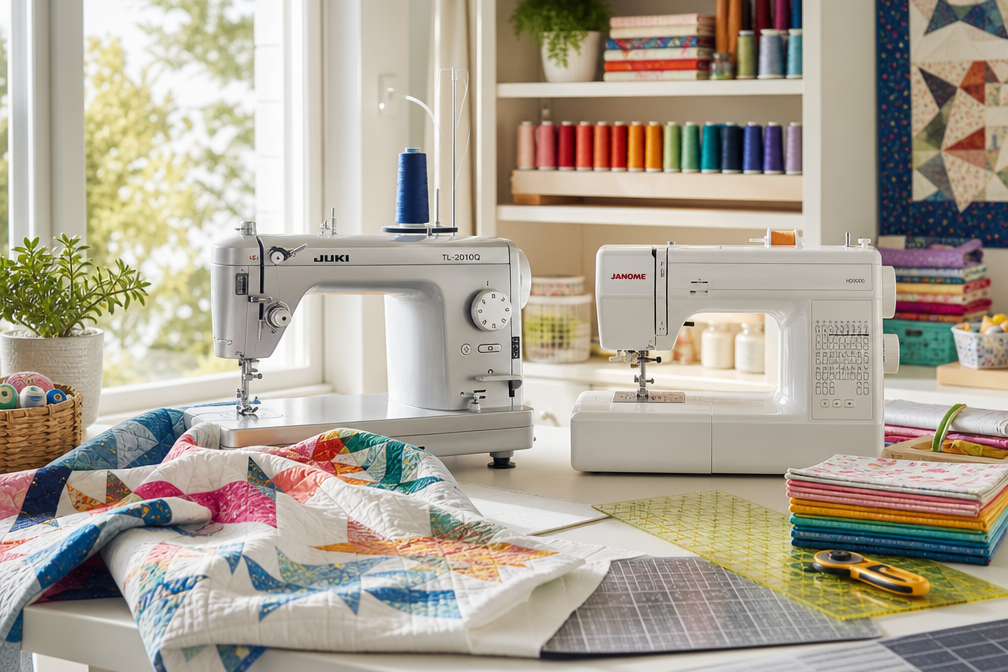
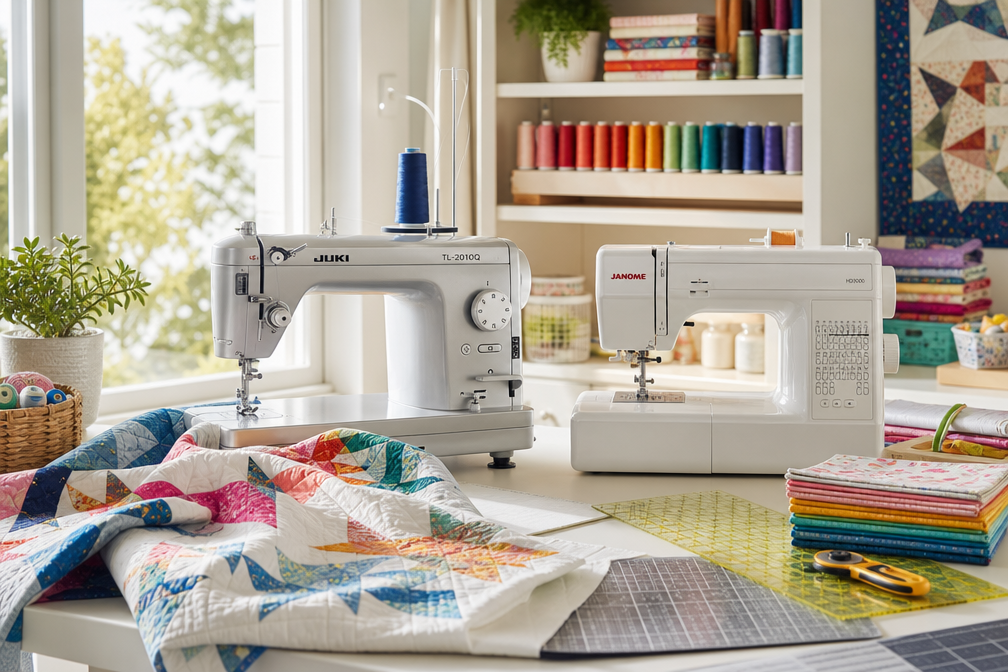
Juki dominates the quilting world, particularly with models like the TL-2010Q and TL-2000Qi. These machines sew at speeds up to 1,500 stitches per minute with remarkable precision, allowing quilters to piece tops and quilt sandwiches significantly faster than on traditional home machines. The automatic thread trimmer on many Juki models saves hours on large projects.
Why quilters choose Juki:
- Throat space – Juki’s quilting models offer 9-12 inches of space to the right of the needle, accommodating bulky quilt sandwiches
- Consistent stitch length – maintains perfect 2.5mm stitches even at high speed, critical for precise piecing
- Minimal vibration – industrial-style construction keeps the machine stable during long quilting sessions
- Straight-stitch focus – no complicated stitch selection to navigate, just pure sewing performance
Janome’s quilting-focused models like the 1600P-QC and MC6700P offer respectable performance but typically max out around 1,000 stitches per minute. However, Janome machines provide better versatility if you quilt but also sew garments or home décor. The Janome Horizon Memory Craft series includes features like automatic thread cutting, adjustable knee lifter, and superior lighting that appeal to quilters who want options.
Choose Juki for quilting if: You primarily piece and quilt, value speed, and don’t need decorative stitches. Most professional longarrm quilters who also piece use Juki for construction.
Choose Janome for quilting if: You split time between quilting and other sewing projects, want built-in decorative stitches for embellishing quilts, or prefer a machine with more automated features.


The Juki TL Series 1/4-inch Presser Foot allows you to get a 1/4" seam allowance every time.
Are Juki Machines More Durable Than Janome?
Both brands build exceptionally durable machines, but Juki’s industrial heritage gives it a slight edge in longevity under heavy use. Juki machines feature all-metal internal construction with industrial-grade components designed for 8+ hours of daily operation in factory settings. When adapted for home use, this translates to machines that can easily last 20-30 years with basic maintenance.
Janome’s serious hobbyist models also use metal frames and quality components, but the brand includes more plastic parts in non-critical areas to reduce weight and cost. This doesn’t mean Janome machines are fragile – many sewers report 15-20 years of reliable service – but Juki’s overbuilt construction provides extra peace of mind for those who sew extensively.
Durability factors to consider:
- Motor longevity – Juki’s industrial motors are rated for longer continuous operation
- Gear train – Both use metal gears in quality models, but Juki’s are typically heavier gauge
- Frame flex – Juki’s solid metal frames show virtually no flex even at high speeds
- Bearing quality – Juki uses industrial-grade bearings that require less frequent replacement
The practical difference? If you sew 5-10 hours weekly, both brands will serve you well for decades. If you’re pushing 20+ hours weekly or running a small sewing business from home, Juki’s industrial DNA provides better long-term value despite potentially higher upfront costs.
Common mistake: Assuming industrial durability means difficult maintenance. Juki’s simpler mechanical design actually makes routine cleaning and oiling easier than computerized Janome models with more complex electronics.
Janome vs Juki Price Comparison for Intermediate Sewers
Price overlap between these brands is substantial in the serious hobbyist category, making the decision more about features than budget. Both offer excellent value in the $500-$1,000 range where most intermediate sewers shop.
Juki pricing tiers:
- Entry serious hobbyist ($400-$600) – TL-2010Q (straight stitch only), HZL-F600 (computerized with decorative stitches)
- Mid-range ($600-$900) – TL-2000Qi (with automatic features), HZL-DX7 (advanced computerized)
- Advanced hobbyist ($900-$1,500) – TL-2200QVP Mini (compact industrial), HZL-NX7 (premium computerized)
Janome pricing tiers:
- Entry serious hobbyist ($400-$600) – HD3000 (heavy-duty mechanical), 2212 (basic but solid)
- Mid-range ($600-$900) – HD5000 (heavy-duty with more features), MC6650 (computerized)
- Advanced hobbyist ($900-$1,500) – 1600P-QC (straight stitch quilting), MC9450QCP (premium computerized)
Value considerations beyond sticker price:
- Included accessories – Janome typically bundles more feet and accessories, adding $50-$100 in value
- Warranty coverage – Both offer 2-5 year warranties on mechanical components; Janome often includes longer coverage on electronics
- Resale value – Janome machines retain 50-60% of original value after 5 years; Juki retains 45-55%
- Repair costs – Juki parts are often less expensive due to industrial standardization
For intermediate sewers on a budget, Janome’s HD3000 ($450-$550) and Juki’s TL-2010Q ($500-$600) represent the best entry points into serious hobbyist territory. Both will handle projects that would choke budget machines, but the Janome offers more stitch variety while the Juki provides superior speed and throat space.

27 Unique Built-in Stitches: The Brother XM2701 sewing machine includes 27 built-in stitches including decorative, blind hem, zigzag, and stretch stitches and an auto-size buttonhole

37 UNIQUE BUILT-IN STITCHES: The XM3700 lightweight sewing machine features 37 unique built-in stitches, and a one-step auto-size buttonhole

60 UNIQUE BUILT-IN STITCHES: The Brother CS5055 sewing machine includes 60 built-in stitches including utility, decorative and heirloom stitch functions, and 7 1-step auto-size buttonholes
Do Juki Machines Require More Maintenance Than Janome?
Surprisingly, Juki machines typically require less frequent professional maintenance than comparable Janome models, though they need more regular user maintenance. This stems from Juki’s simpler mechanical design versus Janome’s more complex computerized systems.
Juki maintenance requirements:
- Oil every 8-10 hours of use – takes 5 minutes with provided oil and diagram
- Clean lint from bobbin area after each project – simple brush-out process
- Professional servicing every 2-3 years – basic timing check and deep cleaning ($75-$125)
- Tension adjustments rare – mechanical tension systems hold settings reliably
Janome maintenance requirements:
- Oil only on mechanical models – computerized models are self-lubricating but require professional servicing
- Clean lint regularly – similar to Juki
- Professional servicing every 1-2 years – computerized models need electronic diagnostics ($100-$200)
- Tension adjustments more common – electronic tension systems can drift and require recalibration
The key difference: Juki puts more routine maintenance in the user’s hands (oiling, basic cleaning) but needs less professional intervention. Janome’s computerized models require less user maintenance but cost more when professional service is needed.
Choose Juki if: You’re comfortable with basic mechanical maintenance and want to minimize service costs over the machine’s lifetime.
Choose Janome if: You prefer minimal routine maintenance and don’t mind paying for periodic professional servicing.
Which Brand Has Better Stitch Quality: Juki or Janome?
Both brands produce excellent stitch quality that satisfies serious hobbyists and even professional sewers. The difference isn’t in quality but in consistency across different conditions and the type of stitching each brand optimizes for.
Juki stitch quality strengths:
- Unmatched straight stitch – perfectly even stitches at any speed from slow to 1,500 SPM
- Heavy fabric performance – maintains consistent tension through thick seams without adjustment
- High-speed precision – no stitch length variation even when sewing fast
- Minimal thread breakage – superior thread path design reduces stress on thread
Janome stitch quality strengths:
- Decorative stitch clarity – computerized models produce crisp, well-defined decorative stitches
- Buttonhole consistency – automatic buttonholes are remarkably uniform
- Delicate fabric handling – gentler feed system prevents puckering on lightweight materials
- Stitch variety execution – 200+ stitches all perform reliably when properly set up
In blind tests, experienced sewers often cannot distinguish between Juki and Janome straight stitches on medium-weight fabrics. The differences emerge in edge cases: Juki excels when sewing very fast or through challenging materials, while Janome shines with decorative work and automatic features.
Common misconception: Industrial-style machines like Juki produce “industrial-looking” stitches. In reality, Juki’s straight stitch is often more refined than home machines because of tighter tolerances in the mechanical components.
For serious hobbyists, both brands exceed the stitch quality threshold needed for professional-looking results. Your choice should depend on what you sew most often, not concerns about stitch quality.
Is Juki Too Industrial for Home Sewing?
Juki’s industrial reputation intimidates some home sewers, but the brand’s home models are specifically adapted for residential use. The TL series and HZL series are not industrial machines – they’re home machines built with industrial-quality components, which is different.
What makes Juki home-friendly:
- Standard home voltage – plugs into regular outlets, no special electrical requirements
- Manageable weight – 20-30 lbs, heavier than basic machines but movable by one person
- Quieter operation – significantly quieter than true industrial machines, comparable to high-end Janome models
- Portable – most models fit in standard sewing machine cases or cabinets
- Home-appropriate speed control – foot pedal offers precise slow-speed control, not just industrial fast
Where industrial DNA shows (in good ways):
- Vibration-free operation – stays planted during high-speed sewing
- Consistent power – no bogging down through thick seams
- Simple, reliable mechanics – fewer things to break or malfunction
- Long-term durability – overbuilt for home use means exceptional longevity
Where it might feel different:
- Learning curve – straight-stitch models lack stitch selection, which feels limiting initially
- Sound – deeper, more mechanical sound than computerized machines (not louder, just different)
- Minimalist controls – fewer buttons and displays than feature-rich Janome models
- Weight – requires more effort to move between storage and sewing table
Choose Juki without hesitation if: You sew regularly, value reliability over features, and primarily need straight stitching and basic utility stitches. The industrial heritage is an advantage, not a drawback.
Reconsider if: You rarely sew, want extensive decorative stitches, or need a lightweight machine to move frequently. Janome’s home-focused design might suit your needs better.
Best Janome Model for Advanced Hobbyists
For advanced hobbyists who want versatility and features, the Janome Memory Craft 6700P ($900-$1,100) and Janome Horizon Memory Craft 9450QCP ($1,800-$2,200) represent the sweet spot between capability and value.
Janome MC6700P highlights:
- 11 inches of throat space for quilting
- 1,000 stitches per minute maximum speed
- Automatic thread trimmer and knee lifter
- 270 built-in stitches including decorative options
- AcuFeed Flex system for precise fabric feeding
- Professional-grade straight stitch quality
This model appeals to sewers who split time between quilting and garment sewing. It handles large quilt projects while offering enough decorative stitches and features for creative garment construction.
For those on a tighter budget, the Janome HD5000 ($600-$700) provides excellent value:
- Heavy-duty metal frame construction
- 1,000 stitches per minute capability
- 18 built-in stitches (focused on utility)
- Handles multiple layers of heavy fabric
- Simple, reliable mechanical operation
- One-step buttonhole
Alternative for straight-stitch specialists: Janome 1600P-QC ($800-$900):
- Straight stitch only (like Juki TL series)
- 1,600 stitches per minute maximum speed
- 9 inches of throat space
- Automatic thread trimmer
- Industrial-quality straight stitch
- Lighter weight than comparable Juki models
Choose the MC6700P if: You want one machine that does everything well and are willing to invest in quality and features.
Choose the HD5000 if: You need heavy-duty performance on a budget and don’t require extensive decorative stitches.
Choose the 1600P-QC if: You primarily quilt or sew long straight seams and want Juki-like performance from a Janome machine.

Create With Total Ease – Enjoy smooth, fuss-free sewing and quilting thanks to intuitive controls designed to let you focus on the craft. The 3160QDC‑G computer sewing machine has a simple, efficient feature set to bring your creative ideas to life.

Create Without Limits – Explore new ideas with 100 built-in stitches and 7 one-step buttonholes, giving you the flexibility to sew garments, quilting details, and décor projects. Nurture your creativity with the versatile JW8100 sewing/quilting machine.

Create With Total Ease – Experience repeatable stitch quality across everyday sewing projects with the Janome 4120QDC-G computer sewing machine. Easily access 120 built-in stitches and lock in your preferred settings with stitch pattern memory capability.
Why Do Quilters Prefer Juki Over Janome?
The quilting community’s preference for Juki stems from speed, throat space, and the quality of straight stitching – the three factors that matter most when piecing quilt tops and quilting sandwiches.
Speed advantage: Juki’s TL-2010Q and TL-2000Qi sew at 1,500 stitches per minute compared to most Janome models’ 1,000 SPM. When piecing a king-size quilt with hundreds of seams, this 50% speed increase saves hours of work. More importantly, Juki maintains perfect stitch quality at top speed, while some machines show inconsistency when pushed to their limits.
Throat space matters: Quilting requires maneuvering bulky fabric sandwiches under the machine arm. Juki’s 9-12 inches of throat space (depending on model) provides more room than most Janome models’ 7-9 inches. This extra space reduces frustration when quilting large projects and allows for more creative free-motion quilting patterns.
Straight-stitch perfection: Quilting relies almost entirely on straight stitches. Juki’s single-purpose focus on straight stitching means the entire machine is optimized for this one task. The result is perfectly consistent 2.5mm stitches (the quilting standard) with no length variation, even when starting, stopping, or sewing at angles.
Community and resources: The quilting community has embraced Juki, creating extensive online resources, tutorials, and troubleshooting guides specific to popular models. This network effect makes Juki easier to learn and optimize for quilting.
However, Janome has advantages for certain quilters:
- Modern quilters who embellish – built-in decorative stitches for adding details
- Quilters who also sew garments – one machine for multiple hobbies
- Those who value automation – features like automatic thread cutting and needle positioning
- Quilters with limited space – some Janome models are more compact
The preference isn’t universal. Many accomplished quilters use Janome machines and produce stunning work. But in quilting guilds and online forums, Juki’s TL series dominates recommendations for serious piecing and quilting.
Common Problems With Juki Machines for Home Use
While Juki machines are exceptionally reliable, home sewers encounter a few recurring issues, mostly related to user adjustment rather than machine defects.
Thread tension learning curve: Juki’s mechanical tension system is precise but requires understanding. New users often struggle initially because Juki tension dials work differently than computerized auto-tension systems. The solution is learning proper tension adjustment for different thread and fabric combinations – a skill that takes a few projects to develop.
Oiling requirements: Unlike self-lubricating computerized machines, Juki models need regular oiling. Forgetting to oil leads to increased noise, stiffness, and eventually mechanical wear. This isn’t a problem once you establish a routine, but it catches some users off guard initially.
Limited stitch options on TL series: The straight-stitch-only design frustrates sewers who occasionally need a zigzag or buttonhole. This isn’t a defect but a design choice. Users either keep a second machine for utility stitches or choose Juki’s HZL series instead.
Bobbin winding quirks: Some Juki models have bobbin winders that require specific technique to wind evenly. Poorly wound bobbins cause tension issues and thread nests. The solution is following the manual’s instructions precisely and practicing the technique.
Foot pedal sensitivity: Juki foot pedals offer precise control but feel more sensitive than typical home machines. Some users accidentally run the machine faster than intended until they adjust to the pedal’s responsiveness.
Weight and portability: At 25-30 lbs, Juki machines are heavier than many home models. This is actually a feature (stability), but it complicates storage and transport to classes or sewing groups.
Availability of specialty feet: While standard feet are readily available, some specialty presser feet are harder to find for Juki than for Janome. The machines use industrial-standard low-shank feet, which are common, but specific branded accessories may require online ordering.
None of these issues are dealbreakers for serious hobbyists. They’re adjustment points that become non-issues after the first few weeks of ownership. The key is buying from a dealer who provides proper setup and initial training.
Can Janome Handle Heavy Fabrics Like Denim and Canvas?
Janome’s heavy-duty models, particularly the HD3000, HD5000, and Memory Craft series, handle heavy fabrics with impressive capability. These machines feature metal frames, powerful motors, and adjustable presser foot pressure that allow them to sew through multiple layers of denim, canvas, upholstery fabric, and leather (with appropriate needles).
Janome models best for heavy fabrics:
HD3000 – Sews through 4-6 layers of denim without hesitation, handles canvas and duck cloth reliably, and manages light leather with a leather needle. The mechanical design and 1.0-amp motor provide consistent power through thick seams.
HD5000 – Upgraded motor and enhanced feed dogs handle even heavier materials. Sewers report success with heavy upholstery projects, bag making with multiple layers of canvas and webbing, and hemming jeans with thick original hems.
MC6700P and higher – Professional-grade feed system (AcuFeed) grips heavy fabrics firmly, preventing shifting and puckering. These models handle heavy materials as well as Juki’s TL series for most home sewing applications.
Comparison to Juki: Juki machines typically power through heavy fabrics with less effort and adjustment. The industrial-grade motors maintain consistent speed through thick seams where some Janome models slow slightly. However, for home sewing purposes, the difference is minimal – both brands handle heavy fabrics far better than entry-level machines.
Tips for heavy fabric success on Janome:
- Use appropriate needles (denim/leather needles size 90-100)
- Reduce presser foot pressure slightly to prevent fabric drag
- Sew at moderate speed through thick seams (let the machine do the work)
- Use quality thread designed for heavy-duty sewing
- Engage the needle-down function to prevent fabric shifting when pivoting
Choose Janome for heavy fabrics if: You sew a mix of heavy and light materials and want one versatile machine. The HD series offers excellent heavy-fabric performance while remaining gentle enough for lightweight materials.
Choose Juki if: You primarily sew heavy fabrics and want the most effortless performance through challenging materials. Juki’s industrial heritage provides extra power and reliability for constant heavy-duty work.
Is Janome Easier to Learn Than Juki for Serious Beginners?
Janome machines are generally more intuitive for sewers transitioning from basic to advanced work. The brand designs with user experience in mind, offering features that guide users toward success rather than requiring mastery of mechanical adjustments.
Why Janome is beginner-friendly:
Visual stitch selection – Computerized models display stitch options on screen or printed panels, making it easy to find and select the right stitch. Juki’s mechanical models require understanding what each dial position does.
Automatic features – Janome’s auto-tension, auto-buttonhole, and auto-thread cutting reduce the number of skills you must master simultaneously. You can focus on sewing technique while the machine handles technical details.
Forgiving settings – Janome machines tolerate a wider range of thread tensions and presser foot pressures before producing poor results. This gives beginners more room for error while learning.
Comprehensive manuals – Janome provides detailed, well-illustrated manuals with project ideas and troubleshooting guides. Juki manuals are more technical and assume greater mechanical understanding.
Dealer support – Janome’s larger dealer network means more local shops offer classes and support specifically for Janome machines.
Where Juki requires more learning:
Tension adjustment – Mechanical tension systems require understanding the relationship between upper and lower tension. Beginners often struggle initially.
Oiling and maintenance – Regular user maintenance is essential and requires learning proper technique.
Minimalist design – Fewer automated features mean more manual control, which is powerful once mastered but overwhelming initially.
However, Juki’s simplicity has advantages: Once you learn the basics, there’s less to go wrong. Mechanical systems are predictable and consistent, while computerized features can malfunction or behave unexpectedly.
Best approach for serious beginners:
Start with Janome if you’re teaching yourself, sewing diverse projects, or want a gentler learning curve with room to grow.
Start with Juki if you have access to in-person instruction, focus on straight-stitch projects (quilting, home décor), or prefer mastering fundamentals over relying on automation.
Many serious sewers eventually own both – a Janome for versatile everyday sewing and a Juki for high-speed straight stitching projects. But for a first serious machine, Janome’s user-friendly design helps beginners build confidence faster.
Where to Buy Juki vs Janome: Best Deals in 2026
Purchasing from authorized dealers provides better value than chasing the lowest price, especially for serious hobbyist machines. Authorized dealers offer setup, training, warranty service, and ongoing support that online-only retailers cannot match.
Best purchasing options:
Local authorized dealers – Provide in-person training, proper machine setup, and immediate warranty service. Prices are typically MSRP but include $100-$200 worth of setup and instruction. Many dealers offer package deals with extra feet, thread, and accessories.
Manufacturer websites – Both Juki and Janome sell direct with full warranty coverage. Prices match dealer MSRP but lack local support. Good option if no nearby dealers exist.
Online authorized retailers – Sites like Goldstar Tool, AllBrands, and Ken’s Sewing Center offer competitive pricing (10-15% below MSRP) while maintaining authorized dealer status. Warranty coverage is full, but setup and training are self-service.
Amazon and eBay – Prices can be 20-30% below MSRP, but verify the seller is authorized. Unauthorized sellers may offer gray-market machines with no warranty coverage. Check the manufacturer’s dealer list before purchasing.
Sewing machine expos and shows – Dealers offer show-special pricing (15-20% off) plus package deals. Good opportunity to test multiple machines before buying.
Used market – Both brands hold value well. Expect to pay 50-70% of original price for machines 3-5 years old in good condition. Buy from sewers who maintained their machines properly, not from estate sales where maintenance history is unknown.
Timing for best deals:
- Black Friday/Cyber Monday – 15-25% off select models
- January/February – Dealers clear previous year’s inventory
- Sewing expos (spring and fall) – Package deals and show specials
- End of model year – When new models release, previous versions drop 20-30%
What to negotiate:
- Accessory packages – Extra feet, bobbins, needles, thread
- Extended warranty – Often available for $50-$100
- Free classes – Many dealers include beginner classes with purchase
- Trade-in value – Some dealers accept old machines as partial payment
Red flags to avoid:
- Prices significantly below market (likely gray-market or refurbished sold as new)
- No manufacturer warranty information
- Seller not on manufacturer’s authorized dealer list
- “Refurbished” machines without clear disclosure of what was refurbished
- Pressure to buy immediately without time to research
For serious hobbyist machines in the $500-$1,500 range, buying from an authorized dealer (local or online) provides the best balance of price and support. The small premium over gray-market prices is worth it for warranty coverage and expert setup.
Do You Need a Juki If You Only Sew Garments, Not Quilts?
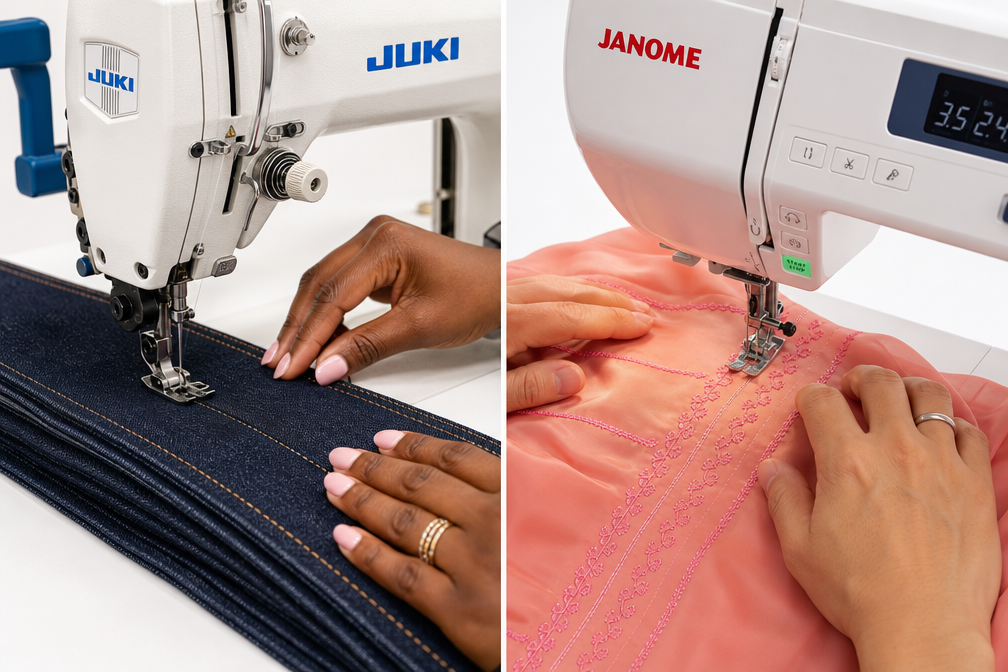
Juki machines excel at garment sewing despite their reputation as quilting specialists. The straight-stitch precision and speed that quilters love translate directly to faster, more professional garment construction. However, Janome offers better versatility for sewers who want one machine for all garment techniques.
Juki advantages for garment sewing:
Seam quality – Perfectly straight seams with consistent stitch length create professional-looking garments. Juki’s straight stitch rivals industrial machines used in garment factories.
Speed – Sewing long seams (pants inseams, skirt hems, jacket linings) happens 50% faster than on typical home machines. This matters when sewing multiple garments or working on deadline.
Heavy fabric handling – Tailored jackets, coats, and structured garments with multiple layers sew effortlessly. No struggling through thick seams at pocket corners or waistbands.
Durability – Garment sewers who produce 5-10 pieces monthly need machines that withstand heavy use. Juki’s industrial construction handles this workload indefinitely.
Juki limitations for garment sewing:
No zigzag on TL series – Finishing seams, sewing knits, and creating buttonholes require a zigzag stitch. Straight-stitch-only models force you to finish seams with a serger or keep a second machine for utility stitches.
No decorative stitches – Embellishing garments with decorative topstitching or heirloom techniques requires a machine with decorative stitch options.
Manual buttonholes – TL series machines don’t have automatic buttonhole functions. You’ll need to use a separate buttonholer attachment or second machine.
Solutions for garment sewers considering Juki:
Choose Juki’s HZL series instead of TL series – Models like HZL-F600 and HZL-DX7 offer decorative stitches, zigzag, and automatic buttonholes while maintaining Juki’s quality construction.
Pair a TL series with a serger – Use Juki for construction seams and a serger for finishing. This combination handles all garment techniques professionally.
Keep a basic second machine – Use Juki for main construction and an inexpensive machine for buttonholes and decorative work.
When Janome makes more sense for garment sewing:
- You sew knits regularly (need zigzag and stretch stitches)
- You create garments with extensive decorative details
- You want one machine that handles all techniques
- You sew a wide variety of garment types (from lingerie to coats)
- You value features like automatic buttonholes and thread cutting
When Juki makes sense for garment sewing:
- You primarily sew woven fabrics
- You focus on tailored garments with lots of straight seams
- You already own a serger for seam finishing
- You value speed and seam quality over stitch variety
- You sew frequently and need industrial-level durability
Many professional garment sewers use Juki for construction and Janome or a serger for finishing. But if you want one machine that does everything, Janome’s versatility better serves the varied techniques garment sewing requires.
FAQ
Which brand is better for beginners moving to advanced sewing?
Janome is better for beginners transitioning to serious hobbyist level. The intuitive controls, automatic features, and forgiving settings help build confidence while learning advanced techniques. Juki requires more mechanical understanding but rewards users with superior performance once mastered.
Can you use regular sewing machine feet on Juki machines?
Yes, Juki home models use standard low-shank presser feet that fit most home sewing machines. Hundreds of specialty feet are available from both Juki and third-party manufacturers. Industrial Juki models use different feet, but home models (TL and HZL series) use standard attachments.
How loud are Juki machines compared to Janome?
Juki machines produce a deeper, more mechanical sound but aren’t significantly louder than Janome models. Both brands operate at 60-70 decibels during normal sewing, similar to conversation volume. Juki’s industrial-style sound is different in character but not volume.
Do Janome machines work well for free-motion quilting?
Yes, Janome’s Memory Craft series excels at free-motion quilting. The ability to drop feed dogs, adjustable presser foot pressure, and smooth fabric movement make models like MC6700P and MC9450QCP popular for free-motion work. Juki’s TL series also performs excellently for free-motion quilting.
Which brand has better customer service?
Both brands offer good customer service through authorized dealers. Janome’s larger dealer network provides more local support options. Juki’s smaller but dedicated dealer network offers specialized expertise. Service quality depends more on your specific dealer than the brand itself.
Can you sew leather on Janome HD models?
Yes, Janome HD3000 and HD5000 handle garment-weight leather (2-3 oz) with appropriate leather needles and adjustments. For heavy leather (4+ oz), Juki’s TL series provides more consistent power. Both brands recommend using a Teflon foot and leather needles for best results.
How often do Juki machines need professional servicing?
Juki machines typically need professional servicing every 2-3 years with regular home use (10-15 hours weekly). Users who maintain proper oiling and cleaning schedules can extend this to 3-4 years. Timing checks and deep cleaning are the primary service needs.
Are Juki machines good for sewing bags and purses?
Excellent. Juki’s ability to handle multiple layers of heavy fabric, webbing, and interfacing makes them ideal for bag making. The straight-stitch quality produces professional-looking topstitching. Many professional bag makers use Juki TL series machines for production work.
Which Janome model is closest to Juki TL-2010Q?
The Janome 1600P-QC is Janome’s answer to Juki’s TL-2010Q. Both are straight-stitch-only machines designed for quilting and high-speed sewing. The 1600P-QC offers similar throat space and speed (1,600 SPM) with Janome’s user-friendly design.
Do you need special thread for Juki machines?
No, Juki machines work with all standard sewing thread. Quality thread (Gutermann, Aurifil, Mettler) produces better results than bargain thread, but this applies to all machines. Juki’s superior thread path actually reduces thread breakage compared to many home machines.
Can Janome machines sew at slow speeds for precision work?
Yes, Janome machines offer excellent slow-speed control through the foot pedal. Computerized models often include speed limiters that cap maximum speed, making slow, precise sewing easier. This is particularly helpful for beginners and detail work.
Which brand holds value better for resale?
Janome machines typically retain 50-60% of original value after 5 years, compared to Juki’s 45-55%. Janome’s wider brand recognition and versatility appeal to more buyers. However, both brands resell well compared to budget machines that lose 70-80% of value.
Conclusion
Choosing between Juki and Janome for serious hobbyist sewing comes down to matching machine strengths to your specific projects and priorities. Juki delivers unmatched straight-stitch performance, industrial durability, and high-speed capability that quilters and production sewers love. Janome provides versatility, user-friendly features, and stitch variety that serves garment sewers and those wanting one machine for diverse projects.
Choose Juki if you:
- Primarily quilt or sew home décor with long straight seams
- Value speed and can benefit from 1,500 stitches per minute
- Want industrial-level durability for heavy, frequent use
- Are comfortable with mechanical maintenance and adjustments
- Already own a serger or second machine for utility stitches
Choose Janome if you:
- Sew garments or mix quilting with other project types
- Want built-in decorative stitches and automated features
- Prefer intuitive controls and a gentler learning curve
- Need one versatile machine for all sewing techniques
- Value brand recognition and strong resale value
Both brands offer exceptional quality in the $500-$1,500 range where serious hobbyists shop. The “better” choice isn’t about which brand is superior overall but which machine aligns with how you actually sew. Visit an authorized dealer to test both brands with your typical fabrics and projects – the right machine will feel natural within minutes of sewing.
Next steps:
- List your three most common project types and required features
- Test drive both brands at a local dealer with your typical fabrics
- Join brand-specific online communities to learn from experienced users
- Budget for quality accessories (feet, needles, thread) that maximize your machine’s capability
- Invest in proper training through dealer classes or online courses to master your chosen machine
The investment in a quality Juki or Janome machine will serve you for decades of creative sewing. Choose based on your needs, not brand loyalty, and you’ll have a reliable partner for thousands of hours of satisfying projects.